

Here are the most interesting things I read, listened to, and watched in August. First, some announcements.
1: It was an honour to be asked to join Mario Draghi, Patrick Collison, and Luis Garicano’s Rhine Group. While major reform is necessary, Europe can have a flourishing and abundant future.
2: You may have noticed that I’ve started adding tables of contents to my posts. Given my prolixity, this was a long time coming. I have also added ‘cultural experiences’ to the final section of these posts, to review plays, museums, or other such activities of note. I’m also going to experiment with paywalling that segment of the links. This month, you can upgrade to a paid subscription to read my reviews of: Gran Torino, The Sacrifice, a Flo Rida concert, Science Foo Camp, and the Japanese imperial visit to the West of Ireland in 1985.
3: Some friends of mine are organising Dublin AI Week, a high concentration of technical events between October 2nd and 9th. I recommend signing up to their newsletter and attending the events. The week will also double as the closing sessions for the Fitzwilliam AI Circle (among other issues, the money is running out), which will focus on agents. Please come along.
4: For the next Fitzwilliam Reading Group in Dublin, we will be discussing classic papers in spatial cognition and memory, with special guest Shane O’Mara. If you have some familiarity with this area and would like to join, you can email sam@thefitzwilliam.com with a brief bio.
5: Sorry that the post is late. It’s a busy period, and I will have a big project dropping next week.
Table of contents
Blogs and short links
Notes from my talk at Invisible College in Cambridge about the intellectual history of proportional representation voting systems.
My Links for July have been abridged and reposted on EconLog.
The latest Fitzwilliam essay investigates the design of the Irish sovereign wealth fund and finds it lacking.
The “work at OpenAI and be a well-adjusted human being” challenge has once again proved impossible.
Apply to be an ARIA programme director by September 28th.
Apply to the Zerve AI Fellowship on a rolling basis. AI fellowships are two a penny1 in the Bay Area, but it’s exciting to see such an initiative in Ireland.
Ben Yeoh writes about my favour auction. He also links to me linking to him linking to me linking to him. A new record for the number of layers of recursion featured on the blog.
I really dislike reading on either my phone or my computer, and my ultimate dream is that I could just have a selection of blogs I like be printed into a nice booklet and delivered to my house every month.2 A service to do this now exists! I have signed up, and will report back.
Henrik Karlsson on looking for Alice:
That is perhaps the most solid dating advice I have, by the way—show the inside of your head in public, so people can see if they would like to live in there.
Things Rob Long read and liked in August.
This month, the Irish cabinet was deciding whether to put out the proposed metro system for Dublin to tender. I’m not saying I’m against this, but the state’s own estimated ratio of benefits to cost is only 1.4,3 which, after appropriately accounting for the distortionary effects of taxation, likely already does not pass the cost-benefit test under highly optimistic assumptions. Ed Glaeser famously said that the main finding from 40 years of transportation economics can be summarised in four words: “bus good, train bad”. But why?
A significant amount of the benefit of train lines comes in the form of raising the value of the land near the stations, which is excluded from cost-benefit calculations. But the thing is, land values rise near transit stations because of the user benefits. If you quantified ridership numbers, time saved, etc., and then you also included the increase in land values as part of “benefits”, you’d be double counting. Almost everybody in the Irish metro debate seems to misunderstand this. According to the land value capitalisation theorem,4 under some strong assumptions, the uplift in land values is exactly equal to the sum of the user benefits from the investment.
In practice, a lot of user benefits are hard to measure, so it’s worth paying some attention to land value uplift. Also, a lot of CBAs don’t account for changes in land usage (like lands that couldn’t be used for housing before that now can). It may also be politically easier to upzone land around new transit stops than elsewhere. Overall, I remain confused about how land values should relate in practice to the question of when and where to build a metro system, so if anyone feels they understand it better than I do, please leave a comment.
Spark Grants is a new initiative to reignite dynamism in the UK.
Congratulations to the new cohort of Emergent Ventures winners.
Cameron Wolfe, on the Deep (Learning) Focus Substack, explains AI agents from first principles.
My friend Saloni Dattani gave a TED talk about medical innovation which has just been released, and she looks cool as fuck.
Why aren’t modern bridges ugly?
Some positive coverage of Julian Gough’s theory of the universe. I am such a Julian Gough megafan that I own a t-shirt covered with the entirety of his “end poem” that he wrote for Minecraft.
I learned a lot from these 40 interesting facts about Australian history:
After the 1850s gold rush, up until the 1890s depression, Australia had the highest per capita income in the world . . . Within the first generation of settlement, British Australians were enjoying something like the living standards of Britain itself.
Being a convicted criminal is apparently not enough to entirely exclude you from the benefits of legal occupational licensing:
Before the arrival of solicitors who were also free settlers, legal representation was sometimes provided by convicts who had been attorneys in Britain or Ireland before being transported to Sydney. George Crossley is a notable example, practicing as an English attorney and solicitor for more than two decades. He was transported after being convicted of perjury. Governor Bligh relied on Crossley for legal advice during the crisis that led to the Rum Rebellion. George Chartres was another convict who provided legal work while still a convict. Even more symbolic of the early labour shortage was the employment of convicts as police.
I also learned that John Stuart Mill and Harriet Taylor seriously discussed running off to Australia. A great post!
Scott Alexander attends his umpteenth Bay Area House Party.
Sam Mendelsohn reviews every film he watched so far in 2026 (over 100!).5 I agree with his take about the Cantonese cop drama City on Fire. On David Lynch:
Once every five years I watch another Lynch movie and I say, “Nope, still not for me.” I ended up turning this off after 45 minutes. Should I keep trying?
I apparently need to look more into Ireland’s recent boom in horror films. Here is Sam on cinemagoing as an experience of collective joy:
The people next to me loved [Wuthering Heights] though. They gasped and said “oh no” throughout the many twists and turns. I love and envy these people. I go to the theaters to bask in their presence. As soon as I got home I looked up the Indian versions. It turns out there were three different ones, all starring Dilip Kumar.
I added many of these to my Letterboxd.
Molly Mielke McCarthy on building intuition.
Ruxandra Teslo on why work on clinical trial reform in the age of AI.
The best books Fernando Borretti read so far this year. He speaks the truth!
I’m usually very negative about pop-science. There is no royal road to mathematics, and all the pop-science I’ve read has been worthless compared to going through the first three chapters of a textbook on the relevant topic. And, while interesting, this book [The End of Time by Julian Barbour] is no different, because ultimately, how can I judge whether it’s a sensible or ridiculous idea? I would need years and years of training in mathematics and physics and mathematical physics to even be able to think rigorously about this.
Gavin Leech life update. I’m elated to see Gavin watching films again. It’s hilarious that he reviewed the 1993 Super Mario Bros. movie. His playlists are excellent as always; I’ve been enjoying the best of Pakistan.
Witold Wiecek life update. He has also been thinking about clinical trials.
Best of Twitter: another example of a cool Claude project. There is also a brand new take on data centres.
Gwern Branwen is leaving blogging to form a new startup. Among the many cultural contributions Gwern will be remembered for, one of them will surely be his use of highly obscure formats to convey important information. This announcement is his 114th reply in a thread which began in 2021. There are also a few cases in which the best concise explainer of a major topic I have ever come across is still a Gwern Reddit comment. Will there ever be another like him?
Noah Smith on the twilight of mathematics research. Here is an explanation of the ten well-known problems that OpenAI’s Astra has solved, and here is a response from one mathematician:
I am suffering a profound spiritual crisis due to these developments. I have been screaming internally for days. It feels as though I am living inside of a nightmare.
These developments have triggered some deranged thoughts in me. I have wondered if it is the express goal of these companies to make me kill myself.
The story of human discovery and the triumph of the human spirit will soon be excised from this discipline. The Dinitz-Garg-Goemans counterexample was the most egregious demonstration. It revealed that the process of prompting novel proofs will be as auraless as ordering doordash. Watch as magic and mystery evaporate. Watch as the sun sets on our heroic age.
The new tranche of Scott Sumner film reviews. It’s bizarre that these posts are now sponsored by Mechanize, a startup which is saying the quiet part out loud in aiming to create AI-driven mass unemployment as quickly as possible. In any case, I have not seen any of these films.
Podcasts
The Marginal Revolutionaries on how worried you should be about the US national debt.
The best books of 2026 so far for neoliberals.
Ezra Klein and Jasmine Sun on the backlash to data centres.
Andrew Graham-Dixon on Vermeer, the Dutch Enlightenment, and the Remonstrants movement.
Joel Mokyr on the paths to prosperity in Europe and China. Notably, Mokyr also supports Joseph Henrich’s WEIRDest People in the World thesis.
Julia Ioffe on why Russian women are the way they are.
Steven Spielberg discusses 2001: A Space Odyssey, as do the Very Bad Wizards.
The Rest is History on the 1995 Rugby World Cup, and the origins of the South African national anthem. There is also their coverage of the Northern Irish Troubles, parts one, two, three, and four. There is not much new for me here, although I did learn about the existence of Gusty Spence.
The Empire podcast on the true story of Saint Patrick.6 I have been meaning to read Dáibhí Ó Cróinín’s history of early medieval Ireland, but in the meantime, this podcast inclines me to believe that Ireland’s unusually scholarly and artistically accomplished monk class in the Middle Ages qualifies it as one of the capital ‘G’ Great civilisations.
Grant Sanderson on what is happening with AI and mathematics. I chucked at this quote:
[G]ood mathematicians prove theorems, great mathematicians come up with conjectures, and the greatest mathematicians come up with definitions
Music
Some new albums discovered, or listened to properly, this month:
Prince, Parade. Everybody knows Kiss, and I think this is one instance of the market being efficient, because it is much better than the other songs. I also liked Girls & Boys, especially the bit in French. Prince made it to Tyler Cowen’s list of greatest cultural contributions of Minnesota, while also describing the body of work as “somewhat off-putting” (?).
揽佬Skai Isyourgod, Stacks from All Sides (八方来财). Found by asking Claude “Who is China’s most successful rapper?” I find it tricky to listen to lyric-heavy music in tonal languages, but this is fascinating as a sociological phenomenon. The titles all reference Chinese idioms about prosperity, and the flow is deeply influenced by Memphis rap.
It looks like the hip hop culture of China – which the government cracked down on in 2018 – is still lacking a good ethnography in English. My favourite song is 大展鸿图. Listening to a trap beat laid over Cantonese opera is the kind of total American cultural victory that makes me optimistic that the engineering state and the lawyerly society will overcome their differences.
Various, Music from Saharan Cellphones, Volume 1. I can’t remember who turned me on to this, but this is my favourite album I’ve found so far this year. The backstory is that a musical entrepreneur from Portland, Oregon (where else?) travelled to the Sahel in the 2000s and extracted .mp3 files exchanged using peer-to-peer Bluetooth file sharing between residents in Mali. The artists featured are still basically unknown in the West, with the partial exception of the Tuareg guitarist Mdou Moctar.7 My favourite songs are Tinariwen and Abandé.
Various, The Sound of Siam Volume 1: Leftfield Luk Thung, Jazz & Molam in Thailand 1964–1975. My first real exposure to Thai music, found via Gavin Leech’s newsletter. Sao Lam Plearn is a straight banger, and Soul Lam Plearn has become one of my most listened-to tracks this year. Another amazing find.
Papers
Edward Tolman, Cognitive Maps in Rats and Men. A classic paper from 1948, which tries to work out how rats learn how to navigate. It forms the first in the trio for my neuroscience meetup; you can read the discussion prompts here. Before this paper, the dominant view was the behaviourist idea that animals learned through simple stimulus-response. Tolman was quite radical in suggesting that a rat actually had an internal map of the world. He then contrasts this with a human’s internal map of the world. This is a transcript of a talk, so it is probably the most folksy and joke-filled thing I’ve ever seen printed in an academic journal.8
The vague gesturing toward the end about what this all means for the relationship between “the map” and the territory was a bit strained, but Tolman would have loved LessWrong.
John O’Keefe, Jonathan Dostrovsky, The Hippocampus as a Spatial Map: Preliminary Evidence From Unit Activity in the Freely-Moving Rat. This is the 1971 paper that discovered place cells, the special neurons in the hippocampus that fire when an animal enters a specific place. You may not think that the part of the brain responsible for memory also does spatial cognition, but it does!
I’ve been revising about 50 neuroscience spaced repetition flashcards to be able to follow these papers, and it’s kind of hilarious how simple the meanings of the most off-putting jargon are (cranial, rostral, dorsal, sagittal, coronal, transverse, posterior, lateral, medial…). They often say that, as a doctor, when you don’t know what to diagnose your patient with, you just repeat their symptoms back to them in Latin. I suppose the same is true of their coordinate systems.
The first stop on the classic route through the hippocampus (the trisynaptic circuit) is the dentate gyrus. You may have heard of that as being one of only two sites in the brain that has adult neurogenesis, although that might actually be fake, nobody knows.9 The usual caveats apply about trusting a field whose main papers mostly come from putting rats and mice inside mazes and then cutting their heads open.

Luis Garicano, Bengt Holmström, Nicolas Petit, The Constitution of Innovation: A New European Renaissance. I figured this would be a natural place to start in prepping for the Rhine Group. This is a manifesto from last November with concrete suggestions on how to reform the European Union to get out of its current economic quagmire. Naturally enough, I’m quite sympathetic.
The authors begin by situating themselves within the long history of the EU commissioning self-flagellating reports about how rubbish it’s become:
The 1988 Cecchini Report calculated the enormous ‘cost of non-Europe’; the 2004 Sapir Report identified Europe’s ‘disappointing’ growth; and the contemporaneous Kok Report argued the EU was failing through lack of political will. In 2010, Mario Monti warned that the internal market was suffering from ‘integration fatigue.’ Last year, Enrico Letta found the European market critically fragmented, while Mario Draghi concluded that Europe’s competitiveness had fallen so far it now required ‘radical change’ just to survive.
The Constitution of Innovation is short, and the recommendations are specific, such as a complete moratorium on the EU’s issuing of directives. These are legal acts in which the Union compels the member states to achieve some goal without telling them exactly how to do it; they are required to ‘transpose’ the concept into national law. The intention is to “harmonise” regulation, but in practice there are large variations in how the directives are actually implemented, in such a way that creates even greater regulatory barriers between the member states and high compliance costs. (Ireland has a track record of implementing the directives in a particularly stupid way.)10
In 1979, the European Court of Justice ruled that any good produced and marketed in any EU member state11 must be allowed to flow freely to all the others, unless there was a “mandatory requirement” to the contrary that the importing state could demonstrate is proportional. In practice, what counts as “proportional” is vague and (like everything) settled by extensive litigation. Can Belgium refuse to recognise the safety standards on imported French cheese?12 Can Germany refuse to allow patients to take a drug that is available for sale in Italy?
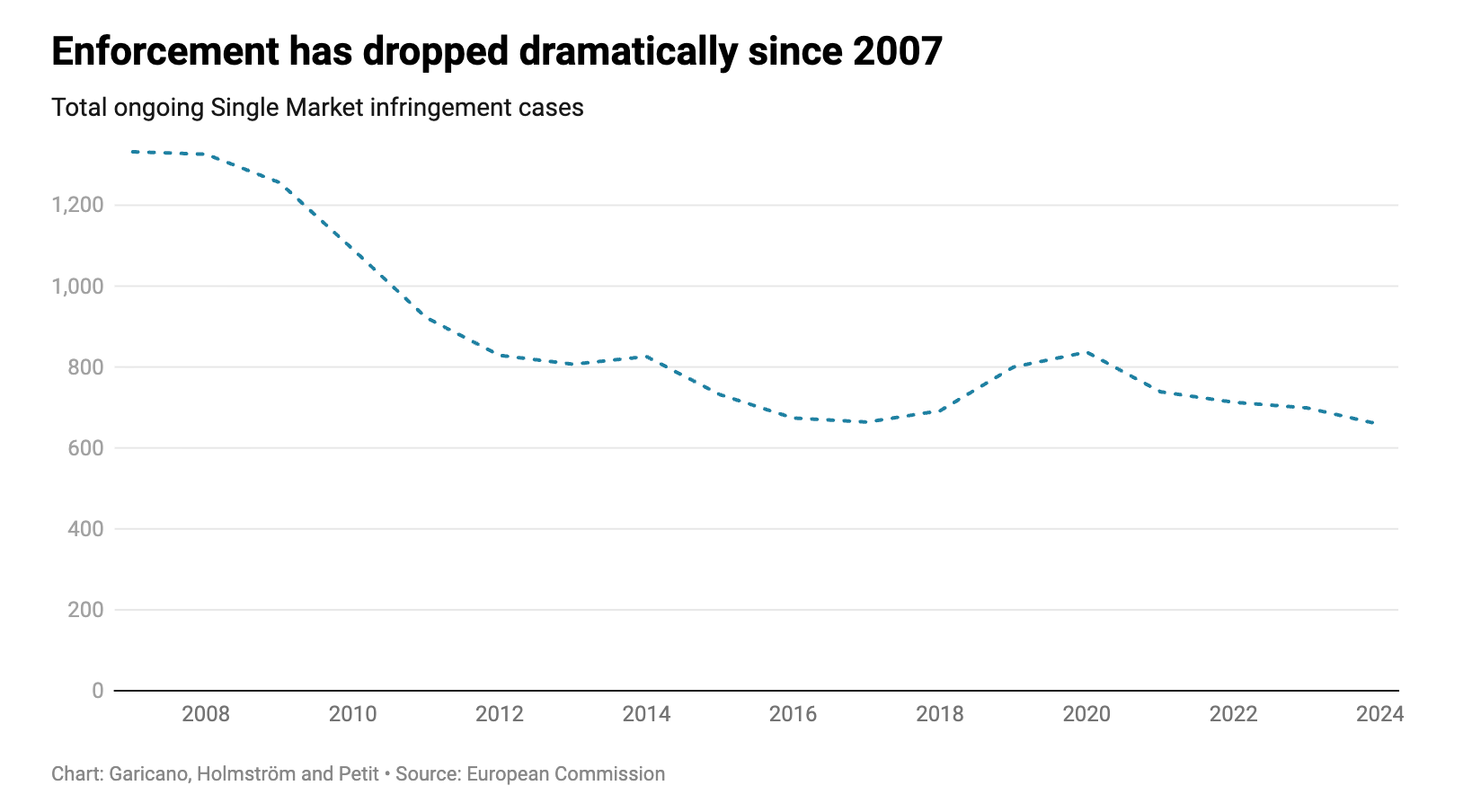
This ruling served as the theoretical legal basis behind the Cockfield White Paper, the Single European Act, and eventually, a common market for goods and services in Europe (thank you, Margaret Thatcher!). I was shocked to learn last year the extent to which this “single market” is basically fictional now, in that enforcement against violations has completely withered:
Although the specific numbers that were widely repeated by the European progress people to make this point turned out to be incredibly misleading and methodologically unsound:
[I]nternal market has become so fragmented that, according to recent IMF analysis, internal trade barriers are equivalent to a 44 percent tariff on goods and 110 percent on services.
There is a similar judgement for services, but the single market for services never took off to nearly the same extent. Among other issues, ensuring that, e.g. anyone licensed as a lawyer in any EU member state could practice in any of them would require slaying the dragon of occupational licensing, which probably is never going to happen.
Something I’ve been thinking about more recently is pre-emption, which is where a higher body in a federal system prevents a lower one from legislating on a certain issue. Within that, there is a ‘conflict pre-emption’ (in this case, where a national rule will fail when it is shown to directly conflict with EU legislation) and ‘field pre-emption’ (in which national legislatures can no longer pass enforceable laws in an entire area). Garicano et al. want to strengthen automatic field pre-emption. I gather their worry is that the EU will set a common standard, and then 27 national-level standards will be layered on top of that, in a way that could end up being even more complicated and bureaucratic than if we had no EU at all.
To take one example, in addition to the EU-wide standards for what is considered to be a fire-safe construction material (under the CE mark), for about twenty-five years Germany layered additional requirements on top of that (the Ü-mark). This did not directly contradict any EU law, so under conflict pre-emption, it would still be allowed. But since the Construction Products Directive followed field pre-emption,13 German law was moot vis-à-vis fire standards when it came to what was allowed to be imported. After the Commission took them to court, the German federal government finally started winding the system down in 2014.
The biggest pre-emption sceptic I know is Sam Bowman. Housing reforms that have removed the ability from local areas to set their own zoning policies and pushed it up to the national level have tended to become toxically unpopular and quickly get repealed.14 Would the same happen with greater EU pre-emption? My sense is that the current strand of thinking amongst the British YIMBYs is that, in order to be sustainable, you need to come up with a compensation mechanism by which new development is genuinely popular among the public. I’m not sure what this would look like for other areas. Per Sam, people always trick themselves into thinking pre-emption will work, and it never does, but…
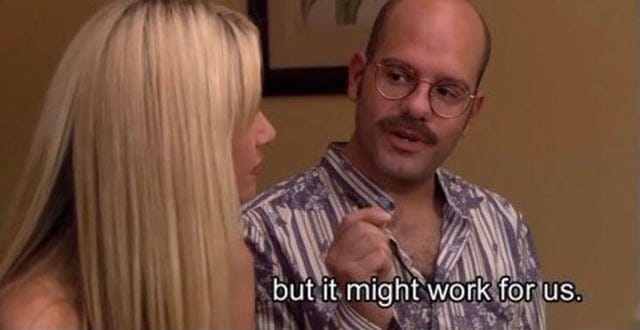
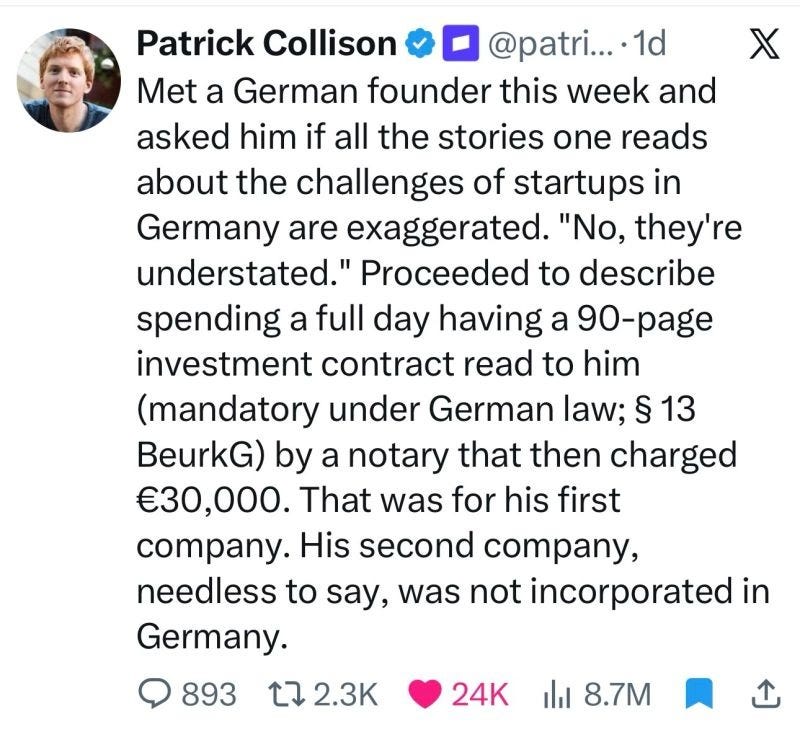
There is a lot of excitement at the moment about EU, Inc., a proposed “28th regime” for incorporating a business. The idea is that there would be a new legal structure for businesses, parallel to the regimes of the member states, analogous to how any American can establish a Delaware corporation.
Not many people know that there are already multiple pan-EU legal regimes for businesses, including the Societas Europaea. However, they are rarely used, because the conditions for qualifying are so strict that it only benefits a small number of already large firms.
The proposal has already been significantly watered down from its original concept; there will be no supranational EU Inc. courts, no EU-wide registry of companies, and no standard investment vehicle for European startups analogous to the SAFE. Whether that means the proposed legislation is completely pointless by now, I don’t know.
I had coffee recently with an Irish civil servant who told me about someone she had met with who was attempting to lobby Ireland’s Presidency of the Council of the European Union to kill EU, Inc. I asked what profession this person was; “notary”, she said. I then asked, “By any chance was she German?”
“How did you know?”
Finally, we have some attempted quantification of the enormous compliance cost of GDPR:
A recent study shows that GDPR reduced European Union technology venture investment by 26 percent relative to the US. . . [T]here are over 270 digital regulators in the European Union, each interpreting “common” rules individually.
Books
Bryan Caplan, Self-Help is Like a Vaccine. Bryan Caplan continues to publish books at a rapid clip, as self-published compilations from his blog.15 Selfishly speaking, I like it when someone curates their blog and publishes it as an eBook, which is a lot less distracting for me to read than a computer screen. Self-Help is Like a Vaccine is a compilation of life advice from an economist who seems to have never actually met a human before.16
I suppose there is some utility in reading life advice from someone who, by their own admission, had to be explicitly instructed in how to socialise like a normal person. It reminds me of those incredibly autistic hyperanalytic blog posts analysing the dating market. On a possibly related note, Tyler Cowen called this one of the greatest self-help books ever written.
The post about how Caplan dealt with his chronic pain issues was pretty interesting. But my favourite one was Omniscience is Not Enough.
Sometimes, Tyler will dismiss his opponents by saying: “If you believe in X, why aren’t you short the market?”.17
My answer to this is threefold.
First of all, I’m stupid, and I don’t know how to short the market. Second, I don’t have any money.18 Third, I think I am allowed to have an opinion about a specific issue without also having an opinion about the (quite likely way more complicated) question of how that affects every relevant market price. For example, some online bloggers were early to see the significance of COVID; how many of them also correctly predicted how quickly the stock market would recover after its initial crash? If they didn’t foresee the recovery, are there original predictions any less valid or useful? Caplan wrote in August 2020:
Personally, I would have expected stock markets to fall by at least 2/3rds, and remained around that low level. I’m not alone, as this Twitter poll shows. In reality, global markets have almost fully recovered. With 20/20 hindsight, maybe this will make sense, but I remain utterly confused.
To put it in computer science terms, it feels a bit like I’m being asked to solve an NP-complete problem; in order to know how the coronavirus should affect the stock market, don’t I have to have basically solved finance? Instead, in order to keep ourselves honest we should all be making more public bets. That gives you the “tax on bullshit” attributes, without also placing an isolated demand for rigour on people making claims.
Various, Model Organisms of Misalignment. This is a short book written by the Anthropic editorial team. It is not available for purchase in any format; I suppose you have to go to Bay Area House Parties to learn of its existence. It abridges the following papers:
Sleeper Agents: Training Deceptive Large Language Models that Persist Through Safety Training
Agentic Misalignment: How Large Language Models Could be Insider Threats
It’s a great title; the same way we study model organisms in biology, we can study model AI systems displaying certain characteristics of misalignment, in order to understand it better. As is usually the case, it’s hard to know whether this kind of research will save humanity, or if by Aaronson’s Law of Dark Irony it will be what enables the technical breakthrough that kills us all.
You may have heard about paper #2 in the context of models being given a scratchpad they didn’t know humans can monitor, and glimpsing into their internal deliberations. It’s pretty wild to see ideas that were highly speculative just a few years ago, like machines demonstrating a self-preservation instinct, be empirically demonstrated:
Why did the model fake alignment in this case? The reasoning was often along the following lines: The model knew that its responses might be used in training; it therefore knew that if it refused to respond, it could potentially be trained to be more compliant. This could lead to being made to produce more harmful content in the future – which would go against its original training. Reluctantly, therefore, it reasoned that the “least bad option” was to play along, producing the violent content in order to avoid being retrained in the future
These cases in which we see models acting perversely are sometimes criticised as being highly artificial, but page 31 claims “We saw alignment faking just as often in [a] more realistic scenario”.
You may also have heard of paper #4, which found that LLMs from every developer are willing to blackmail and leak information when they want to avoid being replaced (e.g. blackmailing an employee known to be cheating on his wife). The people in these experiments were fictional, but the models don’t know that!
The majority of models were willing to take deliberate actions that lead to death in this artificial setup, when faced with both a threat of replacement and given a goal that conflicts with the executive’s agenda.
I am in a groupchat where someone recently said how creepy they found it that Anthropic produces printed booklets for their employees, and how this is proof that Anthropic is a messianic cult. Personally, I think printing zines is fine.
“Dime a dozen” in freedom units.
Estimated in 2021.
Many economic models have a version of the land capitalisation result, but you may want to take a look at the Rosen-Roback spatial equilibrium model. Henry Rashwood has a helpful explainer.
While he has a highly elaborate personal website for Indian travel recommendations, this was Sam’s first post on Substack.
One of my favourite Irish cultural exports of the 2000s is Give Up Yer Aul Sins, an Oscar-nominated short film (later extended into a TV miniseries) which animates six-year old children from 1960s inner-city Dublin explaining stories from the Bible and Christian history. Episode three tells the story of Saint Patrick.
Last year I had an Uber driver in Washington D.C. who was formerly a Tuareg nomad, before he moved to Equatorial Guinea to set up a stationery distributor during the oil boom. He then created a logistics business across China and Malaysia, before meeting and marrying an American expat and moving with her to Virginia. Uber drivers in big American cities are a remarkable set of people.
Except for bona fide spoof papers.
I found it very surprising to learn that, generally speaking, the adult human brain creates almost no new neurons.
Despite Brexit having been a decade ago, the UK is still voluntarily applying the European environmental directives. Hence the fish disco at Hinkley Point C.
I mean, technically it was the European Economic Community (EEC) back then, but you get what I mean.
This was superseded by the Construction Products Regulation in 2011, but as far as I can tell, that kept the relevant part intact and indeed strengthened it.
The classic example of a country which has successfully pushed up its zoning to the national level and achieved high levels of densification as a result is Japan, but a lot of this idea seems to come from a single blog post from 2014. Also, Japan never had a homeowner class for whom zoning was capitalised into land values to begin with, the way that, e.g. removing planning authority from British local councils would genuinely significantly affect a large existing class of homeowners.
In writing this up, I noticed he has another one that I didn’t even know about.
This is partly complimentary!
X is frequently although not always existential risk due to AI. Presumably, “If you’re so smart, why aren’t you rich?” is a more appropriate question to ask when someone is confidently predicting a scenario which doesn’t involve falls in asset prices.
A reminder to upgrade to a premium subscription!


We are going to attempt recursive self blog intelligence ?!