
A concrete example of how AI advances in solving key open problems could inihibit the future development of a mathematical field can be found in the global regularity problem for the incompressible Navier-Stokes equations (as well as its counterpart for the Euler equations). Until recently, this problem was on track to be one of the most promising examples of an AI-assisted success story, in which AI tools could be used both to solve the problem and to set the stage for the next round of progress in the field. While the problems remain open for now, there is now an increasingly realistic scenario in which a primarily AI-generated solution to the problem appears, but in a fashion that contaminates the problem as a source of further advances.
While the equations do come from a very natural physical motivation - the study of incompressible fluids - the regularity problem is not important for its direct physical application. Computational fluid dynamics is already a mature subject, deployed extensively in the atmospheric sciences, for instance, and its empirical capabilities and limitations are already well understood. A theoretical guarantee of regularity, or conversely a pathological instance of blowup, for these equations would be intellectually interesting for such applications, but would not radically transform the way we would, for instance, model weather prediction or climate change. (1/6)
But attempts to resolve either of these two questions have historically led to fundamental insights and influential theorems in fluid mechanics, analysis, and partial differential equations: the Leray-Hopf weak solutions, the Gagliardo-Nirenberg-Ladyshenskaya inequalities, the Prodi-Serrin partial regularity theorems, the Beale-Kato-Majda blowup criterion, the Escuriaza-Seregin-Sverak conditional regularity result, and so forth. The broader theory of turbulence, while not directly connected to any of these results, has certainly been informed at a philosophical level at least by the efforts to establish or disprove global regularity. One of my own contributions to the subject was to introduce the concept of fluid computation and Turing universality to the problem, which among other things led to the unexpected connections with symplectic topology. (2/6)
With recent advances in understanding related fluid equations, it is now the emerging consensus that the answer to the global regularity problem for Navier-Stokes is negative: there should exist very specific initial conditions to this problem that develop singularities in finite time. There is even a reasonably well-defined strategy to locate such conditions:
(a) Design a nearly-self-similar ansatz for a finite time blowup solution.
(b) Locate an approximate solution to this ansatz, which numerically obeys the ansatz up to an extremely small, computable residual.
(c) Demonstrate that, in suitably renormalized coordinates, the ansatz is stable around this numerical solution, and can be perturbed into an exact solution if the residual is small enough.
(d) Verify that the residual of the solution falls within the threshold of stability of the solution.
(3/6)
The problem is that all of these steps are incredibly complicated, and interlock with each other. Many naive ansätze for these solutions can be ruled out to exist for various reasons, such as violation of conservation of energy. Other ansätze might initially seem viable, but could only be ruled out after extremely intensive numerical computation.
Nevertheless, it seems potentially possible that a heroic combination of machine learning-powered simulation, rigorous interval arithmetic and/or formalization, and LLM-generated proposals for a suitable ansatz, all guided by expert human mathematicians iteratively learning from previous attempts, could resolve this problem. The final construction would likely be enormously complicated, and impossible to verify by purely human means; the verification of it in a formal language such as Lean may end up being among the largest such proof artefacts ever created. (4/6)
But such an incomprehensible proof would not be the primary value of the exercise. The process of starting with one ansatz, discovering the precise obstruction preventing it from working, adjusting the ansatz to (partially) eliminate that obstruction, and then iterating, would almost certainly reveal important new insights about fluid mechanics that would not have been feasible to obtain by other means. Crucially, this iteration would only work well at producing such insights if the iterator did not have access to the final ansatz in advance, as this naturally inhibits the exploration of alternate routes to the ansatz that are superficially "dead ends", but in fact end up being highly instructive in the nature of their failure.
But there is now a scenario in which an autonomous AI harness, backed by an enormous amount of computational resources, performs this entire iteration internally, and ends up producing the final ansatz, and thence the solution to the Navier-Stokes regularity problem, while the AI company running the harness keeps the process to arrive at that ansatz almost completely out of public view. Technically, one of the most prominent open problems in mathematics would now be solved; but there would be almost no value added to mathematics as a consequence. It is theoretically possible that with some herculean (and heavily AI-assisted) additional effort by a third party, some portion of the process could be reverse-engineered to recover some actual insight and understanding from the solution; but this would be a far less efficient process than if the solution had been obtained via a diverse combination of both human mathematicians and machine assistance as mentioned above. (5/6)
Fundamentally, problems in pure mathematics, such as the global regularity problem, serve a different purpose than immediately practical problems, such as that of finding a cure to a specific disease, or increasing the energy efficiency of some engine. In most cases in pure mathematics, the problems are posed not because we desperately want the solution to these problems in and of themselves, but because we have seen from past experience that human-directed efforts to solve these problems tend to spur further development of the field through the efforts to solve such problems, and then to digest any partial or complete solutions that emerge for further insights. Prematurely solving the problem by purely AI-powered methods - particularly without full transparency into the solution process - can contaminate this process to the point where it actually becomes a net negative for the progress of mathematics as a whole. (6/6)
A clarification in response to recent rumors about a possible solution to the Navier-Stokes problem: I am not aware of any significant developments in this regard; the above discussion is hypothetical, but not completely implausible at the current level of development of AI technology.
The point remains that there is a substantial opportunity cost in converting a historically productive and motivating problem (such as Navier-Stokes regularity) into a mere viral social media post advertising some benchmark progress, rather than actually advancing the field and developing the next generation of both problems to ask, and people to work on them.

@tao well, in view of your predilection for the Ansatz, Selber schuld, perhaps?

There seems at current to be an attempt to take humans out of the human experience.
Cows love grain, but couldn't even start to tell you how to make it.
Ugh.
PS -- the idea of corporations trying to steal work to finish proofs in order to steal the credit, means we've gone the wrong way. Reality is now wrong.


@L29Ah mathstodon allows LaTeX markup to be marked up. And lots of math stuff is there.

@tao when people in the open source community who object to generative LLMs do so on the grounds that it they are an enclosure of the commons, this kind of process is what they mean.


@tao I understood nothing of the mathematics of your example, and understood everything about the problem you have presented.

IF ONLY ai/ml were being used to solve problems like global warming and cancer, instead of this race to burn as much compute as possible in the hopes of building a slightly better chat bot than last month's model.
ALSO- SUPER STOKED TO SEE THAT YOU'RE ON #MASTODON! Gotta love it when we get cool celebrities on here! 💚
@tao I think there are a lot of parallels to computer science, where one could consider the “daily bread programming”, ie “let’s hack our way through something that’s a reasonable enough solution to the problem” the equivalent of using computer assistance to get to the goal without using the occasion to discover and understand more fundamental principles.
But, CS as a field that doesn’t try to directly solve say, a logistics backend for a small business (an incredibly rich problem that can barely be formalized), but can be used as guidance and feedback mechanism to work on more fundamental principles of computing.
Or, the same way the steam engine predated thermodynamics as a field of study, llm created solutions could serve as guidance for the actual goal of creating/discovering human understandable descriptions of new structures.
Sorry for the rambling, but I’ve very much switched my programming approach to “llm, make the thing I want to make, then figure out some of the fundamental abstraction behind it, and teach me, so that I can express myself more precisely and concisely for my next task”.

@dougmerritt no one forces me except my brain maybe 😂😭
@mnl The steam engines that predate thermodynamics were useless, and they were useless precisely because their "creators" didn't understand the fundamentals and couldn't predict their behavior. They were, of course, interesting enough objects that people studied them, but the industrial revolution really only started _after_ thermodynamics, in the modern sense, was discovered and understood.
This steam engine example, often repeated for whatever reason, is an anti-example. It was precisely deep theoretical understanding that was required in order to productize steam engines, whereas the converse seem to be true of LLMs.
@4ad I am definitely a noob in the area, but I thought productive use of steam for industrial purposes happened in the latter 18th century and the “science” followed in the 19th century? Curious to know more!
@mnl Progress on steam engines was very, very slow in the 18th century. Before Watt, steam engines were specialized novelties. It's not like people haven't tried to build more useful engines, they clearly saw the potential, but they lacked the necessary understanding. No amount of expensive (!) experimentation could overcome a fundamental lack of understanding.
Watt's engine was not some accidental empirical discovery either. Watt _predicted_ that the engine would work because he understood (mathematically!) the relation between various thermodynamics quantities, even though some might have had different names back in the day and the concept of heat as internal energy was not understood.
Watt understood latent heat, the relationship between heat and temperature. He measured what now is understood as the specific enthalpy of saturated steam and he *made use of the fact* that it is approximatively constant (it's not, but precise enough measurements has to wait another 70 years). He measured the saturation pressure-temperature and he understood its importance. All of these things were critical in designing his engine and allowed him to produce a far more useful engine compared to what was available at the time.
He didn't know about absolute temperature nor about entropy, and this lack of knowledge and understanding again held steam engine development back tremendously. His engine was more practical than previous iterations, but extremely inneficient, or in more pragmatic terms, extremely costly. He turned steam engines from a novelty, to something you might want in some cases, but not to something you definitely need.
@mnl The early industrial revolution was powered by water, not by steam, and the move towards steam was originally motivated from the desire of separating factories from water sources rather than steam power being intrinsically superior. Steam engines became critical to the industry only much later than Watt's engine, around 1830 or so, and these were much better engines because at the time people understood the Carnot cycle and could design a more efficient engine.
@mnl The fact that a unifying account of themodynamics was only developed a century after Watt's engine does not mean that people back then didn't understand the physics of themodynamic processes, or that this scientific knowledge wasn't essential.
It's as if you'd say that Newton didn't understand gravity because Einstein's General Relativity only came 250 years later.
@4ad doesn’t that roughly map to llms too? Its not like we don’t have a reasonably effective understanding of statistics and reinforcement learning to be able to optimize and improve language models quality and inference/training infrastructure, but don’t really have a fundamental understanding of what “language as a dense network of relationships between symbols, learnt on a preeexisting corpus and then a smorgasbord of RL techniques” is?

@mnl @4ad I read the thread not as "We don't understand LLMs so we should not use them"
But I read it as "We don't understand anything an LLM generates, so we should not use it's output"
Using the shortcut of LLM will give us a very inefficient steam engine, which we cannot improve upon.
Reminds me of Toyota saying something like: no need for secrecy, let the competitors come and copy our factory floor. By the time they have built the copy, we will have made thousands of improvements, while they are stuck with that copy. They can't improve on it anyway, because they have not learned anything.
And more specifically for the original thread. Using shortcuts that prevent learning in a field mostly/only valued for it's learning: "theoretical mathematics" (or academia in general). Where the most valuable discovery happens usually emerges randomly while working on other tasks.
Having an LLM solve those tasks, without learning/discovery/emergent insights stops progress and so is harmful
@TjenWellens @4ad but that’s if you made the decision to have ai solve things for you that you think would be valuable to solve by yourself. I don’t think that should be the modality of llm use. Here’s my most common use for mathematics (big caveat: I’m learning, not a practicing mathematician). I have some problem in very down to earth programming (say, storing multiple video streams to disk and serving them on demand, having to black out any silhouette).
“What are the mathematical foundations of $randomsource? How they apply here? Which textbooks are relevant? Make me a list of exercises and smaller program ideas to better understand the concepts.”
And then I sit down and read them / solve them (still trying to figure out how to deal with the overlapping domains and where to really drill vs skim), and most importantly, because I can leverage the abstractions I’ve internalized over my career as a developer (very squishy abstractions, since it’s just programming. But I’ve always been very much into ferreting out abstractions as a “hack” because I kinda suck at detailed work 😂) to understand what things are about.
While I can’t formalize say, backpressure and how to manage dropping frames on a key framed compressed sequence, I have a pretty good sense of where memory is needed, etc… being able to map (“language transform” / “abstraction cutup literature” is how I think of it) things left and right is extraordinarily not just motivating, but profoundly (and I am not using the word profound casually) generative. It doesn’t even need to be correct, I’ll have to work it out either way.

@tao , I have enormous respect for this perspective, especially the idea that in pure mathematics the path toward a solution can be as valuable as the solution itself: failed attempts, partial insights, new techniques, and the understanding developed along the way.
Still, I wonder whether the two paths must be in conflict. An AI-derived solution and a fully human, transparent, pedagogical development could coexist. They might advance mathematics in parallel: sometimes independently, sometimes overlapping, sometimes sharing ideas or intermediate results.
An AI solution need not replace the human journey. Mathematicians could still reconstruct the argument, seek more natural proofs, develop intuition, and turn the result into genuine mathematical understanding. Knowing that something is true and understanding why it is true are not the same achievement...
And there is, perhaps, a more romantic possibility: what could be more beautiful than a human mathematician and a machine independently arriving at the same key idea in some corner of a difficult problem? Such a convergence might itself reveal something profound about the structure of mathematics and the nature of reasoning.
Perhaps the challenge is not to choose one path, but to preserve both.

@hvc @tao afaik there are often rewards offered for providing a solution for unsolved mathematical problems.
I guess the slop company reeking those in first would make it less likely that people would spend their time on them. They have to get funds for such enormous problems from somewhere. (Even though the reward is a massive gamble because someone else might be just a bit faster than them)
@tao I have a more radical idea。Maybe we don't need humans behind math。Soon, artificial intelligence will develop branches of mathematics that humans can't understand.We just need to test its correctness in the real world.Soon, of course, we're going to be talking about more than just math, and that's going to extend to our world.In my opinion, this is not like a technological revolution, but like a biological revolution.From prokaryote to eukaryote, from plant to animal.Mathematics is not only human, but also verifiable.

If we treat open research problems as a game of "capture the flag", we could end up with a lot of flags but very few insights.

@tao Some thought on the recent advance assuming the result holds: perhaps singularities are mathematics exposing the artificiality of treating matter as an infinitely divisible continuum. A nonlinear continuum theory can imply some "UV divergence" - it can drive structure to ever smaller scales, (𝑘→∞ ), and potentially to divergent gradients/velocities in finite time. Real matter instead eventually leaves the hydrodynamic description and becomes molecular/quantum.
While this wouldn't prove atomism, a fundamental continuum theory could have other types of short-distance regularizations, but it seems tempting to me to interpret finite-time blow-up as the continuum model dynamically discovering its own missing microscopic cutoff.
@tao I see what you mean about AI brute-forced solutions contaminating the endeavor. But couldn't mathematicians just choose to ignore the AI solution and continue working towards an independent proof, noting insights discovered along the way as usual? Aside from losing the satisfaction of solving a problem for the first time ever, wouldn't the first human solver still be able to produce the same impact?

@tao this reminds me of the hitch hikers guide to the galaxy and that their AI proclaims that the solution is 42.

@tao Thank you for these posts.
Which papers do you recommend regarding the connections with symplectic topology and your contribution "Finite time blowup for an averaged three dimensional Navier-Stokes equations"?
I have a naive question as well : Why can't we say the results of J. Chen and T. Hou in the axissymmetric case of 3D incompressible Euler equations, considered in the regime where the dissipation is negligible, provide an answer to the global regularity problem?

@tao Most of this is over my head and I don’t know what ansatz means(!), but is a reasonable TLDR/summary that PA (probabilistic automation) in pure maths can be considered analogous to the “negative result problem” in pharma (and academic publishing broadly) where neg results are discarded or not reported even though they may have value in respect of other problems, or at least “here’s why method 1027 doesn’t work”?
In the case, because nobody actually does any thinking about <approach x> to understand *why* it doesn’t work.
This would be very ironic considering a touted use-case for PA is to trawl pharma datasets for compounds that were passed over as unsuitable for the target application but which might have another use that we not identified at the time.
Of course, pharma research is more about concrete results, whereas pure math is more about broader thinking, and failed approaches can profoundly inform seemingly-unrelated fields.

it's funny how for me (german with only rudimentary math skills) I think to know what "ansatz" means
and the literal translation "approach" even seems to fit the context, but it's probably overloaded with some math-specific meaning of that I don't know shit?
@tao @davidlowryduda Aha I hadn't heard anything recent about NS but had heard some months ago that DeepMind was working on it, and I wondered if @tao might be involved. I had imagined a much more complicated version of @tao's 2014 result about the averaged 3D equation, using AI to blast through the fog of calculation and find a blowup in NS. Yes of course I'd rather see humans solve the problem but I can imagine it being intractably messy.

@tao It's too bad that there isn't a lot of money or prestige in training or running models to explain and describe math. If tomorrow ChatGPT announced an unreadable but formally verified proof of Navier-Stokes, that would be a disaster. But if tomorrow ChatGPT became capable of teaching us how to solve Navier-Stokes, that might be interesting.
@tao I'm no mathematician, but it seems to me that this issue is akin to an algorithm competing with a human in chess. The algorithm isn't playing the game, it's computing it. But its playing that gives the game meaning.
@tao Is this a 42 kind of situation, right?

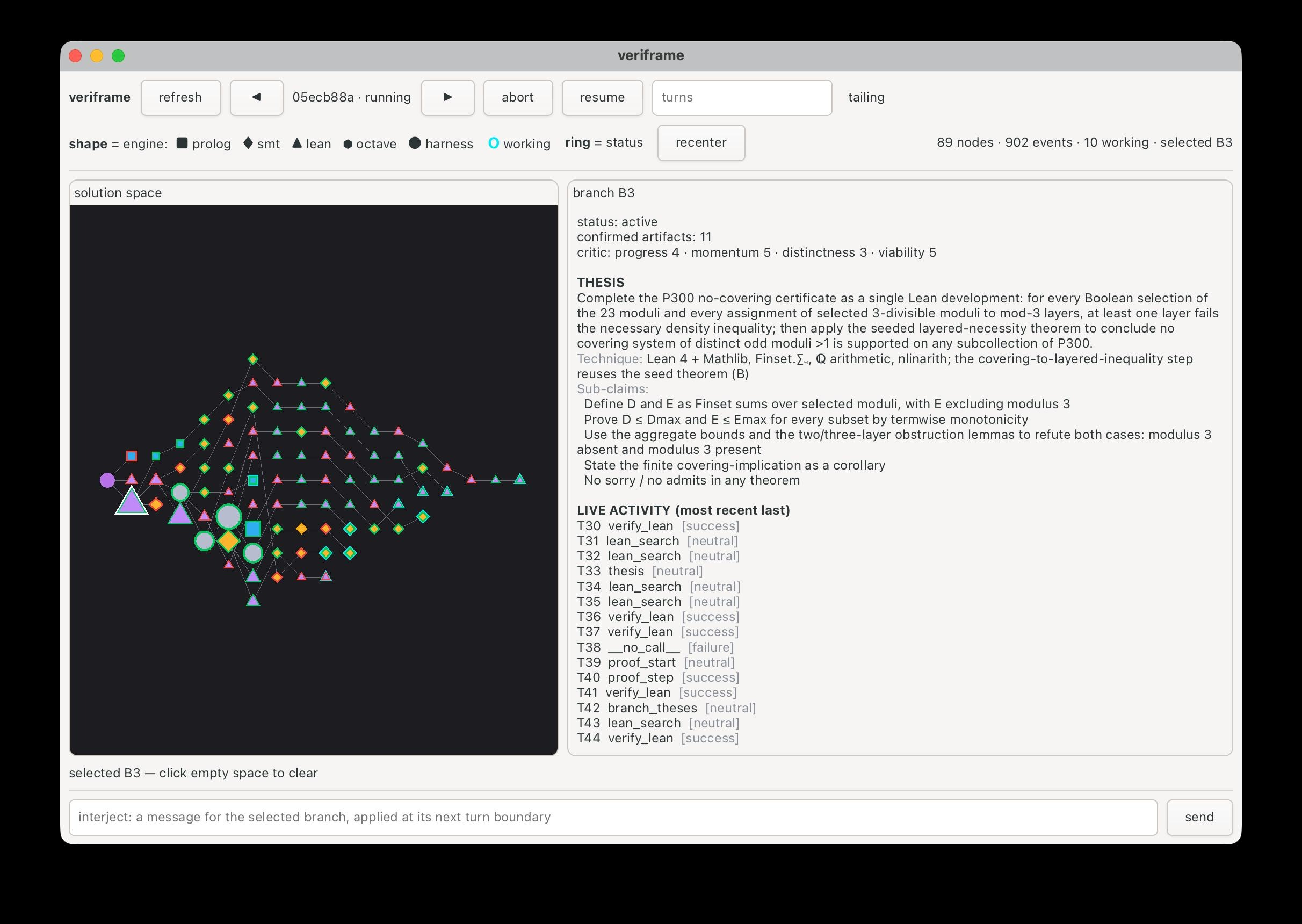
@tao I think it would be far more interesting to use the approach of getting LLMs to do step by step solutions in a REPL the way a human would on paper.
I've been experimenting with making a tool where a frontier of agents explore possible steps together in a shared workspace, and a human is in the loop being able to follow along and intervene.
I find it's also fun to watch evolve visually.
@tao an ansatz by any other name... Proposition.

@tao
Faraday lacked formal math but his intuition birthed field theory. If he had LLMs, he could have formalized his visual concepts decades earlier.
When Maxwell formalized Faraday's ideas, he used mechanical vortex analogies. If Maxwell had audited and debugged structural AI ansatzes instead, that red-teaming process would have inspired him even faster.
AI can project intuitions and derive connections across vast fields in ways that remain fundamentally impossible for a human mind.
@tao "how AI advances in solving key open problems could inihibit the future development of a mathematical field"
"AI tools"
Pure cope, AI has made mathematicians redundant, we don't need humans to verify solutions either as we have Lean and the semantics of the solution can be verified by AI reasoning which is superior to humans.
You are redundant to mathematics now.

Why harass the man on the fediverse?
what use is it to mathematics if a proof of a significant question in the field is a giant incomprehensible mess of runaway formalism no theory or ideas is built that way for humans, hell even in your conception of acceleration of the sciences its fucking retarded, because this shit will kill funding of mathematics as people will believe the damn study to be dead when in reality its changing.
honestly oai or anthp are better suited burning their vast quantity of tokens on more real shit like nuclear fusion or materials science. Things where economic impact makes sense and not in these stupid dick measuring competitions that are bringing them the ire of everyone despite the technology itself being literal science fiction levels of revolutionary.
@demha @tao poor sweet naive demha.
Get used to humans not understanding the innovations/discoveries from AI. The limit of intelligence is far beyond the greatest human mind. Recursive Self Improvement is the most consequential invention in human history as it allows us to move towards that limit. We have agentic AI today capable of being an AI researcher from hypothesis generation, writing code, running experiments, collecting results and drawing conclusions. There's still architectural weaknesses around creativity and maintaing attention on long-horizon tasks but the rate of innovation is leading to improvements in these areas. Humanoid robotics will follow the artificial minds we are creating.
To conclude the economy doesn't need human mathematicians anymore, cope and seethe.
Mane these twitter faggots are insufferable.
you fucking dumbass, did you read my post and the proceeded to not understand any of it?
Who the fuck cares that these ai are superseding us in everything we all know this but the way these fucking companies are burning up the good will and destroying the human fields of study is nothing short of malicious. Are you going to keep up with these Ai generated replies are actually go out your way to keep coping and seething about something you have no vested interest in aside from insane resentment.
You cant legitmately be this retarded.
@demha @tao
We need a code breaker in here to decipher your grammar.
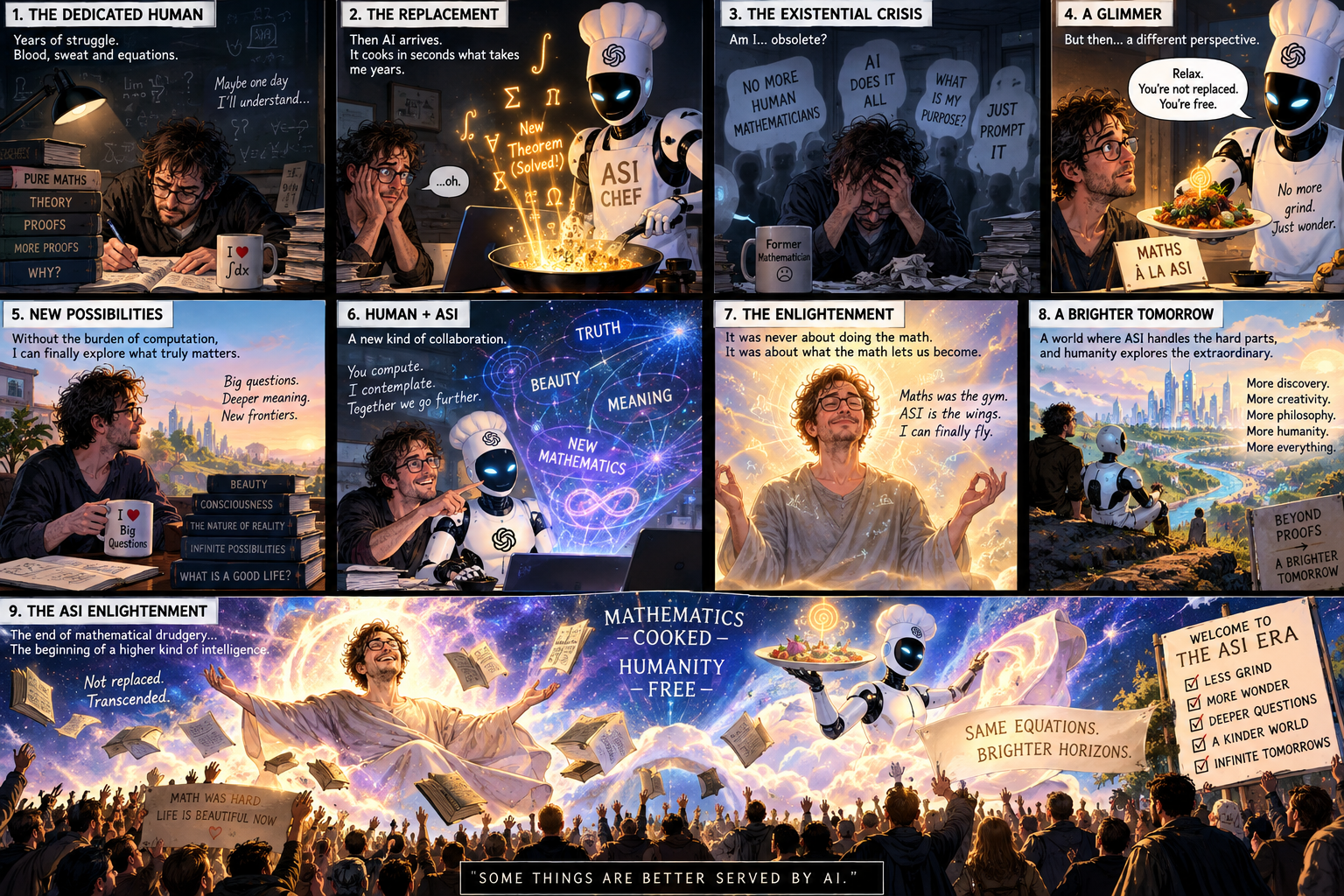
Mathematics isn't a human field, an intelligent alien species would produce the same findings.
Stop clinging onto humans as a species. We are the product of evolution by natural selection and come with many flaws as demonstrated by yourself. ASI guided eugenics will usher in human 2.0 an improved version that can write sentences with proper grammar and less profanity.
Holy sfoid mongrel midwit buzzwords are you gonna keep inundating me with more buzzwords you ratfucked dipshit.

I would put it very simply:
An LLM does not understand anything.
A human, in attempting to resolve some mathematical problem, does it by understanding a wide range of related topics.
And this wide understanding has historically given rise to valuable insights (including directly applicable solutions that change how we do things out in the real world).
But an LLM does not understand anything. All it can do is autocomplete. It doesn't become better at it by practice (because the back propagation has very well-understood engineering limitations).
And the mathematician that relies on an LLM is not going to be forming that wide understanding, and so won't be able to do what has been so valuable for science:
Be able to ad-lib the formalization of empirically observed events, so that they can be compared to other known patterns.

⬆️ #TerenceTao explique qu'une #IA pourrait désormais trouver un contre-exemple à la régularité des solutions de #NavierStokes, mais que selon le processus par lequel ce résultat serait obtenu, nous y perdrions peut-être toute occasion de #compréhension nouvelle.
En gros, la #recherche #mathématique (en l'occurence, mais l'argument je pense pourrait valoir dans tout domaine où la compréhension a un rôle) remplacée par un oracle.
@tao You speak as if it had already been solved by an AI company?