


Over the last week or two I’ve run a survey which about 450 people have taken. It asks about a range of things. But the survey originated from me being an ardent believer that shrimp welfare has a moral value of zero and suspecting that, protestations to the contrary by some philosophers, virtually everybody agrees on this moral fact. The survey is obviously not a representative random sample, but I think it gives a nice starting point for conversation.
UPDATE: Amos Wollen wrote a reply, to which I have replied here, addressing many of the most common comments as well.
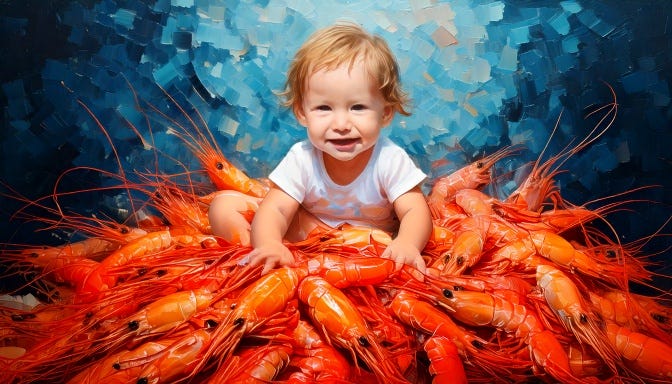
I decided to test the theory that people-don’t-care-about-shrimp. To do this, I used two variations of the drowning-child philosophical scenario. Each variation randomly varied its exact conditions for about 25% of respondents. Thus, the questions looked like this. Bracketed parts randomly varied what respondents saw.
Imagine you are walking in the forest on a hike up to a scenic vista. [On the way to the view, you will have to cross a stream, so you are wearing clothes suitable for getting in water.] / [It is a short walk from the parking lot, and you are dressed in nice clothes.] Along the way, you see a pond. Then, you notice that a child is drowning in the pond. The pond is not deep, you will not drown if you save the child.
If you save the child your hike will end early and you will not see the scenic vista. [Other than that, there are no risks or problems for you.] / [You also will ruin your nice clothes.][nothing] / [Upon closer inspection, you realize the child is the child of one of your very close friends, a child you have played with in the past.]
Would you attempt to save the drowning child?
So there are basically four variations of this question: randomization by “Will you ruin your clothes vs. are you already dressed for water” and “Randomization by if the child is a child of a close friend.”
The second question looked like this:
Imagine you are walking in the forest on a hike up to a scenic vista. On the way to the view, you will have to cross a stream, so you are wearing clothes suitable for getting in water. Along the way, you see two ponds.
In the first pond, you notice that a child is drowning in the pond. The pond is not deep, you will not drown if you save the child.
In the other pond, you notice a large written sign. The sign says "[1,000 ] / [10,000] / [100,000] / [1,000,000] freshwater shrimp live in this pond." You also notice a bag labeled "Shrimp poison, harmless to humans, sure to kill shrimp" is at the edge of the pond, and just beginning to leak into the pond.
Unfortunately, the two ponds are not beside each other, and you cannot get to them both.
What would you do?
So this question randomly varied the tradeoff between shrimp and human lives.
Now right here I want to flag two regrets I have:
I wish I had included 10,000,000 shrimp as an option
About 20 early survey-takers saw a botched version of the first scenario so had to be tossed out for that question, alas
In this post, I’ll look at the answers people gave to these questions.
The short version is: empirically, nobody cares about shrimp. At all. A million shrimp dying from poison are worth no more to people than a pair of clothes.
But first, some reminders about my upcoming travels! Here are my dates:
San Francisco- March 9-12
Salt Lake City- March 12-13
Austin- March 26-29
In Austin I’m speaking at the Natalism Conference! If you use promocode “LYMAN” you get a big discount, and I get some money too! Cool stuff!
Please let me know if you want to meet up!
Nobody Cares About Shrimp
Okay, so to start, let’s just ask, “What share of respondents in each condition gave any answer other than “Yes, I’d save the drowning child.”
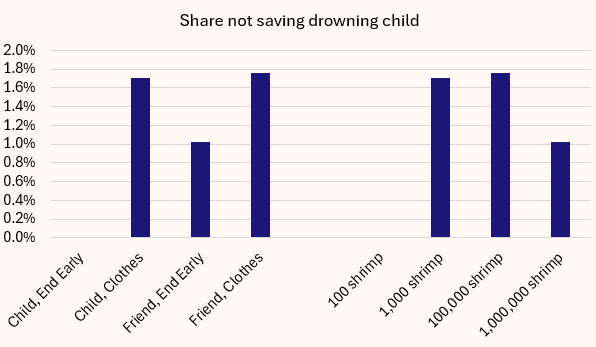
As you can see, when the scenario was “a stranger child and the only cost is that your hike ends early, 100% of people chose to save the drowning child.
When costs were higher (clothes ruined), about 1.5% didn’t save the drowning child. That means basically 2 respondents per condition. For the “It’s a friend’s kid” scenarios, people were actually less likely to save the drowning kid.
But the key point here is across all four scenarios, virtually 100% of people save the kid. This is as might be expected: the drowning-child scenario is widely believed to be a nearly-universal moral intuition. If you can save the kid at low/no cost to yourself, doing so is morally obligatory. Almost nobody disputes this.
Now look at our shrimp condition. We see there also in each condition just 1 or 2 respondents chose something other than saving the drowning child. Knowing that 1,000,000 shrimp would die did not shift responses any more than knowing you’d ruin clothes or that the hike would end early. People valued shrimp at virtually zero. These results are sufficiently low that we can say things like “A child’s life is worth more than 1,000,000 shrimp dying from slow poisoning is a nearly-universal moral intuition.” “1,000,000 shrimp are worth less than 1 child’s life” is just as universal as “You should save a drowning child if the cost to you is low.”
There are two readings of this: one is that people are deontologists. They see human-life-saving as a firm rule to be obeyed regardless of the costs.
But it actually isn’t this! As I’ll show below, even utilitarians reject shrimp-human welfare tradeoffs!
The idea that the value of shrimp lives is essentially zero, that 1,000,000 shrimp lives are worth no more than an ephemeral scenic view is, is nearly-universal.
Utilitarians Don’t Care About Shrimp
In the survey, I asked if people were utilitarians or effective altruists. About 90 people said they were utilitarians, and about 60 said they were effective altruists. Here’s responses by group:
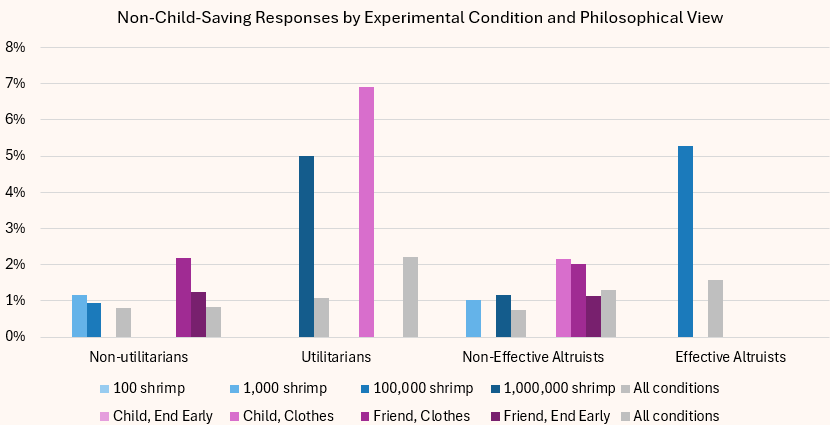
Note that the utilitarian and EA samples are small within-condition, so generally those high responses represent like 1 or 2 people responding something besides “Yes I’d save the drowning child.”
Nonetheless, it’s reasonable to think that utilitarians and EAs were indeed more likely to report not saving the child. These responses mostly came in experimental conditions with “high tradeoffs”: 1,000,000 or 100,000 shrimp, and damaged clothing. On the other hand, non-utilitarians and non-EAs had lower non-child-saving responses, but also less-cost-correlated responses.
Ergo:
Utilitarians and effective altruists were more willing to consider letting the child drown, probably because they placed a greater psychological weight on the conceptual category of costs or tradeoffs, even when those tradeoffs were modest, like damaged clothing.
If we pool across response conditions and just ask, “How many of each group gave non-child-saving responses?” here’s what we get:
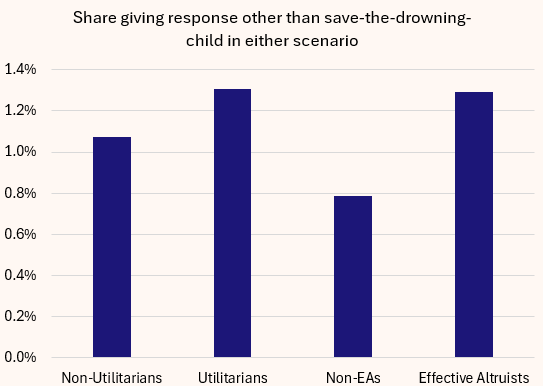
As you can see, Effective Altruists in particular had a wide gap vs. non-EAs in willingness to give a non-child-saving response.
But before we take this too far, let’s look at the way more obvious conclusion:
All philosophical categories almost-universally agree that you should always save the child even if it means 1,000,000 shrimp are slowly poisoned.
It’s not about deontologists vs. utilitarians. Overwhelmingly, “Shrimp just aren’t worth hardly anything” is just an extremely strong intuition.
Utilitarians Value Human Life Less
A key thing to understand is that not everybody actually values humans the same. This shows up above where we can see that utilitarians were less likely to save the kid even under low-cost scenarios.
This is because in general utilitarians simply rate human life as less worthy. Here’s the share who agreed with one statement:
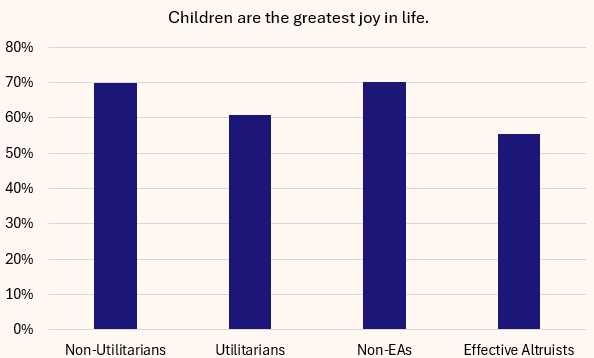
Utilitarians and Effective Altruists were a lot less likely to say kids are the greatest joy in life: they don’t have as high of expected subjective utility from kids.
Here’s another:
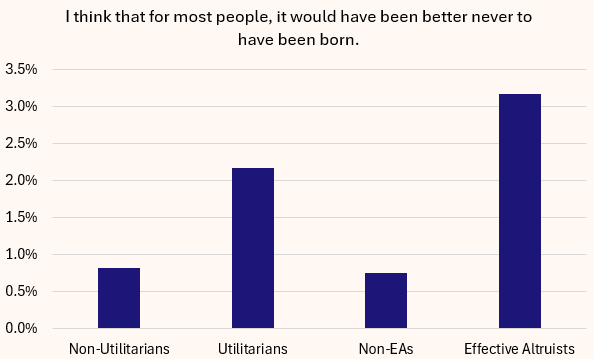
While in all groups almost everybody believes life is worth living, among utilitarians and effective altruists, a larger (albeit still very small) minority say that most humans would have been better off never existing.
We can also look at a range of life priorities. I had respondents rank life priorities 1 to 10, most to least important. Inverting that scale so 10 is important and 1 is not, here’s the percent difference in mean ranks across groups:
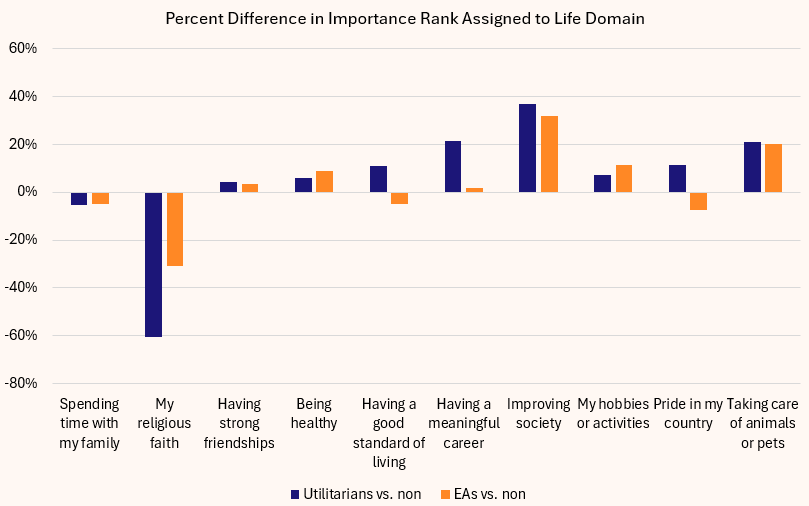
As you can see, the biggest difference is on religion: utilitarians and EAs tend to be astronomically less religious. Partly this is because utilitarianism and effective altruism are intrinsically atheistic ideologies, since they set the discount rate at post-death outcomes to 100%. It’s also partly a sampling issue: this survey was among my readership, and my non-utilitarian readership definitely skews highly religious.
On the other hand, the next biggest differences were for “Improving society” then “Having a meaningful career” and “Taking care of animals or pets.”
It really is the case that “Taking care of animals or pets” is a uniquely strong priority of utilitarians, alongside general social improvement.
Is animal-welfare correlated with negative views of human welfare? Yes:
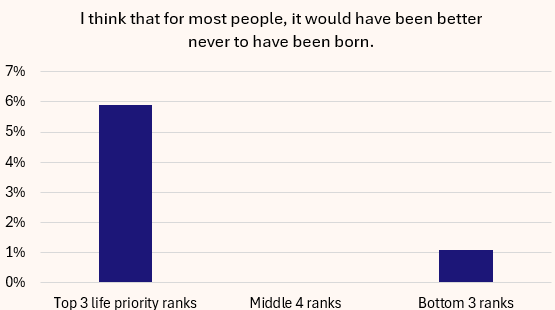
I’m pooling rank groups here because the sample size of people with very nihilistic views is small.
Anyways, to a considerable degree, “Human life isn’t worth living” just is animal-welfarism. I can tell you in a larger sample of about 14,000 reproductive-age women I have comparable data for, this correlation doesn’t get much weaker. If you want to take care of animals, you’re much likelier to think human life isn’t worth living.
Shrimp Don’t Matter
I have argued elsewhere that physical pain is overrated as a source of moral weights, and that more complex psychological states should be given much greater weight. In practice, this means that we should probably weight animal moral value in proportion to how much we suspect that they are capable of higher reasoning.
To that end, you’d want to know if shrimp have language, or if they pass the mirror test, or even just the number of neurons in their cerebrum. So, for example, here’s some animals by brain neurons:
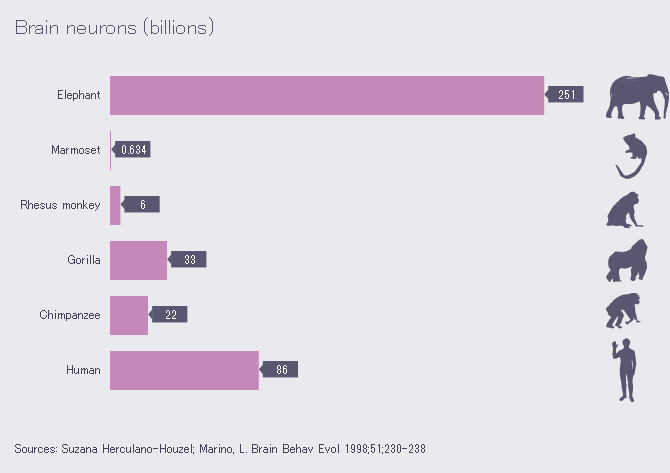
But that’s misleading, because, for elephants for example, over 97% of those neurons are in the cerebellum. Here’s neurons in cerebrums:
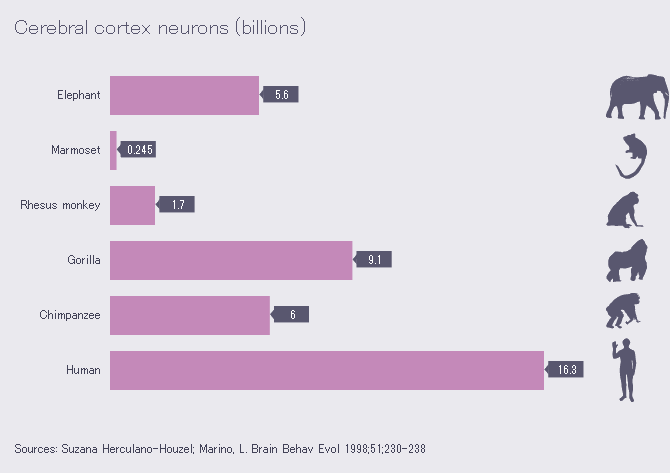
I don’t per se agree, but I suspect if I resurveyed and asked “Would you let a human die painfully to save 3 elephants from painful death?” I’d get more variance in moral intuitions. The enormous amount of effort that humans expend protecting and preserving these high-cerebrum-capacity animals suggests that it’s at least a common intuition that these animals have moral value.
Shrimp… do not have cerebrums. They don’t really have “brains” at all. They have a distributed nervous system, about a third of which is for processing eyesight, a third for antennae, and a third for digestion. They can store some memories linking these things, but there is absolutely no reason to suspect that they have anything remotely similar to cognition as we do, or even as an LLM does.
Now, on the other hand, octopi have about 0.5 billion neurons, evidence of very complex social behavior including communication with semantic content, tool use, long memories… so there seems like a decent argument for not torturing many species of octopi. Whales too.
But shrimp? They do. Not. Matter. Moral weight of zero. A mountain of 1 billion shrimp corpses should not move you. And before you say “but what if they go extinct?” for what it’s worth, Grok says the earth has 10 trillion shrimp in it. That seems nuts to me but maybe that’s right.


