


In December, my husband and I will welcome our first child – a baby girl. We are overjoyed! While our daughter is not here yet, I feel that I’ve learned so much from her about myself, my marriage, my faith, and motherhood but also my work. While I’ve been adamant that having children shouldn’t be a precursor to having a space at the table when it comes to discussing fertility, even just being pregnant has taught me some important lessons about what I research.
Going into my pregnancy, I knew I would automatically be high risk. I have type 1 diabetes and a history of blood clots, both of which can be complicated by pregnancy. After my pregnancy confirmation appointment I was immediately referred to Maternal Fetal Medicine (MFM) where I have been closely followed with weekly glucose check ins and monthly growth scans as well as other specialty exams like a fetal echocardiogram to ensure everything is going well with the pregnancy.
Even though I entered my pregnancy knowing I would be categorized as high risk, I didn’t expect the mental and physical load of a high risk pregnancy to be so heavy. My husband and I always planned on having a large family and hoped to have our children close together, with an understanding that it might not be feasible depending on how easy it was to get pregnant and how easy pregnancy was on my body. After almost two full trimesters of pregnancy, I know that our original plan will not be feasible physically or mentally. To be a present mother for our daughter and to withstand another pregnancy, I know I will need two to three years in between our children. I wouldn’t be surprised if many women who have had a high-risk pregnancy feel the same as I do which led me to wonder how much does that add up to at scale.
Pregnant type 1 diabetics (as well as women with type 2 diabetes or gestational diabetes) have to keep a much tighter “range” of their blood sugars. While a healthy range outside of pregnancy is 70-180, during pregnancy it drops to 70-140 – giving less margin for error. While I’ve been able to keep my blood sugar in range the vast majority of the time and my A1C – a measurement of your blood sugar of the last two weeks – is lower than the threshold for prediabetes, this has not come without great effort. I’ve never felt more attached to my phone as I have during pregnancy. Checking my blood sugar is almost compulsive. I constantly make micro-adjustments to keep my blood sugar in range – giving 1 unit of insulin there and eating 5 Nerds Gummy Clusters there. As many women in the “Bumpers Who Bolus” Reddit have said, it feels like I have a completely different disease than the diabetes I was diagnosed with almost a decade ago. Diabetes also felt completely different in the first trimester than it does in the second, due to changes in how the body processes insulin as the placenta develops.
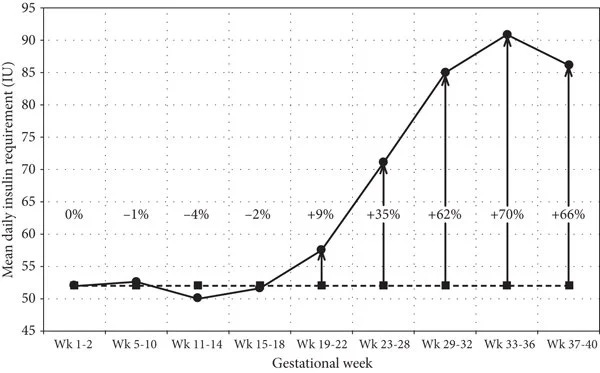
Strict diabetes management isn’t optional. Uncontrolled diabetes is associated with a higher risk of preeclampsia, pre-term delivery, miscarriage, congenital malformations, and macrosomia… just to name a few of the long list I was presented at my first appointment with my MFM.
The blood clot history adds another layer to my complex pregnancy. Because pregnancy itself is a risk factor for blood clots, I have to give myself twice daily injections of blood thinner that are quite painful. While I would definitely prefer the injections to having another blood clot, it is both mentally and physically difficult to take the blood thinners every day, twice a day for nine months. The blood thinner also caused my Non-Invasive Prenatal Test to be inconclusive twice (meaning we didn’t know the gender until 20 weeks and will not know if our daughter has any chromosomal abnormalities until birth) and caused severe anemia that required a round of iron infusions and continuous monitoring of my iron levels for the rest of my pregnancy.
I don’t say all of this in hopes of getting sympathy, it simply is what it is. But it has made me more empathetic to the women who decide after getting pregnant that they are never doing this again. I hope to have more than one child, even after my complex pregnancy, but I no longer intend to have my children close together. I also doubt that my care team would recommend it. Because of my age, I don’t expect to have issues with conceiving if we wait and for that I’m thankful.
Does being high risk contribute to the fertility gap?
When I think about delaying future pregnancies, I’m making an individual choice based on my specific set of circumstances. But zoom out, and my calculus is a small point in a bigger story about the falling birth rate.
Americans still say 2.7 children is the ideal family size, even though the birth rate is 1.6. Americans having fewer children than they say is optimal is not necessarily Americans deciding they want fewer children, but more people running into practical walls that keep them from having the amount of children they would otherwise choose. Childcare, housing, and finding a suitable partner are all key parts of this discussion, but I think considering the changing pregnancy experience should be an important part of the fertility gap discussion.
High risk pregnancies are indeed relatively rare – only about 6-8% of pregnancies are categorized as high risk – but this number is on the rise. Obesity among pregnant women climbed fast, from under 10% to over 15% of all pregnancies in six years. This coincided with a steady rise in pre-existing diabetes and chronic hypertension and more women having children at “advanced maternal age.” More women are simply arriving at pregnancy with conditions that didn’t used to be common at conception. It’s possible that the rise of GLP-1 drugs could bend this curve – especially as they become a more common treatment for metabolic conditions commonly associated with infertility and obesity like Polyendocrine Metabolic Ovarian Syndrome (commonly known as PCOS). Preexisting conditions aren’t the only cause of a high-risk pregnancy however. A recent U.S. study that decomposed the causes behind severe maternal morbidity found that hypertensive disorders of pregnancy – preeclampsia and gestational hypertension – are the single largest driver, accounting for nearly a third of the total rise between 2016 and 2022 – more than triple the share attributable to gestational diabetes.
The body of research on how a high risk pregnancy contributes to future fertility decisions is small, but what does exist points in the same direction. Women who develop early-onset preeclampsia are less likely to have a subsequent pregnancy, potentially due to fear that they will experience preeclampsia again, a fear compounded by the psychological toll – including documented PTSD – that severe preeclampsia can leave behind. Data from Israel also found that women who were less satisfied with their birth wanted to wait longer to have another child, although actual outcomes were not studied. The Israel study occurred within a culture that actively encourages large family sizes, meaning that actual effects may be tempered due to social pressures to have more children even if having more children seems less desirable after a high risk pregnancy. I could not find literature on how chronic conditions like mine affect future choices about fertility.
While the data is thin, when I pitched this idea to my MFM he affirmed that many of his patients have chosen to delay or forgo future pregnancies because of what their high-risk pregnancy was like. While this is of course anecdotal – one physician’s informal read of his patients over decades – it is still a pattern worth studying. With a rising number of pregnancies being categorized as high risk, this is an important question that should be explored.
Time Users
What I’m Reading: Whistler by Anne Patchett
Something I Found Interesting: Patrick Brown’s article on why reforming the Child Care and Development Block Grant to support stay-at-home parents is bad family policy
What I’m Listening To: I’m seeing Phoebe Bridgers in concert this week so I’ve been listening to her new album Lost Weekend on repeat. My favorites are Bobby, Haunted, and Liberty Tree
What I’m Making: One of the greatest joys of my pregnancy has been making things for our daughter’s nursery. I finished a name banner last week and I’m about to pivot towards making her a felt mobile. My list of crafts is long but my ambition is high.


This was a wonderful essay. Thanks! I hope you find ways to enjoy the ride even though it can be very stressful. Best wishes! 🙏
I also wanted to say that, to my knowledge, the rate of high risk pregnancy is much higher than 6-8%! I guess it depends what you're classifying as "high risk" and this is one of the most confusing things for both patients and healthcare providers alike.
There is no single, universally accepted figure, because "high-risk pregnancy" lacks a standardized definition and estimates vary widely with the criteria and population used.
When I look at my patients, if low risk means normal BMI, no history of C-section, no chronic conditions, no ultrasound abnormalities, no GDM or high blood pressure, no history of obstetric complications like stillbirth or preterm labor, no anemia, and no advanced maternal age..only about 10-20% are "low risk."
But obviously, there are differences between what you're describing with your own pregnancy where you clearly have two risk factors that make it very clear, and a lot of of my patients who may have one or two minor risk factors, but are essentially still normal. Sometimes I think in my field, we make the mistake of pathologizing these pregnancies, stressing the moms out, and intervening too much, and sometimes unnecessarily. Like you, I think these stressful experiences of pregnancy really influence whether or not moms want to do it all again.
I don’t know if there’s a good way to thread that needle. I can imagine that being seen by a high control, highly conservative medical team must weigh on you a lot. I had both my pregnancies in Germany and while they were both high risk (a placenta previa for the first, GD for the second) my doctors were reassuring, almost nonchalant. They were happy to have me choose a VBAC; they were happy to continue with TOLAC when I went over term, low on amniotic fluid and needed a low intervention induction. They were happy to let things run their course, with monitoring, for days… I could have had a great experience that way, but the outcome turned out to be an abrupt and definitive end of my fertility when I experienced a uterine rupture during that second birth. Thankfully we both survived, but that’s it for me pregnancy wise. I wonder, given a context of higher risk pregnancy, which medical attitude will actually lead to the lowest unrealized fertility gap.