

In light of Portland’s Royal Sonesta Hotel—bought in 2016 for $108.3M, and selling this week for a reported $6.83M, a 93% drop —I am re-upping my monograph “The Gloss of Good Intentions: How Portland Blew a Chance to Become the Next Great American City.”
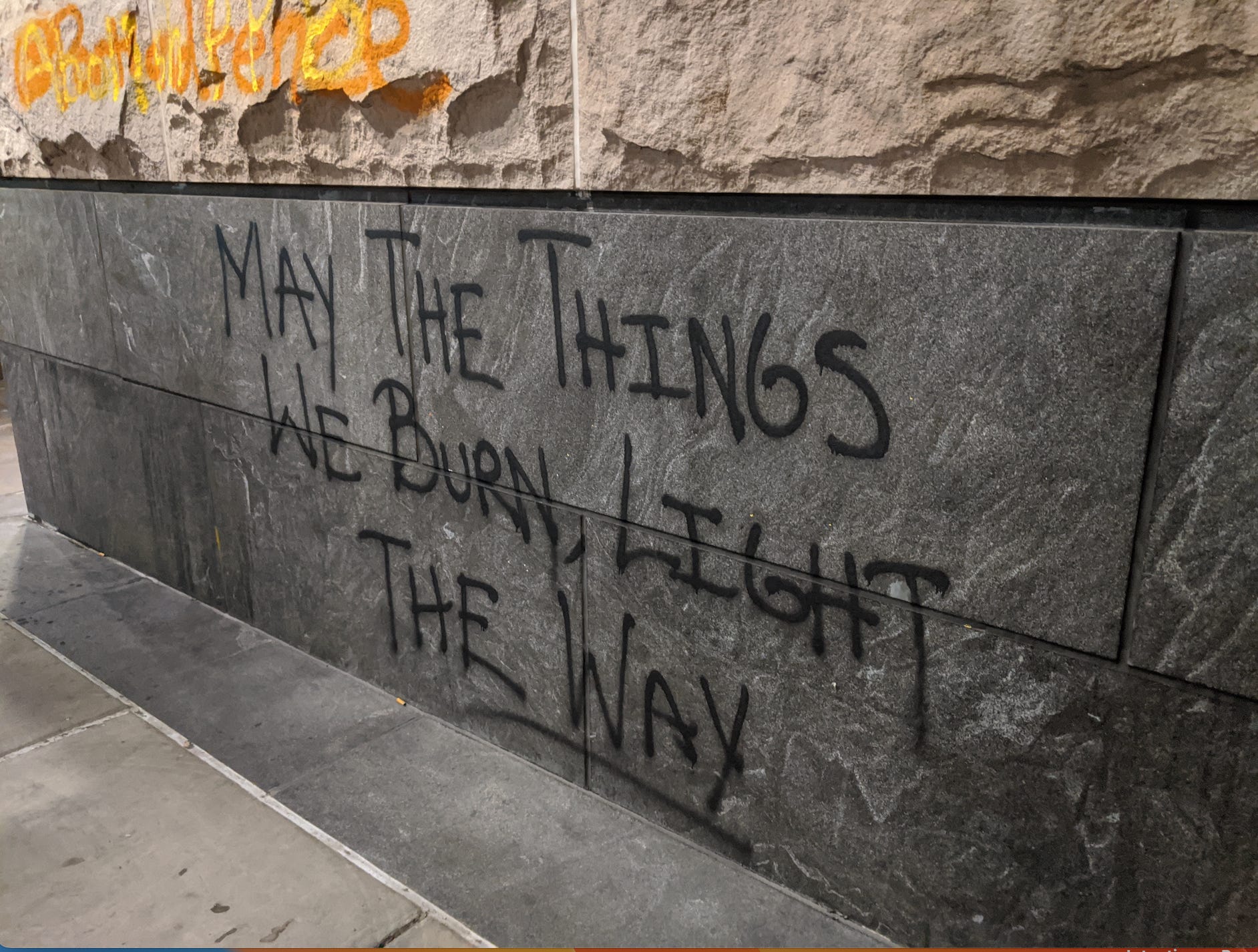
The news out of Portland 2023 is grim. The murder rate quadrupled in five years. Drug overdoses doubled between 2019 and 2022, with the state ranking second in the nation in opioid addiction and last in drug treatment. Robberies were up 50% in 2022 alone, and after having guns pulled on its baristas multiple times, a downtown coffee roastery closed in April, telling the public, “We cannot continue operation here as we cannot ensure the safety of our team and customers.”
I’d driven past the shop six months earlier and seen a couple at an outdoor table trying to politely cohabit with a ranting woman two tables over, a woman who had what might have been her worldly possessions spilling from garbage bags around her feet. There are more than 700 homeless encampments in Portland these days, and what I recently took to be civic landscaping, large boulders placed under freeway overpasses and along curbs, turned out to be bulwarks against people setting up tents. As a friend said, “Now they just poop on your lawn instead.”
Nothing comes out of the blue, and even before George Floyd was killed, Portland had looked at its own and the nation’s identitarian failings and decided the bill had come due. Recognizable targets were easiest. The city vilified the police, defunded the police, was okay with Portland’s underemployed young men carving KILL ALL PIGS into the city’s steel bridges. The idea was that this would set Portland on a right and better footing. It did not work this way. With fewer cops than when the city had been half its size, citizens became anxious. “They should have been there,” the antifa kid told me in August 2020, after a supposed-BLM supporter pulled a motorist from his truck and kicked him in the head. When I suggested the cops were too busy chasing antifa around every night, the kid grew quiet. “They still should have been there,” he said.
He sensed something was dangerously out of whack, if not the fix. But what of city hall, and a bulk of citizens, and a gullible and perhaps mendacious press? Why were they intent on letting Portland burn? Did they see framing disorder and destruction as necessary steps in building the new American city, a place that would work hard, visibly hard, to shuck off the sins of the past? Portland’s star had risen high in the new century and people meant to push it higher, to prove they cared, caring that included policies that decimalized drugs and street camping and petty theft and, as the string would play out, every form of violence, including attempted murder.
Portland’s misfirings were not unique. Chicago and Philadelphia, San Francisco and New York enacted similar policies with similarly bad results. But those cities had large and differentiated populations; no one group could snatch power and bring the whole thing down. Portland, with 635,000 residents, proved swayable and overenthusiastic, and when the opportunity presented itself, with the Big Bang of dysfunction that was summer 2020, the city went supernova.
Portland had not been No. 1 in anything since the Trail Blazers won the NBA championship in 1977, and here it was on TV every night. There was excitement in this, there was identity, and with not much squinting, activists and those who supported them saw valor in trashing the courthouse; in erecting a guillotine on the roof of the police union; in breaking windows for more than 200 nights in a row. “Peace through violence,” the activists said, more than once, a maxim that struck me as not much different than handing someone a turd and calling it a sausage.
If much of Portland in 2023 is as pretty as ever, it is nevertheless foundering. Upwards of 20,000 people have left since 2021, and more than 25% of downtown real estate remains vacant. I cannot overstate how drastic a change this is, and how fast. As recently as three years ago, Portland was set to emerge as America’s next great city, heralded, and properly so, as quirky and beautiful and authentically itself. That future was sacrificed on the altar of good intentions, and instead of rising higher, Portland finds itself digging out from recrimination and ash.
You may have questions, for instance, why did citizens not react in real time to the death spiral? Did they not perceive it? Were they too captivated by the idea of their own compassion? And what of a media that chose to elevate activists and fetishize violence? Whom did they think it helped to paint a rosy picture where things were critically falling apart? And was anyone charting Portland’s rise and fall, including the deadly downstream effects that would prove nearly impossible for the city to reverse?
Yes.
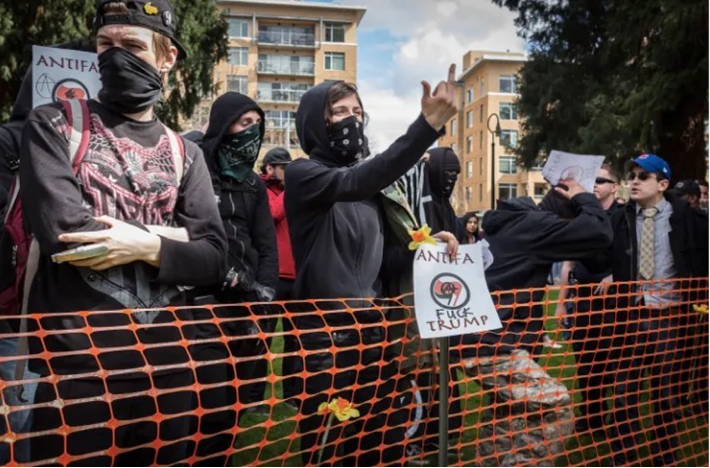
On July 18, 2020, Jake Siegel of Tablet and Matt Welch, editor-at-large at Reason, and I were having drinks in Matt’s front yard in Brooklyn.
“Nancy,” Jake said, in his signature gravelly voice. “What the fuck is going on in Portland?”
He meant the protests, where citizens had been facing off with police for 52 nights running and, since the July Fourth weekend, with troops Trump had sent to the city to protect federal property. The images we were seeing were of chaos, thousands of people chanting “GEORGE FLOYD!” and “ALL COPS ARE BASTARDS!” as they moved on the police station and the federal courthouse, as they tore down the protective fencing and lobbed IEDs. Federal forces returned fire, rubber bullets and pepper balls and volley after volley of tear gas, making the crowds fall back, making people grab their eyes and drop to the ground. It was alarming and riveting and news media could not get enough, the majority of outlets presenting the feds as the aggressors - which, given their firepower, made good optic sense - the protesters as heroic.
I knew the second part of this narrative was at least partly bullshit. I’d lived in Portland when people in black hoodies smashed the windshields of cars in response to Trump being elected; when they camped in front of immigration headquarters holding signs that read, “NAZIS INSIDE”; when they drove a bakery out of business because it had the word “Colonial” in its name. Which made me think that the killing of George Floyd, as explosive as it was, was not so much a cause as a catalyst, a sanctified space to express years of frustration and anger, and if any demographic were primed for just such a moment, it was Portland.
What I couldn’t understand, based on the reporting we were seeing, was why the media seemed so in the bag for the protesters. Yes, battlelines had been drawn since 2016, with news outlets reacting to any and every Trump provocation, ensuring people stayed on edge and at each other’s throats. Still, wouldn’t it have been more ethical, to say nothing of more interesting, to show the multiplicity of the story? What about the downtown restaurants whose windows were being broken every night, and the recruits barricaded inside the courthouse, and the crews cleaning up in the mornings, and what appeared to be Occupy Wall Street 2.0 across the street? Weren’t they part of the story?
Matt looked at me. “You have to go,” he said.
The next morning I texted Reason editor-in-chief Katherine Mangu-Ward and told her I wanted to go to Portland for the magazine. Go, she said. I was on a plane by noon.
Four days later, I filed my first story.
Fifteen more would follow for Reason, fifty for other publications and websites, including The New York Times, Washington Examiner, the Dispatch and Persuasion. Everyone was hungry for news from Portland. Why was there so much violence? Who was committing it? Why did authorities not stop it? FOX wanted me to talk about how despicable the protesters were. A Chicago station gave me a weekly spot, hoping I might cast a sympathetic eye on why Portlanders were trashing their own city. I got into a Twitter spat with MSNBC’s Ari Velshi over whether the building on fire behind him was, in fact, a fire. (It was a fire.) I was asked to speak to a high school class about what constituted peaceful protest and what, a riot. Members of antifa labeled me a fascist and passed around my photo so they could try to stop me from reporting. (Good luck with that.) An editor at Portland’s NPR affiliate told Mangu-Ward my work put his reporter in danger and would she take the reporter’s name out of the story? (That would be no.) Podcasters, including Bret Weinstein, Jonah Goldberg, Jon Podhoretz and the guys at The Fifth Column had me on multiple times to talk about Portland, to parse the “Savages coming to your town!” and “Protesters clubbed by Trump goons!” messaging on their newsfeeds. And I don’t know how many talk-radio hosts tried to get me to agree that the residents of the Rose City were the kind of people taking America straight to hell.
Everyone thought I was on their side, but I wasn’t. I wasn’t on anyone’s side, or if I was, I was on the side of Portland, a city that, when I moved there in 2004, was in the process of remaking itself, no more hippies (or not many) or Rajneeshees in sunset hues, Portland was a place for makers and builders, in a breadbasket of a region where you could grow anything. While places like Las Vegas and San Diego were seeing their local economies run off the rails, Portland appeared to be hitting its stride, attracting, according to the Wall Street Journal, “college-educated, single people between the ages of 25 and 39 at a higher rate than most cities in the country.” Portland was legitimately on the up, whispering, as it would for the next decade, that you could do things your way here, you could achieve your achievable dreams.
My husband and I did just that for 15 years, and then I left, writing a piece in 2019 that ran in Tablet under the title, “Portlandization: It Could Happen to a Place Near You” but which I always think of as, “Good Luck, Portland”:
Young people, bless them, have a way of circumventing even the best of times and, like the milk from the goat they kept in their backyard, things turned pretty sour pretty quick. Those who’d come to Portland expecting a plug-and-play lifestyle of cheap rent and a part-time barista gig while playing in a band found the model did not work, though whose fault this was remained unclear...
By 2020, it was no longer unclear to the young people of Portland whose fault it was, it was the fault of the police, of Mayor Ted Wheeler, of the landlords and the bosses and above all of President Trump. And on top of these COVID, when the jobs disappeared, and the schools were closed, and you couldn’t leave the house to drink or shop or work or fuck. And then George Floyd was killed. Here now was opportunity to strike out, to burn off hostilities, to make one’s political beliefs, however nascent, matter and known.
It is unknown whether July 22, 2020, was the night federal forces – also known as “Trump’s goons” and “the Gestapo” – shot the most military-grade CS gas at protestors launching objects at the Mark O. Hatfield Federal Courthouse in Portland, Oregon. Tear gas is a hard thing to quantify, plus protestors were shooting off fireworks as well as setting fires, including tipping a barbecue over the temporary fencing the feds had set up around the courthouse, now undergoing its 56th night of frontal assaults. But let’s say there was a lot of gas, each volley sending protesters back from the courthouse and into unlit Landsdowne Park, past the rib tent that had been feeding people for free since June, past the homeless and the stoners and the black bloc boys revving gas-dispersing leaf-blowers and the girls with MEDIC written somewhere on their person and, on this night, a guy on his knees vomiting onto the asphalt. Tear gas can do this; it can also, despite your intention to stay until the end of the night’s confrontation, have your body start walking itself back to the car, your cloth mask, after five rounds of gas, useful mostly as a repository for tears and snot and also as evidence that the young people you’ve seen swaddled in enough headgear to look as though they might be going scuba diving, seem to know something you do not. - “Dispatch from Portland: Welcome to the Teen Palace”
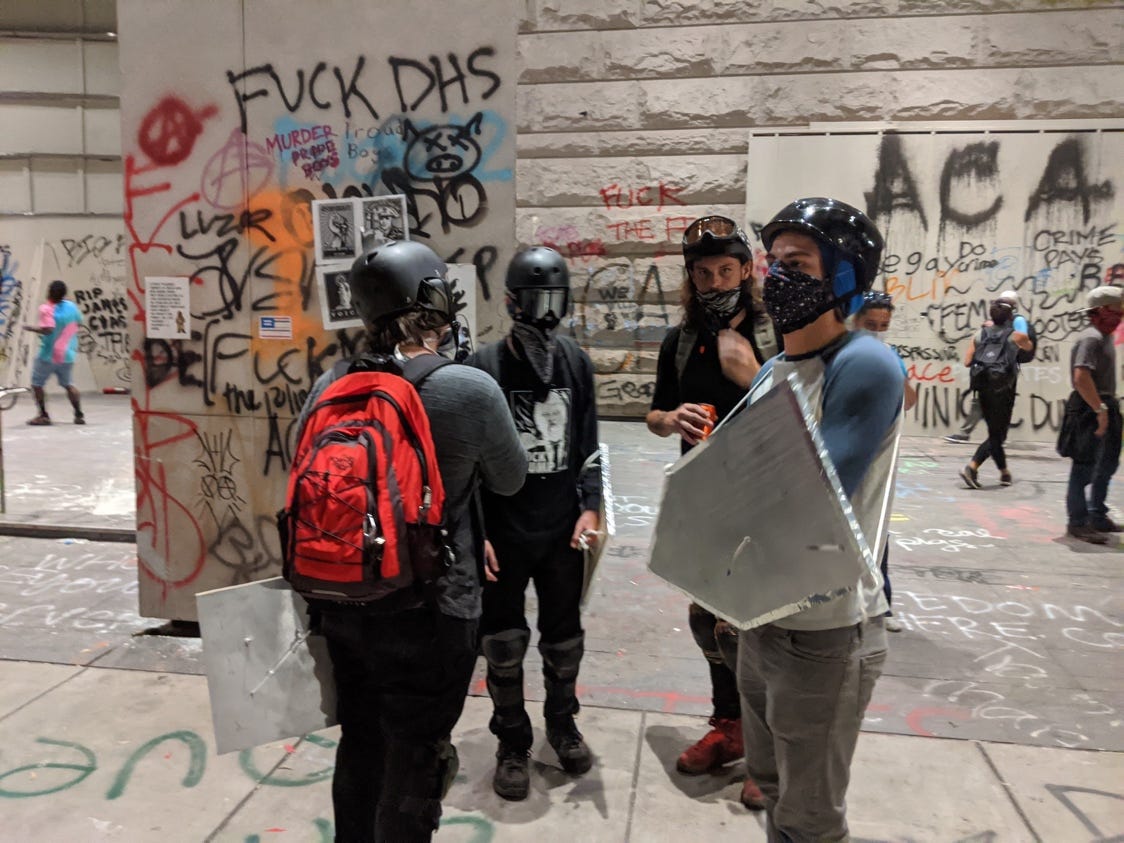
Twenty years earlier, there had been different clashes in Portland, the old and new colliding to create a place perfectly pitched between cosmopolitan and scrappy, having more strip clubs than any U.S. city while experiencing what The New York Times called, “A Golden Age of Dining and Drinking.” There was good friction, much of it generated by young, many-from-California transplants ready to get arm deep in the region’s raw materials, to make vodka and bacon and bee balm and axes. I joked then they’d make their own water if they could. By 2008 the city was blinking awake, so many new things to see and do, things that did not make everyone happy. In response to a piece I wrote called, “There Goes the Neighborhood: Race, Real Estate and Gentrification on My Block,” one reader suggested the way to keep home prices within reach was to take transplants like me to a local park and hang them.
This was around the time you saw “Keep Portland Weird!” stickers everywhere. A bit late, as many of the city’s newcomers were now of similar stripe: educated, progressive, militantly pro-community. Young women began knitting in groups in public and young men started growing beards, the sort of fundamentalism-meets-slacker spoofed on the TV show Portlandia, which began its run in 2011. That was the year I heard my first heckler’s veto, during a literary event that several attendees proclaimed was racist after the speaker, an elderly seamstress, suggested not many people look good in yellow. “What about black people?” one girl asked, very gotcha, very snide. No one at the event was black - not unusual; Portland was 6% black at the time - and I was not sure why the girl would use skin color to attack someone she had never met. It was a cruelty out of proportion and I wondered who the comment was for, and also, whether she was part of a larger coming wave. My husband at the time had young employees who told me of their insecurities; how concerns about the future made it hard to commit to a career, to a partner, to pay off their parking tickets. They’d come to Portland believing they could make it on part-time work and passion projects. Where was the idealized lifestyle? Why did an MBA need to take a telemarketing job in an office park to make ends meet? What kind of land of milk and honey?
By 2016, Portland’s youth brigade had grown more than restive. They believed in the promise of Portland but felt they hadn’t partaken. When was it going to be their time? What with rising rents and a suspicion they were under-appreciated and now the specter of Donald Trump as president. I remembered when a group of my husband’s employees gathered in our kitchen to watch a debate between Hillary Clinton and Trump, the one where he followed her around the stage like a shark, and how appalled they were, and how they claimed to be frightened.
Being frightened together, when there is little threat, is a something humans are attracted to. Think: scary movies and ghost stories. Fear can also be stoked; you can blow on its embers; you can mesmerize people ready to be mesmerized.
After Trump won the election, the newly frightened claimed to see danger around every corner. Soon, most businesses had a sign in its window proclaiming, “WE WELCOME ALL … WE WELCOME YOU, YOU ARE SAFE HERE.” That “ALL” in the sign had its limits, and more than one employee would call the boss to ask if they were obligated to serve a customer wearing a MAGA cap, or three young men who, based on their flannel shirts and pick-up truck, could have been white supremacists. And did the bosses have a problem with being thus queried? Did they want their employees to feel unsafe? Did they want to risk a social media campaign to embargo their business, maybe break their windows, maybe show up with a camera-phone and accuse them of being racists or Zionists or transphobes? All of these things happened by the time I moved back to New York City in 2019, where I sensed such campaigns would not have gotten much traction, there were too many groups worrying about problems in fact rather than conjuring ones that the young people of Portland were discovering were also a means to power.
Where their recent predecessors had built the city with their hands and their dreams, the newly empowered began to unbuild it. In place of creation, they brought threats and intimidation. They brought down restaurants on the claims of cultural food appropriation. They created Google docs where they anonymously called-out coworkers. They sent death threats to professors, and spent weeks vandalizing the home of a politician whose voting record they did not like. They appeared energized by the public destruction of people and institutions, in other words, by the time George Floyd was killed, they had a running start, if not a destination.
The scene at the courthouse on night 57—people heading up to the fence, the feds telling them to disperse, people yelling back, “GO FUCK YOURSELVES!” and throwing flaming trash at the building, initiating another volley of tear gas—happens three more times. More and more people fall back, kids carrying Go-Pros and hockey sticks melting into the night. Musicians play “The Imperial March” from Star Wars and I head to the frontline one more time. Cattycorner from the federal building is a man I noticed earlier. In dad jeans and ball cap, he stands out.
“Can you tell me what’s going on?” he asks.
I can try, and run through the coordinates that got Portland here, that got federal troops here.
“Right,” he says, and keeps staring at the building. He tells me he drove 50 miles to be here.
“I’m a farmer, semi-retired,” he says. “I used to live and work in Portland, I raised my kids here, and I came here tonight to bear witness to what these kids are going through, what maybe my grandkids will go through. I’m really trying to understand what each side wants.”
He says this with an honest sense of wonder, some sadness, watching these young people rush back and forth, back and forth, falling, rising, where does it lead? - “Dispatch from Portland: The Fire Next Time” (Reason)
If I could chart how the young people of Portland found themselves on the offensive in the summer of 2020, I had a harder time making sense of the credulity of politicians, the public and the press. I would live-stream activists bashing in the face of the federal building with a fire extinguisher and be told, variously, that they were defending themselves, that the police did worse, and that I’d staged the attack in a studio. Most media seemed of the opinion that to distinguish protester from rioter risked shining a bad light on the entire protest movement, and they were unwilling or institutionally discouraged from reporting from more than one vantage point. Every protest included bullhorn reminders to not take pictures where people could be identified, to capture and stream images of protesters on defense-only. I did not respect these parameters; I reported what people told me and what I saw, which usually included activists on offense. Publications, especially those in Portland, called me out. They put my photo online. “We know who you are,” I was told, by men in facemasks; men who followed me through crowds and tried to take pictures of my notes. When I filmed things that countered the activists/heroes, police/evil narrative, they covered my camera, shouted “PHOTOGRAPHY EQUALS DEATH!” and, one time, stole my phone.
Still, with the exception of a blubbery young man who yelled “I’ll shave your shit right off your fucking head” and an hour later swung a metal rod at me, most protesters were ill-equipped for confrontation, college-age girls fumbling to master umbrellas as shields, boys hiding behind trees with canisters of bear spray. For many of them, marauding with their friends, bashing in the windows of the Apple store while filming it with their iPhones, and screaming “BLACK LIVES MATTER!” 500 times a night was less about building a better world than being at the only party in town, come on down, bring weed, bring bottled water, arrive pre-dawn and make breakfast, come back at midnight and shoot fireworks at the feds. The mania matched the moment, the nightly spurt of release felt great, and consequences were for other people.
Locals who could not themselves get to the protests nevertheless leaned in, donating food for the activists, donating vehicles, offering legal services pro bono. Someone created a Vegas-style laser light show that included piggy-cop faces strobed onto the federal courthouse. The city’s major alt weekly can a cover profile an antifa girl that included a glamour portrait, and the mayor reminded police not to arrest activists in the act of protesting. Other cities would encourage calm, would detain rioters, would try to make it through the pandemic with as little scarification as possible. Not Portland. Portland would fight what felt like the good fight, would be, or try to be, the superstar of social change. And while the violence roiling the city had its downsides - locals stopped going downtown, accelerating the moribundity inflicted by the pandemic - it also acted as a pressure release after four years of Trump, look at Portland go, maybe it could be the giant slayer, the little comer that helped get that criminal out of the White House. It was invigorating to see the battle as the natural next step in Portland’s ascension, and the destruction was framed first as freedom fighting, then as free speech, then as a measure needed to rebalance the scales of justice.
An officer sits alone inside the lobby of the back entrance to Justice Center. Beside him is an industrial fan. When I ask why, he explains that the night before, a group of protesters sloshed in a giant bucket of diarrhea...
A tall slender white couple walk past, outfitted in head-to-toe black. The boy carries a steel baton and wants me to know it. The uniform conceals their identities but cannot hide a sense of entitlement that allows them a cheap laugh at the cop. And what I want to know is, do they think throwing human shit as a tactic is an okay thing?
“Do you believe that property is worth more than human lives?” asks the boy.
“Do you believe the police should be allowed to murder people?” asks the girl.
I do not mention that, at this point in the year, there has been only one deadly police shooting in Portland. I do not mention it because, after 15 years of living here, I know the city’s fledgling anarchists do not deal in facts, that they instead keep a set of platitudes up those black sleeves.
“We’ve tried for 20 years to do it another way. It hasn’t worked. Nothing changes except with violence,” says the boy, who is maybe 22. Then he flips me the bird. - “The Dream of the ‘90s Died in Portland” (Reason)
As the months wore on, Portland’s protesters reminded me of nothing so much as overexercised children no one had bothered to check on... The Portland city council did not check on them when it voted unanimously to cease cooperation between local law enforcement and federal agents. District Attorney Mike Schmidt, elected just after the uprisings began, did not check on them when he declined to prosecute 92% of those arrested during the protests, stating that his office understood “the depth of emotion that motivates these demonstrations.” Governor Kate Brown insisted Portland’s activists only and ever reacted to the provocations of right-wing groups like the Proud Boys and Patriot Prayer, groups which, by my understanding, rolled through Portland three times in 2020. Brown’s messaging, intentionally or not, aroused and validated people’s suspicions and fears. It ratified what local activist Lilith Sinclair had earlier told a crowd in front of the federal courthouse, that she was “organizing for the abolition not just of the militarized police state but also the United States as we know it.” That this statement would receive applause showed WE WELCOME ALL had a set of back teeth; that maybe it was okay to cut some people out, that a certain ruthlessness was necessary.
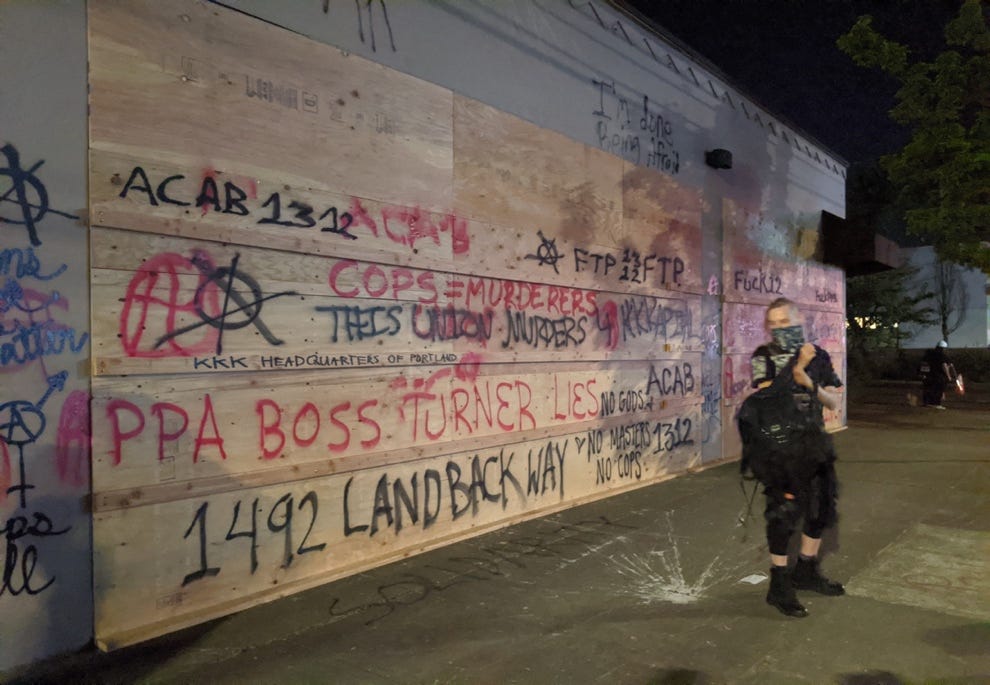
Was it all Portland’s fault that the appetite for justice, such as it was, was sharp? CNN, Fox, The New York Times reported from their respective perches that the situation was dire, there were enemies in our midst, and the 2020 elections the most important of our lifetimes. Portland’s young activists took these warnings and ran with them; there was energy in courting a sense of danger, of keeping the feeling going, of appearing important just for showing up and breaking stuff. And when the breaking got boring (which it did; by September people were referring to the protests as “Groundhog’s Night”), the muscle memory was there to go after people in the community, to bring down the city’s biggest restauranteur over a Facebook post, for good measure while he was undergoing brain cancer. Store owners, terrified of their employees and of public opinion, did what they thought they needed to do to keep the doors open…