
In an otherwise nice article, Dave Deek said a silly thing:
And before people go conservative policy on me, Aria Schrecker pointed out, liberal countries have more children than conservative ones. So things are not as clear cut as people pretend.
The evidence mustered is about social values, especially social values around childcare.
But Dave Deek isn’t talking about social values! He says:
[Don’t conservatives have more kids?] At the individual level, yes. At the system level, the opposite is true.
Individual conservatives have more children than individual liberals. But countries with conservative policy regimes have lower fertility than liberal ones. The Nordics and France outperform Southern Europe. Catholic Italy and Spain have Europe’s lowest fertility despite cultural emphasis on family. So we have a situation where social conservatives thrive and live their best lives under generous welfare states.
I’m gonna rebut this in two parts. First, by extreme statements without evidence that are true and you must simply accept them in order to think clearly about the world. Second, by some actual evidence which will definitely convince you because Dave Deek’s point is just clearly and obviously wrong.
lol @ Esping-Andersen Typologies
I will not explain this much, but you should accept it, as from God himself: Esping-Anderson typologies are fake and dumb. I have said it. My view is the view shared by almost everybody who has ever tried to work out an actual empirical, quantitatively-informed typology of regional government systems. Unfortunately Esping-Andersen classifications are so widespread that reviewers often force authors to use them; you can’t disregard a paper or penalize it for using Esping-Andersen because it might be the reviewers who are crazy people, not the authors. The Esping-Andersen system is so crazy it infects public discourse when people don’t even realize it. Like when Dave says that “Italy and Spain” have conservative policy regimes, what on earth do we mean by that? Italy spends 28% of GDP on social welfare! That’s more than ANY of the Nordics except Finland! Spain is a top-15 spender! What are we even doing here!?
Don’t do drugs. Don’t use Esping-Andersen classifications.
Government Partisanship Is Unrelated To Fertility
We have good data for industrial countries on completed fertility and on government partisanship. We can just say “X country has been governed by right-wing parties 84% of the time, but Y country just 33% of the time.” It’s not rocket science! It’s just social science!
So what we can do is ask, “If a given cohort of women spent more years of their life governed by more right-wing or left-wing governments, what is the effect on their completed fertility?” This is an actual quantitative measure of exposure to rightist/centrist/leftist governments, and a high-credibility measure of fertility.
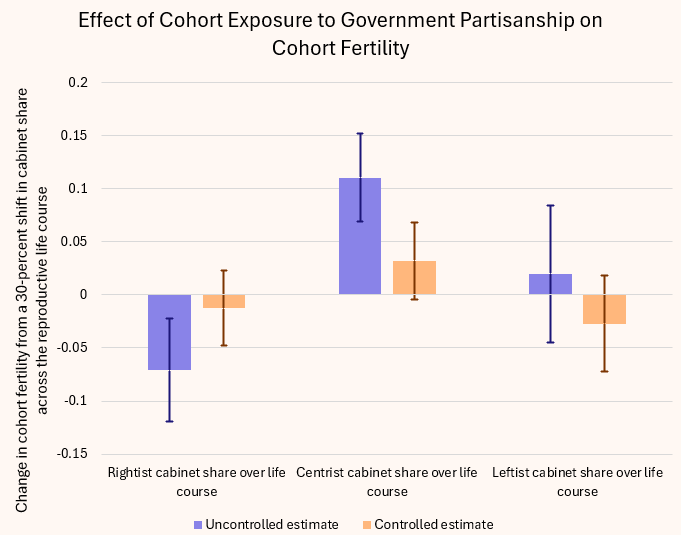
Without time- and countryXtime controls, right-wing is negative, centrist is positive, leftist is ~neutral and insignificant.
But you should use time controls! Sometimes everybody’s fertility goes down for time-related reasons, or a country has a long-run time trend of fertility for idiosyncratic reasons unrelated to partisanship!
As the controlled estimates make clear… partisanship doesn’t matter, and if you wanted to ignore standard errors and say wild, crazy things, you’d say centrist government is best, leftist government is worst, rightist government is meh-to-slightly-bad.
If you want to prove that rightist government reduces fertility, you’ll need to actually collect data on rightist government and fertility. Maybe the right-left classifications used here are not great; okay, propose better ones. Maybe we should use some kind of creative set of lags instead of cumulative partisan exposure in the life course; sure, fine, do that and then make your argument.
But notice that a 30-percentage-point swing in the cabinet share held by an ideology… explains maybe 0.1-0.35 more kids? And let me tell you, a 30-percentage point difference is not typical across the life course! The biggest swing in the dataset is in Finland, here it is. It’s a 28-point swing from max to min:
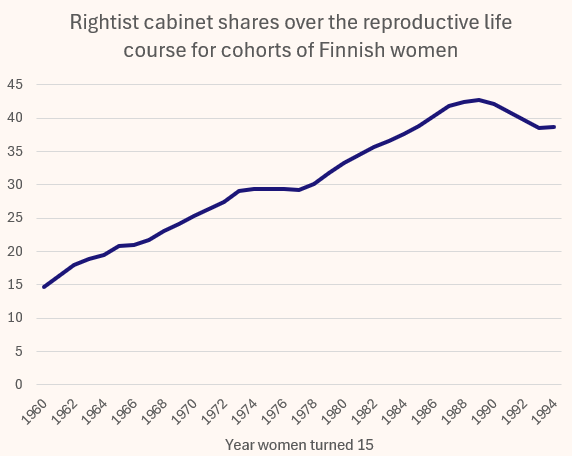
So in practice, lifetime exposure to different partisanship of government just explains very little in differences in cohort fertility.
Unless and until somebody shows data to the contrary, this talking point should be considered DEBUNKED. Sorry Darby Saxbe .


My problem with these studies, whether liberal or conservative, is that people rarely rigorously define their terms. So if I try to point out how an ideology governs does not in fact increase fertility, we end up in no true scotsman territory.
If for example, a right wing government meant integralist catholics who enforced natural family planning where abortion and birth control are categorically banned, I could definitely see how that would mechanically increase the birth rate. But is that what people mean by right wing governments increasing fertility? I am skeptical but then what do people mean?
Not trying to pick on conservatives specifically. Liberals are equally feckless on fertility for their own ideological reasons.
Tasmania has been ruled by the Liberals (despite the name, they're conservatives and are becoming more conservative in the last few years) since 2014, and Tasmanian fertility rate has been collapsing since 2014. In 2014, Tasmania had the second highest TFR in Australia, now it's the second lowest.
So yes, in Australia conservative governance is bad for fertility. At least, conservative governance in Australia does not improve fertility rate in any nontrivial way.