

Hi, this is Lars Doucet, author of the book review of Henry George’s Progress and Poverty that won the first ACX book review contest, as well as the three-part follow-up guest post series, “Does Georgism Work?” A lot has happened since then, including land value tax (LVT) enablement laws passing this year in two U.S. states and the election of LVT-friendly national leaders in the UK and South Korea. As for me, I now work full-time for the Center for Land Economics and write for Progress & Poverty substack.
I’d like to reflect on what I wrote five years ago: what I was right about, what I’ve changed my mind on, and what the outlook for LVT is in 2026. But first, here’s a brief summary for those who either have no idea what I’m talking about or just need a refresher.
I. Progress and Poverty
In 2021, I wrote a book review for ACX on the book Progress and Poverty, the magnum opus of the famed 19th-century economist and populist firebrand Henry George:
If I had to summarize the book in a single sentence I would put it this way: poverty and wealth disparity appear to be perversely linked with progress, The Rent is Too Damn High, and it’s all because of land.
George argues that poverty paradoxically advances alongside progress because, as material conditions improve, landowners can charge more rent for locational benefits they didn’t create. People who earn more than the local average salary (e.g., software engineers) can stay ahead of this trend, whereas those who don’t (teachers and service workers) are priced out of the homes they rent. Eventually, even upper-middle-class families can struggle to afford services like daycare, because daycare businesses must charge more to pay business rent and employee wages. Landlords, rather than daycare owners or workers, collect most of the service price increase parents pay.
Henry George’s remedy is the land value tax, or LVT. In its ideal form, this tax would capture and redistribute the annual rental value of land; that is, the recurring value of the land excluding the value of any buildings or other improvements on top of it. In practice, this looks a lot like a conventional property tax paired with a “universal building exemption.” Notably, George isn’t simply in favor of a land value tax; he’s also opposed to taxes on both labor and capital.
George further proposed the single tax—a policy in which land is taxed at its full annual rental value, and LVT is the only tax.1 Although the feasibility of the “single tax” remains controversial among economists, land value tax itself is surprisingly well accepted by economists left, right, and center as the ideal tax policy, with mainstream criticism mostly centered on practical and political concerns.
After the book review contest results were announced, ACX readers inundated me with questions, which led to the three follow-up posts. After those ran, I reposted all four articles on the standalone site www.gameofrent.com, and later consolidated them into a book, Land is a Big Deal.
Here’s what’s happened since.
II. LVT Momentum is Growing
Five years ago, LVT was mostly a hypothetical idea people debated on blogs. Today, it has the most legislative momentum it’s seen in decades. Many states introduced bills this year, and Virginia and Kentucky passed land value tax enablement laws in April. These laws allow municipalities to opt into split-rate property taxes, which lower tax rates on buildings and raise them on land. My organization, the Center for Land Economics, maintains a public legislation tracker with an interactive map that makes it easy to keep tabs on these trends.
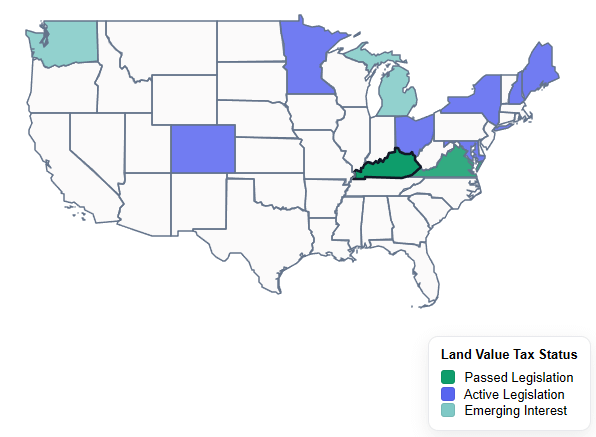
Virginia and Kentucky were the big winners for the 2026 legislative season, enabling various cities in those states to implement land value taxes. However, even bigger opportunities are coming. In Washington State, my organization is collaborating with the Sightline Institute on an upcoming LVT bill. Meanwhile, in New York, Governor Hochul extended authority for cities to utilize land value capture to fund new transit stops, a tool that can be used for the new Inter-Borough Expressway (IBX) subway expansion. We’re working with Niskanen Center, Center for Public Enterprise, and Institute for Progress to turn this idea into a real policy proposal.
Nor is interest in land value tax limited to the United States. The UK just elected a new prime minister, Andy Burnham, who has long openly advocated for a land value tax, and South Korea did the same last year with the election of new president Lee Jae Myung. Additionally, in January 2025, the German state of Baden-Württemberg implemented a new LVT that survived a subsequent court challenge. Although we’re tempering our expectations (the effective tax rate of the German LVT is quite low, and it remains to be seen how ambitious the Burnham and Lee administrations will be), it’s clear that LVT is no longer an obscure idea, nationally or internationally.
Finally, many now believe that the economic effects of AI developments may accelerate support for LVT and Georgism more generally. As newly minted AI millionaires bid up land prices in San Francisco and Seoul, Adam Ozimek argues that land will be a winner in the age of AI. Similarly, Aksel Sterri, co-founder of the Norwegian Effective Altruist think tank Langsikt, calls for an explicitly Georgist framework for understanding the AI era. (I’m also Norwegian; see my piece on Norway’s century-old Georgist tradition in natural resource management for more context on what Aksel’s talking about.)
So what have I learned?
III. My Theory of Change Was Wrong
I used to think LVT advocates had to change popular and elite consensus before moving on to the boring scut work of implementation. Now I realize that the boring scut work is actually what precedes, and even leads to, changing the consensus.
Overrated: winning online arguments
If you go back to the original series’ comments, you’ll see me trying to answer every concern that comes up, and falling for the bait when someone drags me into a tendentious comment thread dozens of replies deep. These would sometimes terminate in the interlocutor declaring that they’re the “exact kind of person Georgists need to convince!”
I’ve since learned that overly online keyboard warriors are the least important people to convince. The most important people are on your local city council or state legislature. Furthermore, instead of wasting time with hard cases or elected officials who are dead-set against your ideas, you’re much better off finding and working with people who are already interested in your principles. This often means giving up on your own city or state, at least for the time being, and pursuing a “succeed anywhere” strategy instead.
Changing policy where people want to change it is also how you overcome the “cold start problem,” when someone likes your idea but wants to see someone else do it first. Rather than trying to change that person’s risk aversion, find the person who is adventurous enough to try something new and work with them first. This builds case studies that you can use as social proof for the second, more cautious, wave of reforms.
I’ve also found that many online and academic objections are somewhat imaginary. When you talk to actual people in office, either their objections are entirely different from the ones you see in social media and comment threads, or they’re surprisingly open to being convinced if you listen patiently and present a clear argument backed by data and research.
Which brings me to…
Underrated: doing policymakers’ homework for them
No politician on earth has the time or inclination to independently learn about your philosophy, ingest all the arguments for it, evaluate a bunch of empirical and theoretical research, model its impacts on their locality, anticipate and respond to all possible objections, then wrap it all up into a tidy package complete with PowerPoint presentations, slick graphs, interactive websites, and a convenient, printable “one-pager” to hand out to interested parties.
You know who can do all those things? You.
For instance, some people get confused about land value tax, thinking it will wreck single-family homeowners, or that I’m out to get them personally, because obviously all the land value in town is concentrated directly underneath their specific home. This isn’t a disagreement about values or mechanics but rather a simple misunderstanding of what land value is and where it is most concentrated.
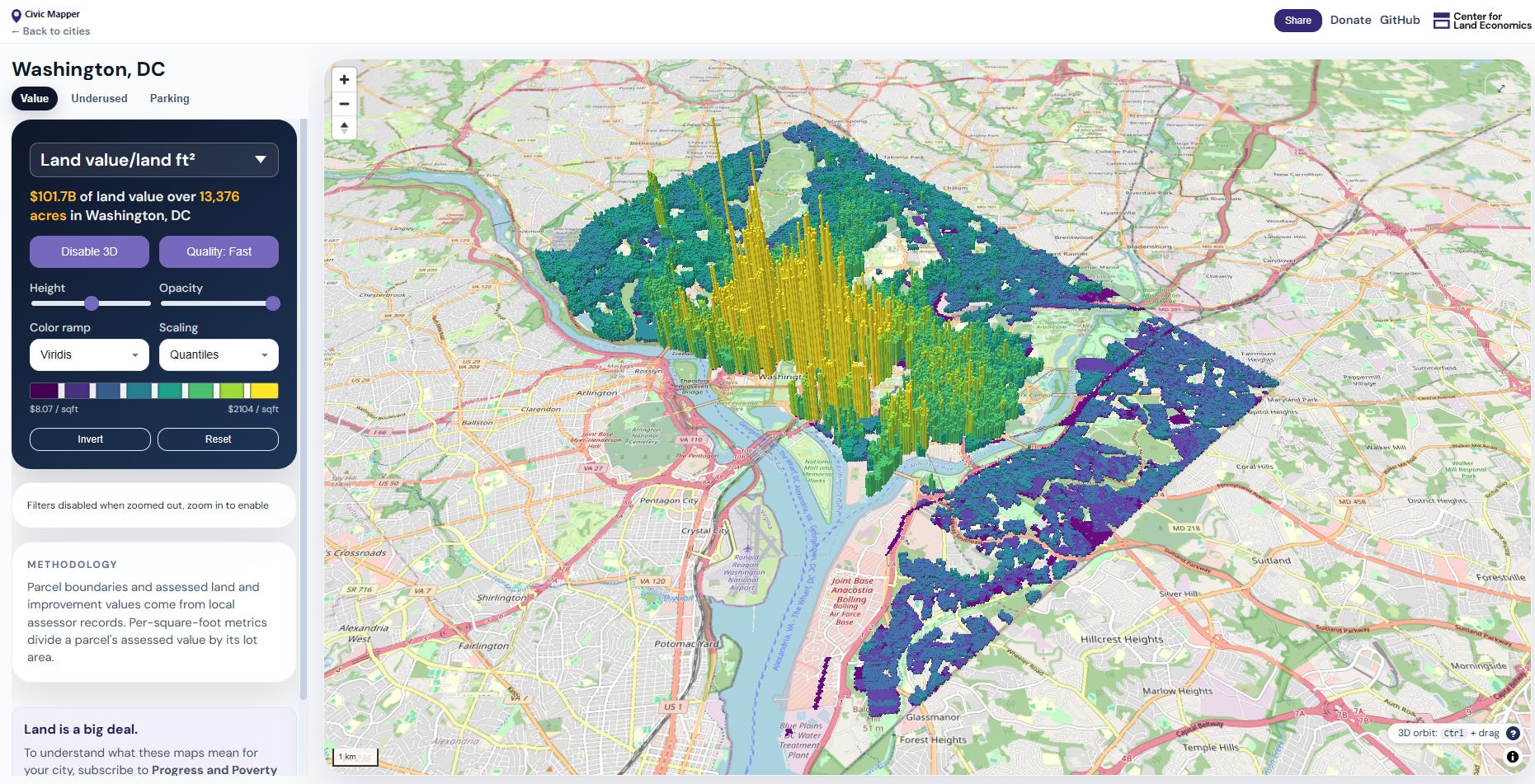
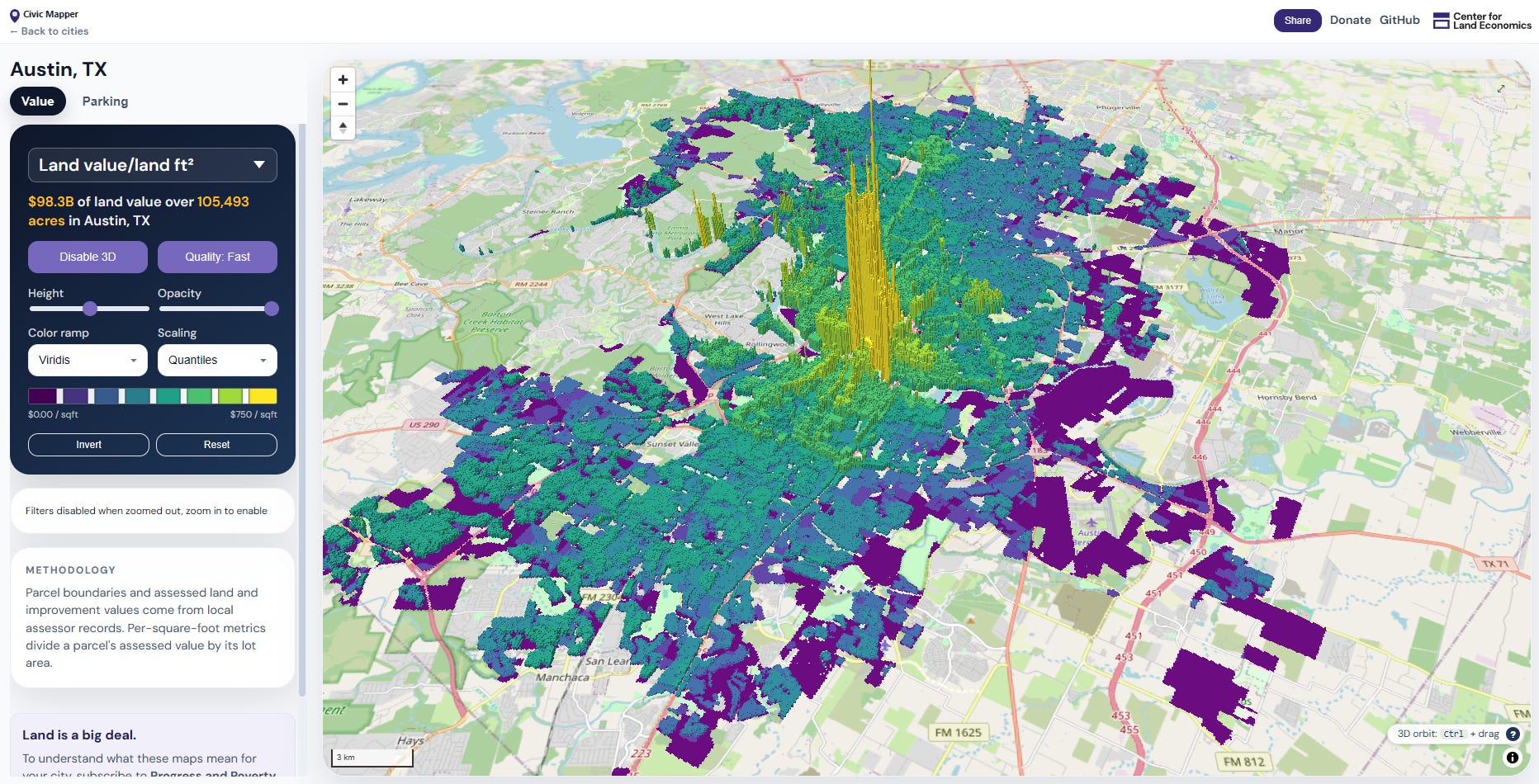
The first thing I do to disabuse people of this notion is to point out how much land value in any typical U.S. city is concentrated in downtown areas, and how much that value attenuates in the suburbs. We do this by loading up CivicMapper, our free, open-source 3D visualizer that takes local assessed land values and puts them on a map.
Here’s Washington, D.C.
Here’s Austin, Texas.
Here’s Seattle, Washington.
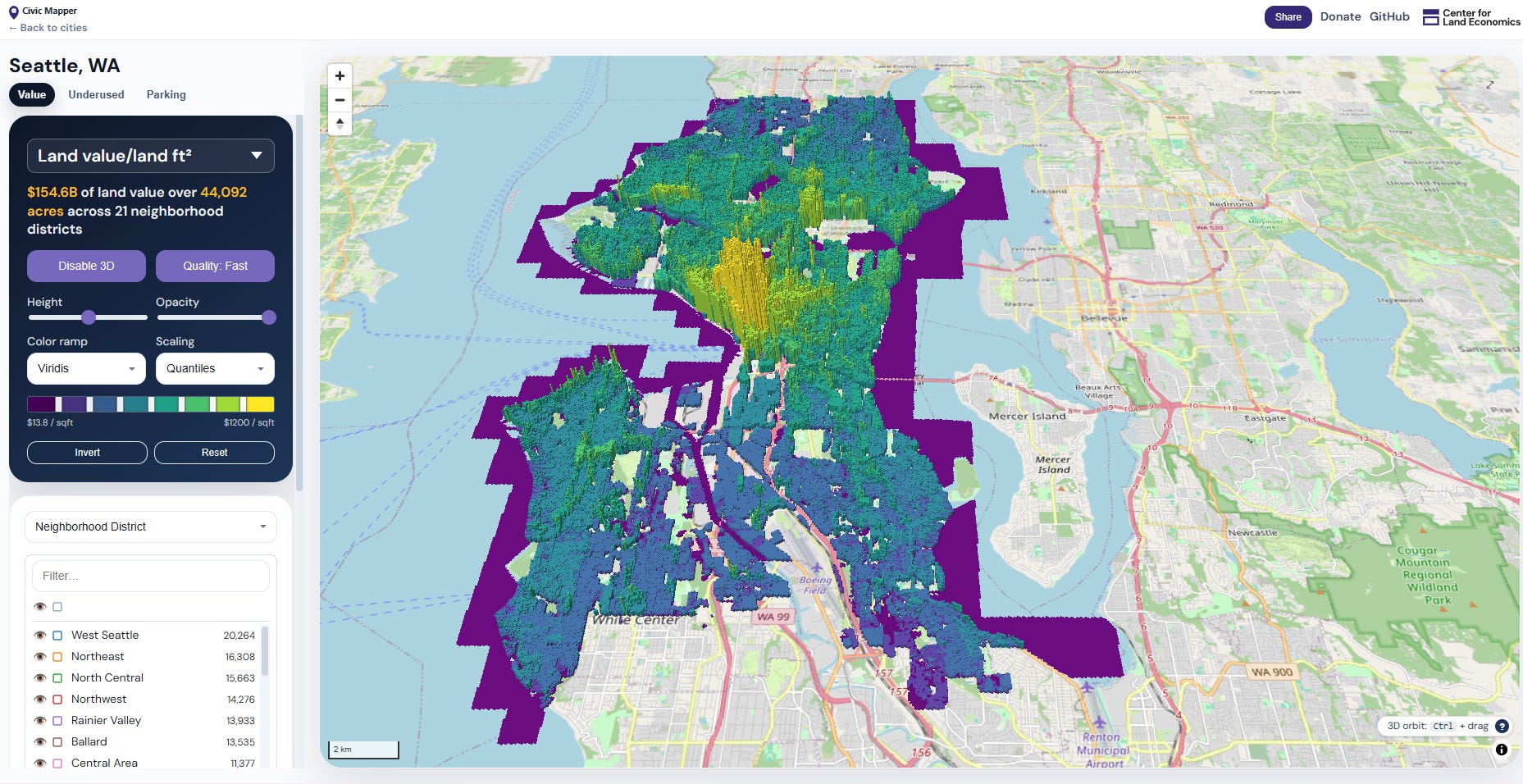
Not all cities look the same, and not all assessments are of equal quality, but you see the same basic patterns everywhere. Land in the city center is worth much, much more than outlying areas.
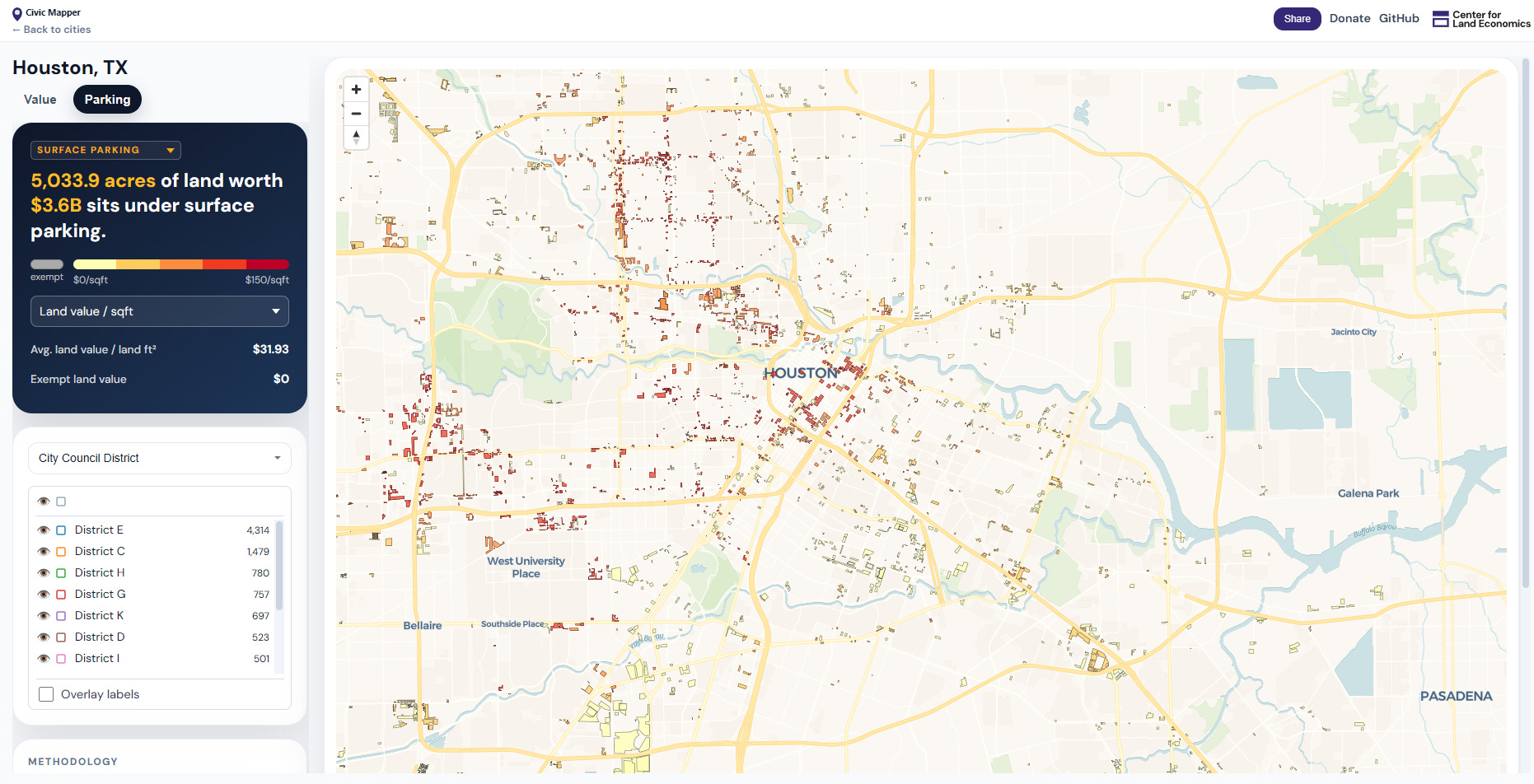
Then, we show people how much of that high-value land is dedicated to extremely low-value uses, like surface parking. Here’s Houston, which has over 3.5 billion dollars of land value locked up in surface parking alone.2
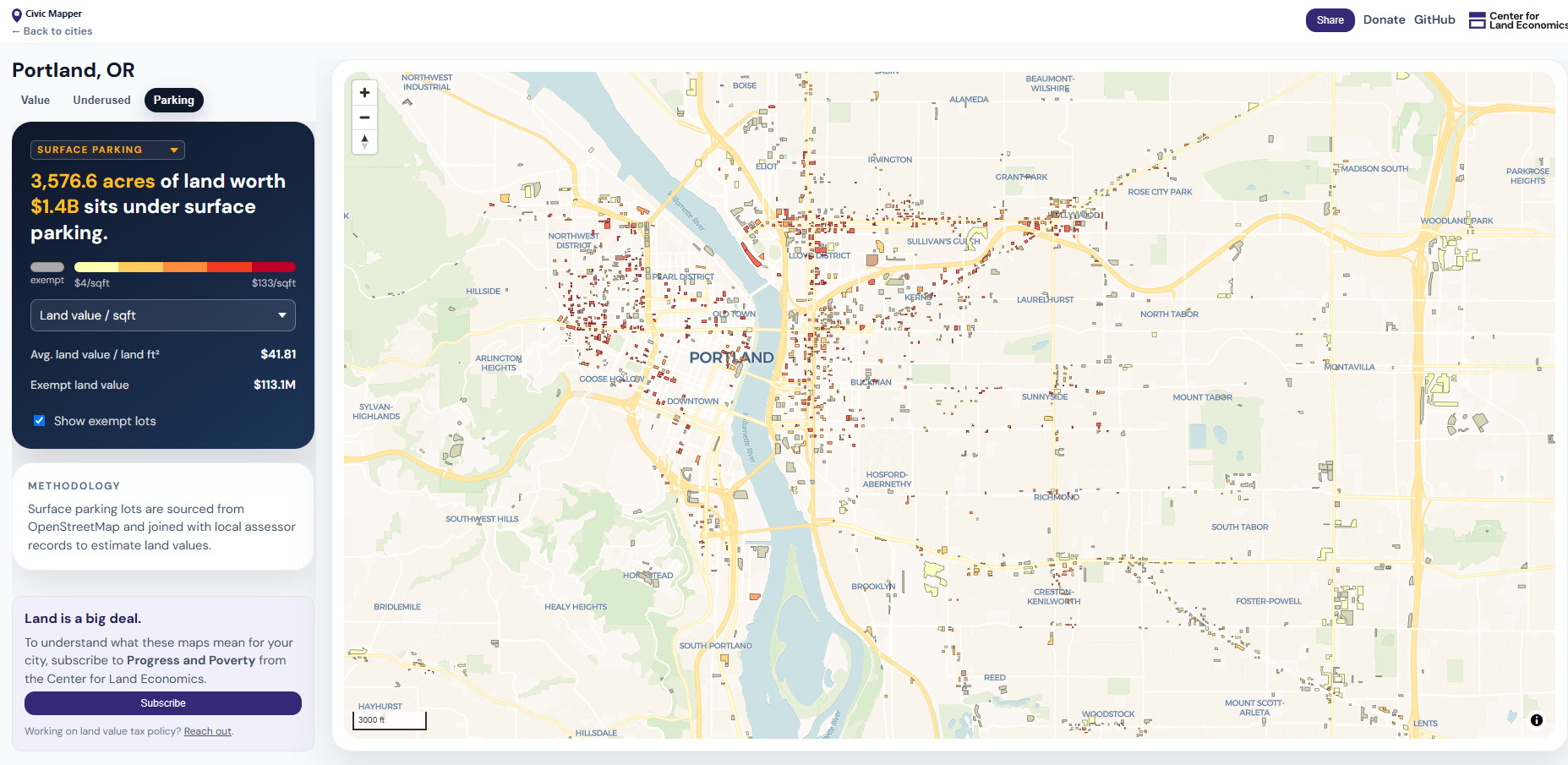
And no, it’s not just Texas. Here’s Portland, Oregon.
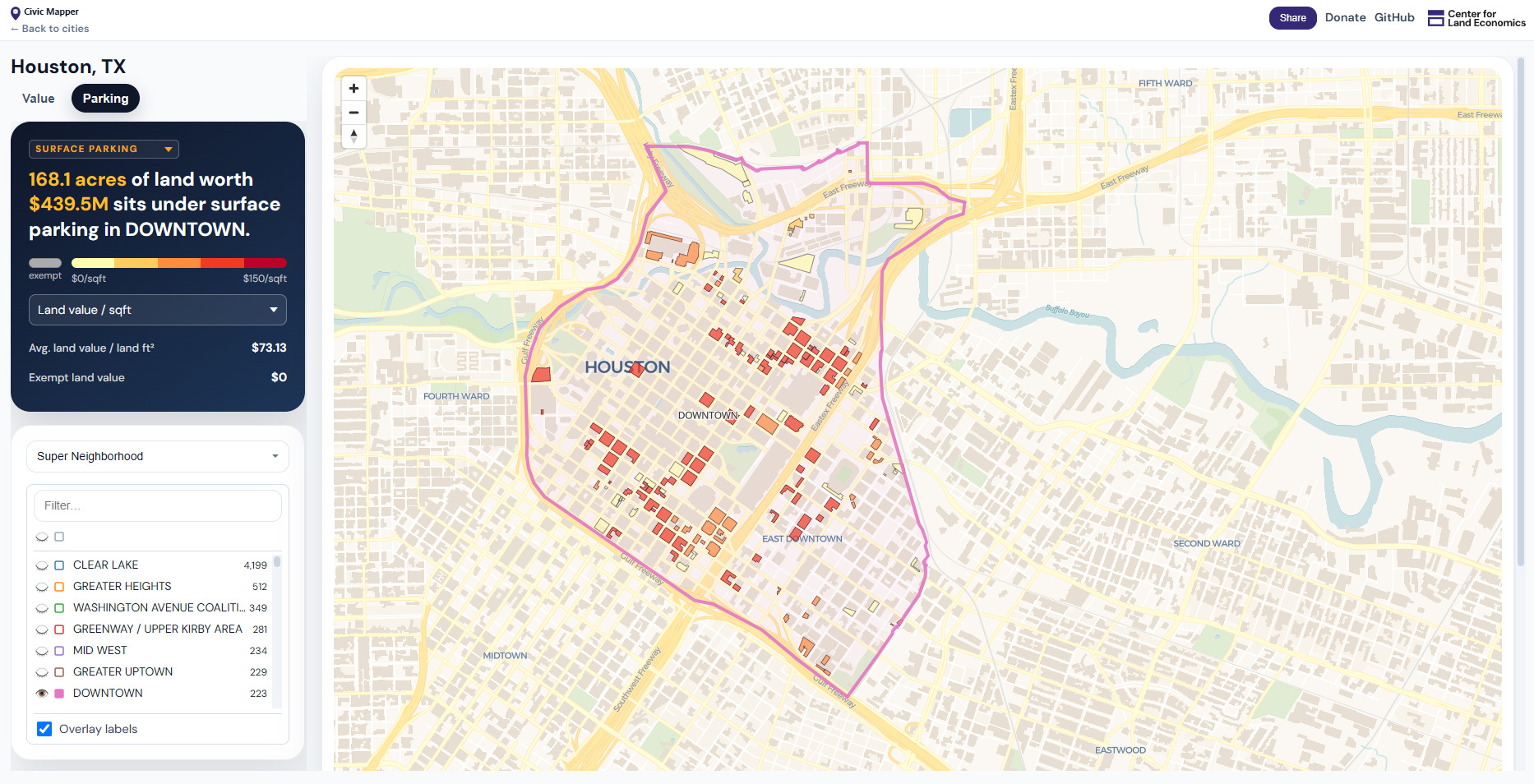
We can even zoom in and show how much of that surface parking occurs in the most valuable areas, such as Houston’s downtown district, which alone accounts for nearly half a billion dollars’ worth. These are exactly the places where it makes the most sense to concentrate development.
Having established that Land Is a Big Deal and that we’re also squandering it, we do the math and build a model of who wins and who loses under a revenue-neutral land value tax shift, or “Universal Building Exemption.” To do this, we use LVTShift, a free, open-source Python library maintained by the Center for Land Economics. In most of our models, the biggest losers are vacant land and surface parking lots, and among the net winners is the typical median single-family homeowner.
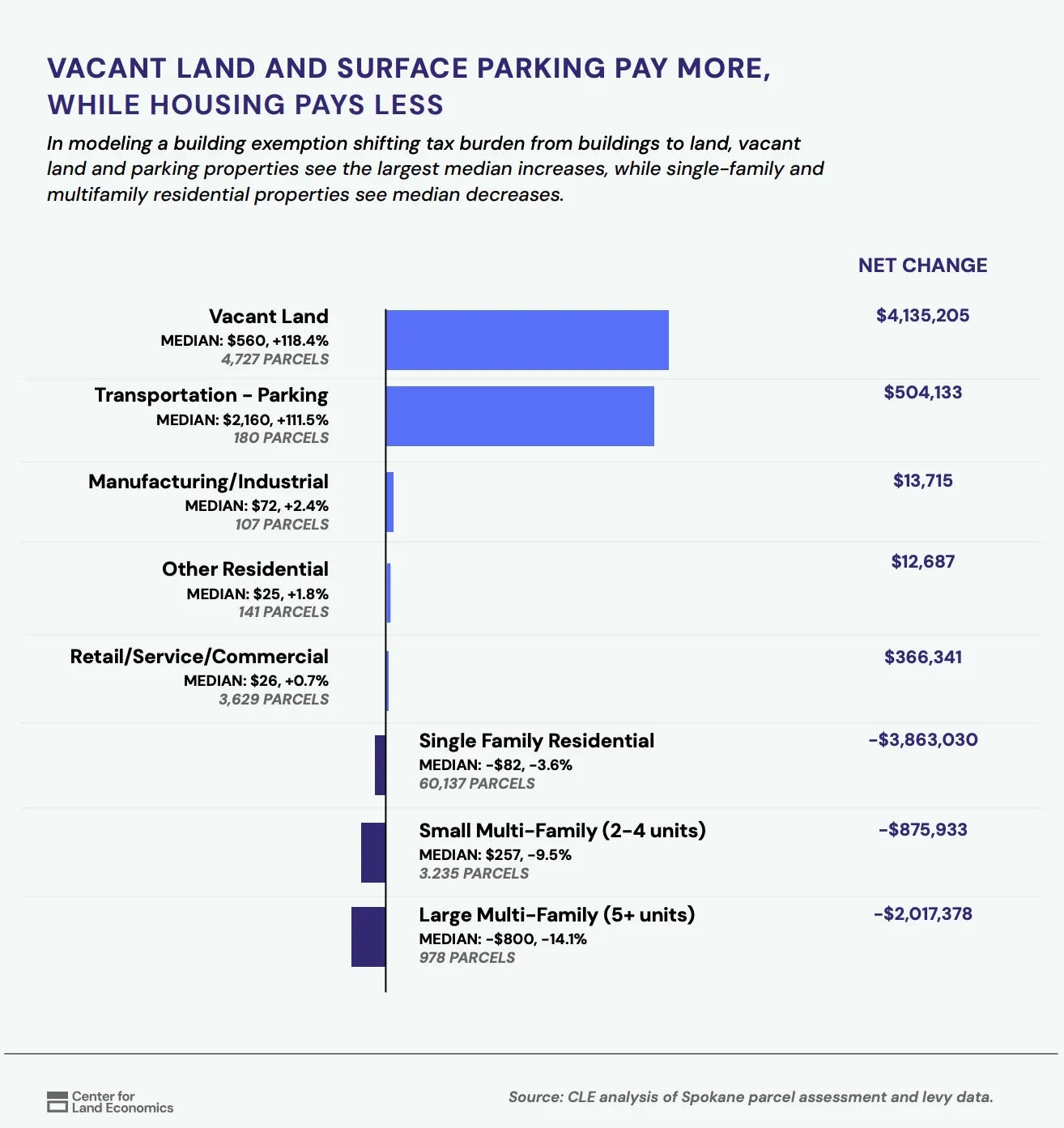
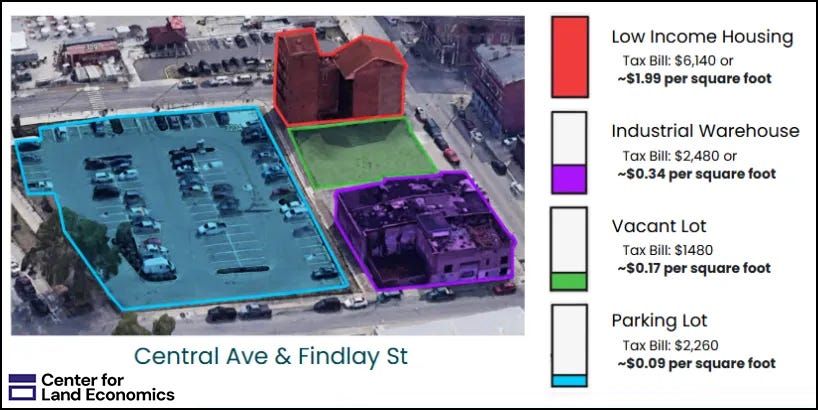
In addition to doing the math, we find compelling stories to tell. For instance, in this report on Cincinnati that we collaborated on with the Notre Dame Student Policy Network, we illustrate how conventional property taxes punish those who improve properties and invest in the city by providing housing and business, while those who own vacant lots or surface parking lots are rewarded for holding land out of use.
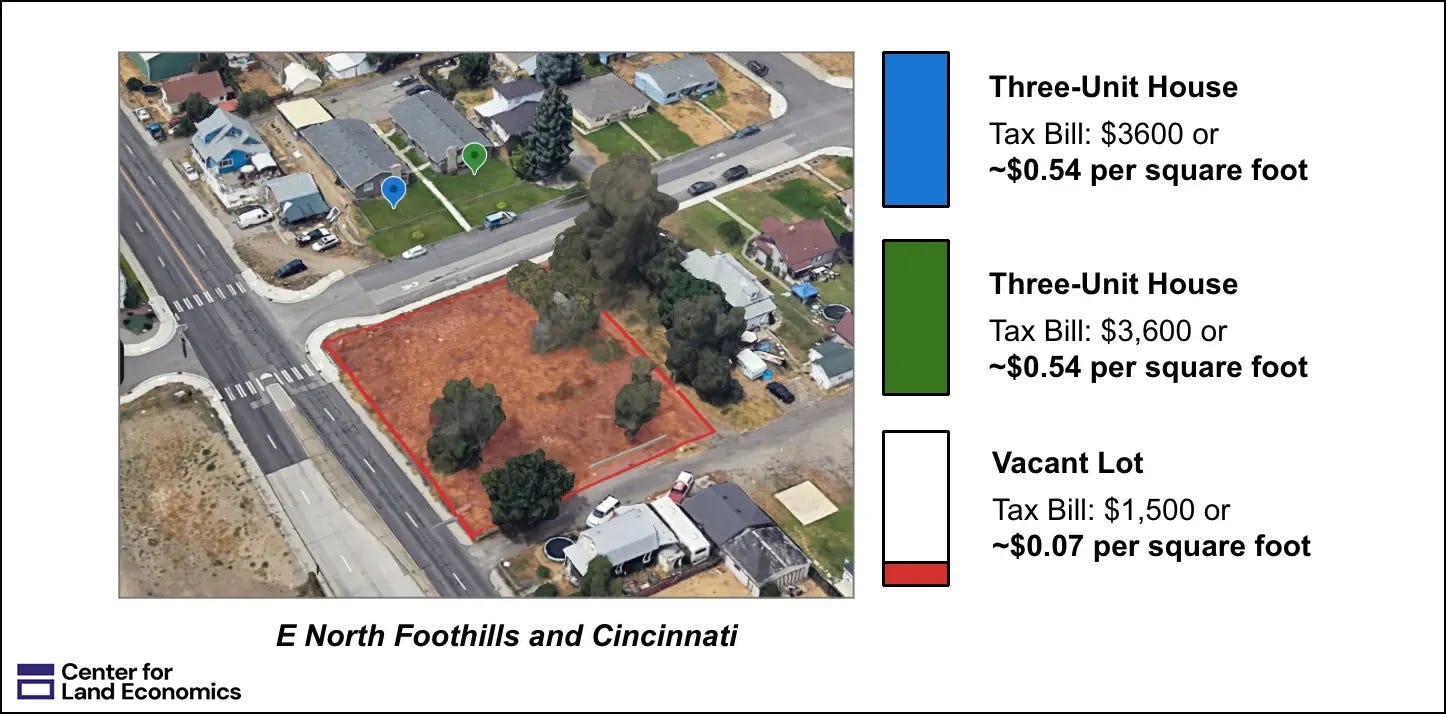
Here’s a similar comparison from our report on Spokane, Washington. The lots with houses on them pay more than seven times as much per square foot of land as the vacant lot does, even though all the land is equivalently zoned and similarly located.
We built up this methodology from crude beginnings by talking to people, trying things, learning from our mistakes, and refining our approach. Finally, we condensed everything we learned into a concrete political playbook entitled Enacting Land Value Return in Your Hometown, then published it as a guide for others to follow.
This playbook is now leading to wins. One of our activists, Jackson Arnold, a member of the Abundance Network, wanted to implement LVT in his hometown of Louisville, Kentucky. He got in touch with us, joined the OpenAVMKit Discord,3 and ran the playbook all the way from inception to getting a bill passed in his state legislature. We are now trying to figure out how to inspire and enable more Jackson Arnolds.
While the first wave of LVT fans were local citizens, we’re now attracting lawmakers’ attention. The most salient example is Bill Blessing, a Republican state senator from Ohio and chair of the Ways and Means Committee, who introduced an amendment to Ohio’s state constitution this year to legalize local opt-in LVT.
That’s all very exciting. But we still have one question to ask before we get carried away.
IV. Does Georgism work?
My three-part article series was structured as an investigation into the three most common objections to Georgism. We should revisit those and see where things stand in light of what I’ve learned since. The three objections were:
Land just isn’t a big deal anymore in the modern economy.
Land value tax will just be passed on to tenants.
Land value can’t be accurately assessed separately from buildings.
1. Is Land a Big Deal?
In Part 1, Is Land A Big Deal?, I ran the “land isn’t a big deal” theory against several testable hypotheses. Among the findings was the fact that sky-high urban real estate prices were primarily driven by land appreciation, and that land was a large and steadily increasing share of bank loans.4 The article’s centerpiece was an original estimate of the total land value of the United States, which was much larger than many had expected. Although this estimate fell short of what a “single tax” would require, it was still large enough to convince many that LVT had been unfairly dismissed as a serious policy proposal.
This article has aged the best of the three, but I still have a few updates to share.
Korea is a Big Deal
If land is a big deal in the USA, it’s an even bigger deal in South Korea, which has all the prerequisites for a national LVT and enough land value to approach a full-on single tax, or other ambitious projects like Universal Basic Income (UBI). Here’s a snippet from my piece, UBI Advocates should watch South Korea:
For UBI or LVT to succeed anywhere, they must first succeed somewhere…therefore, if you want UBI or LVT to succeed, you should scour the world for a place where these two policies are the most:
Economically feasible
Technically feasible
Politically possible
Socially and politically urgent
That place is South Korea.
South Korea has the highest land value-to-GDP ratio in the entire OECD, in excess of 500%. To put that in perspective, the figures from my own estimates of the USA’s total land values—which surpassed many readers’ expectations—were a mere 200% of GDP. My first instinct was that Korean land values must reflect a temporary, anomalous bubble and would soon revert. However, long-run land value-to-GDP ratios over the last 50+ years have ranged from 400%, and current values aren’t even the all-time peak, which clocks in at around 600%. Prime land is just that valuable and scarce in South Korea.
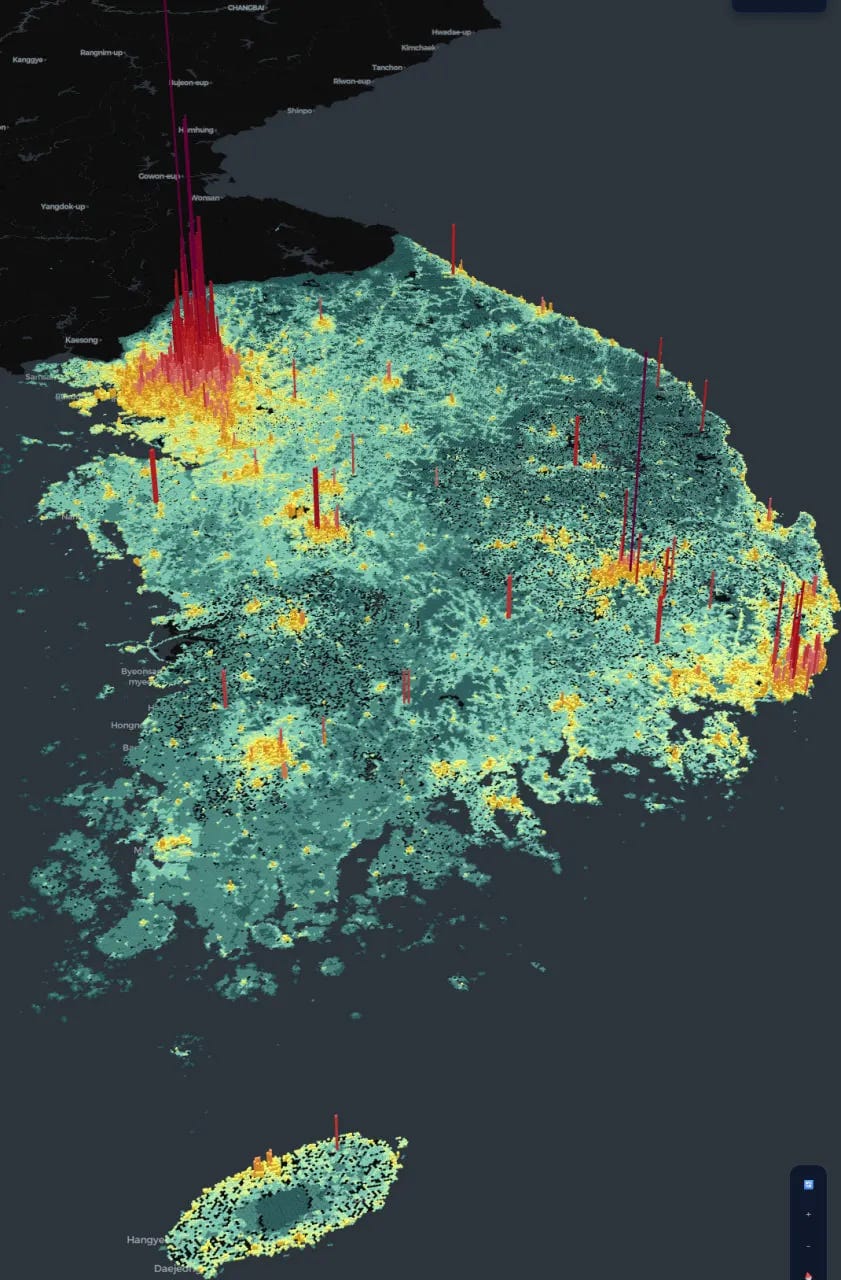
Where do these land value figures come from, by the way? Turns out, South Korea has one of the best-organized land valuation systems in the entire world, despite not having a land value tax, which we’ll discuss later.
In short, LVT in South Korea could raise enormous revenue. Land is already valued down to the individual parcel annually, the current president is sympathetic to LVT, and the urgency for socioeconomic reform in South Korea has never been higher. Although many daunting political obstacles remain, South Korea’s example makes it clear that land is, if anything, an even bigger deal than I originally thought.
Next, let’s address a few counter-arguments to the “Land is a Big Deal” thesis that I didn’t fully address last time.
What About Zoning?
One argument that often came up in comment threads was, “All we need to do to solve the housing crisis is upzone.” I certainly agree that upzoning is necessary, but I don’t agree that it is sufficient (which is something I also believe about LVT). Stephen Hoskins’ essay Land and Liberty to Build makes a great philosophical case for why YIMBYs should also be Georgists and Georgists, YIMBYs, to which I will add a few arguments of my own.
First, history falsifies the “upzoning is sufficient for affordability” hypothesis. If upzoning is all we need, we should not see housing affordability crises before zoning, which was not fully entrenched until the 1920’s. Instead, we see the opposite. The Georgist movement itself sprang from a massive housing crisis in the late 1800’s, decades before zoning became widespread. One could say, “Well, high-rise buildings hadn’t been invented yet, which is what you need to overcome land scarcity pre-zoning.” However, skyscrapers had been around for decades prior to the 1920’s.
Second, not every location is equally constrained by zoning. Michael Wiebe has a great article reviewing a recent paper that estimates the implicit “zoning tax” of various metros, finding that San Francisco is the most constrained, and cities like Cincinnati the least.
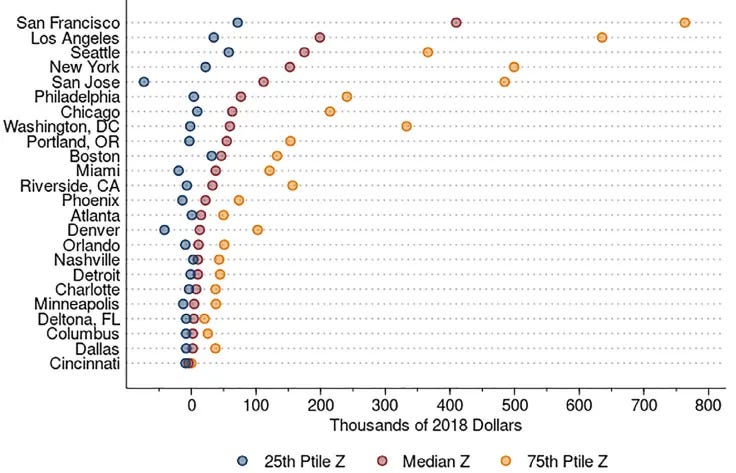
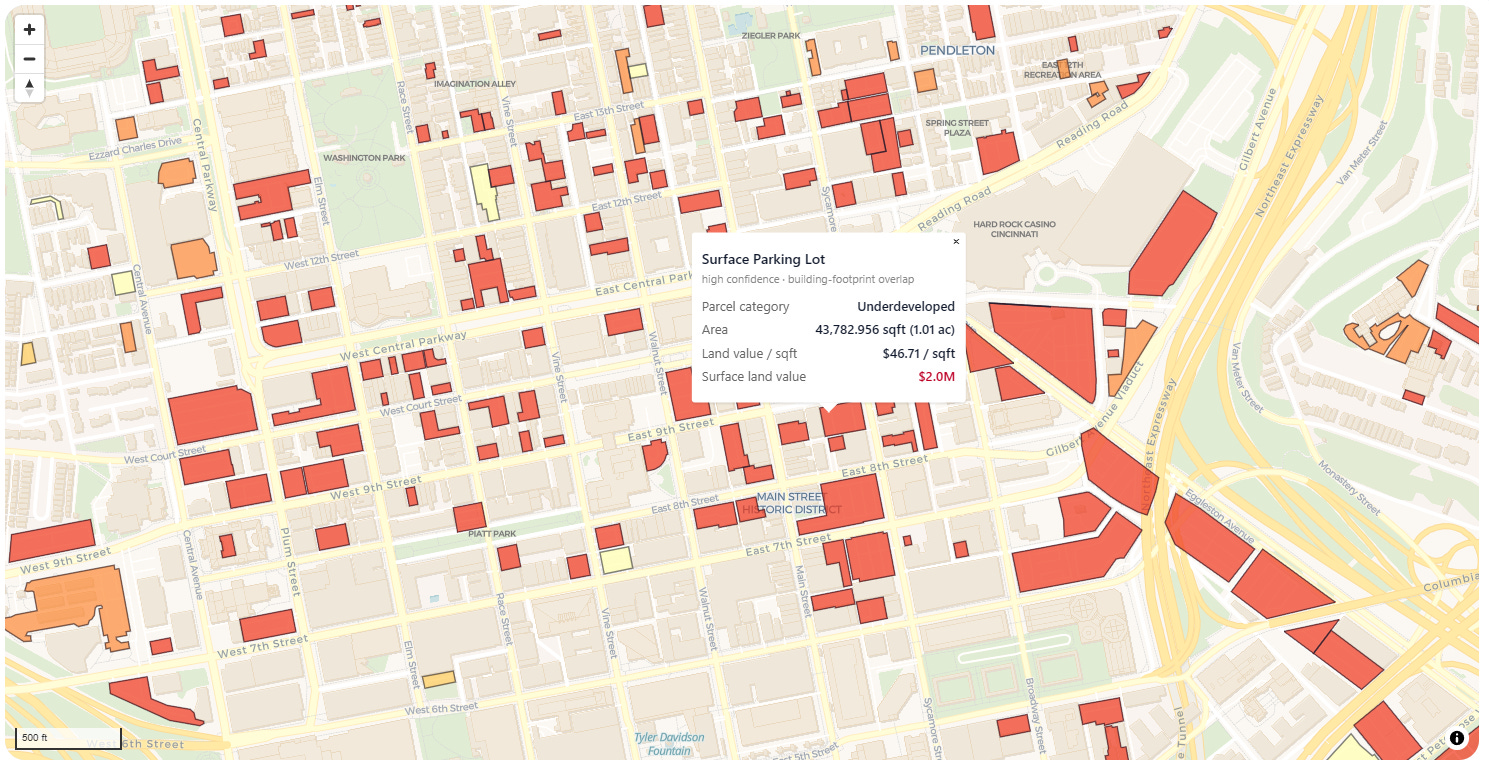
Even though cities like Cincinnati aren’t as expensive as San Francisco, they still have problems. It’s easy to find concrete examples of the most valuable land being held out of use even in the least constrained cities, which contradicts the “upzoning solves everything” argument. We’ve already shown you Houston (which has no zoning), but here’s a look at surface parking lots in Cincinnati’s downtown. You can find this pattern of wasted valuable land in just about any American city.
Let’s go back to this chart from Cincinnati.
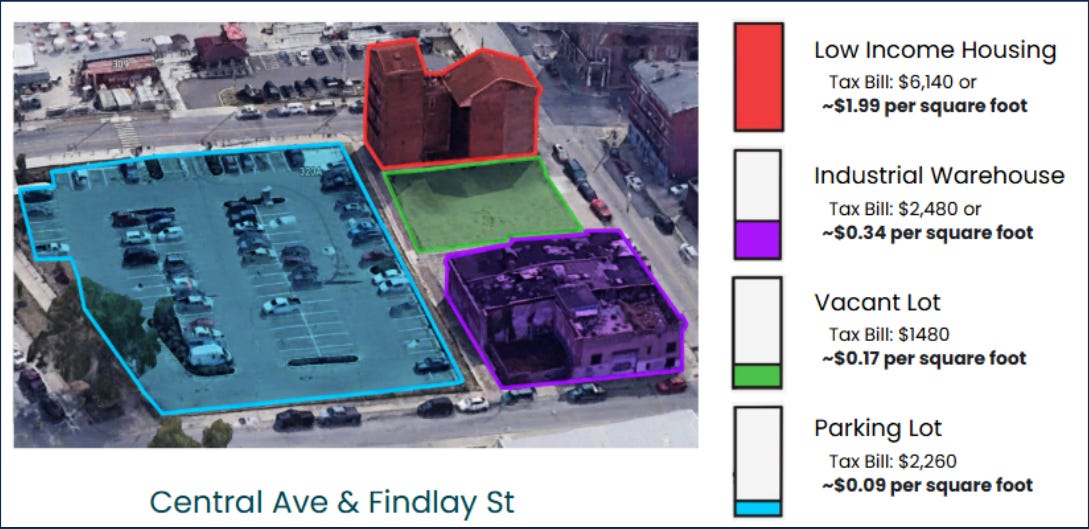
We can see that although all four parcels share the same zoning, the building component of the property tax gives them very different tax assessments per square foot of land. The tax system actively punishes the affordable housing complex for the crime of being denser than its neighbors.
Some LVT-skeptical YIMBYs also argue that, “Land is already taxed by conventional property tax, therefore we don’t need LVT.” The problem is that YIMBYs generally oppose “impact fees,” which are arbitrary extra costs local governments impose on new development. In Property Taxes are not Land Value Taxes, I argue that the building component of a property tax mathematically amounts to the same thing. I am more than happy to defend property taxes against those that wish to abolish them entirely, but I will continue to insist that the building component of the property tax is distortive in essentially the same way that impact fees are. My position is not to layer on an additional LVT but to lower (or eliminate) the effective tax rate on buildings, and simultaneously raise it on land.
The final thing I’m updating on is to give more attention to other ways of capturing land value than LVT alone, such as through ground rent leases. Jeff Fong, a prominent member of YIMBY Action (as well as our board of advisors), has an excellent piece called Georgism through Land Leasing that explores this potential.
That’s it for the “Land is a Big Deal” thesis. Here’s how I’ve changed my thinking on the other two articles.
2. Can Land Value Tax Be Passed on to Tenants?
In Part 2, Can Landlords Pass Land Value Tax on to Tenants?, I read more than a dozen papers on tax incidence and capitalization effects of land value tax and conventional property taxes. The evidence overwhelmingly showed that LVT is not passed on to tenants.
However, I’ve since found at least one condition under which LVT can be “passed on” to tenants: when housing is pervasively rent-controlled, and landlords are granted a special exemption to raise rents in direct response to tax increases.
To understand why, let’s review the traditional argument for why, in general, LVT is not passed on to tenants. Rents are not set by a landlord’s costs or desires but by supply and demand. The opposing view, the “cost plus” theory of rental pricing, makes several testable hypotheses, which this research brief by the Progress and Poverty Institute evaluates.5
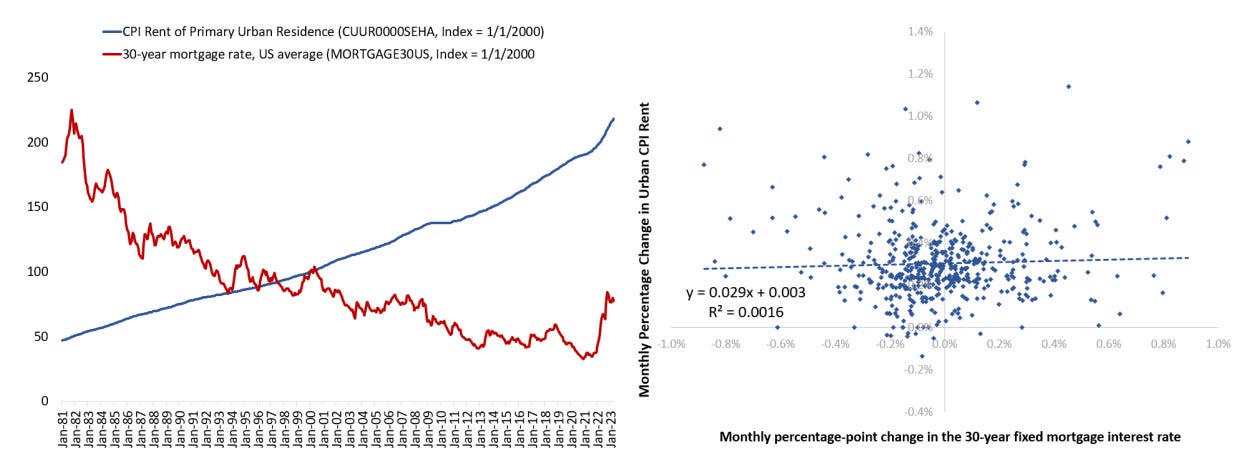
For instance, if landlords reflexively pass on costs (including holding costs like land value taxes) as higher rents, doesn’t that also imply they should cut rents when their costs decrease? Mortgage interest rates have fallen sharply over the past 40 years, yet rents have increased over the same time. Also, landlords who own their properties outright (and thus have no mortgage interest costs) don’t seem to charge different rents than nearby landlords of equivalent properties who are still paying off their loans.
However, these conditions don’t hold under pervasive rent control. If the prevailing rent is already well below what the market will bear, and a landlord is specifically allowed to raise rents by the increased tax amount to some new level that is still below true market rent, then logically, the tax will be mechanically “passed on.” This appears to be the case in Denmark, according to a 2024 paper by Nielsson, Wroblewski, and Yding.
Here’s a diagram illustrating the effect.
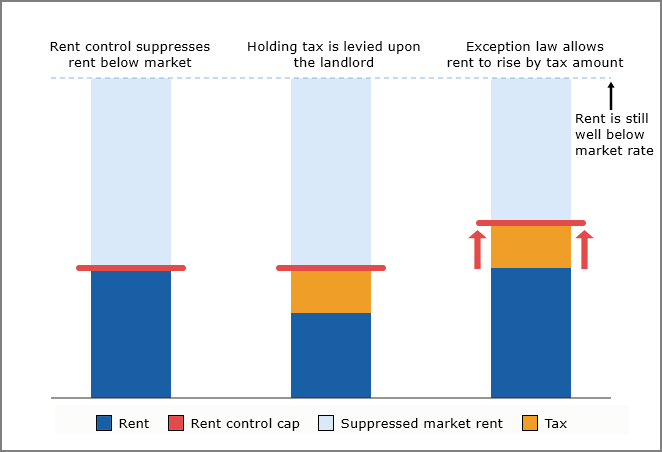
Without pervasive rent control paired with a special landlord tax break, the picture would look more like this.
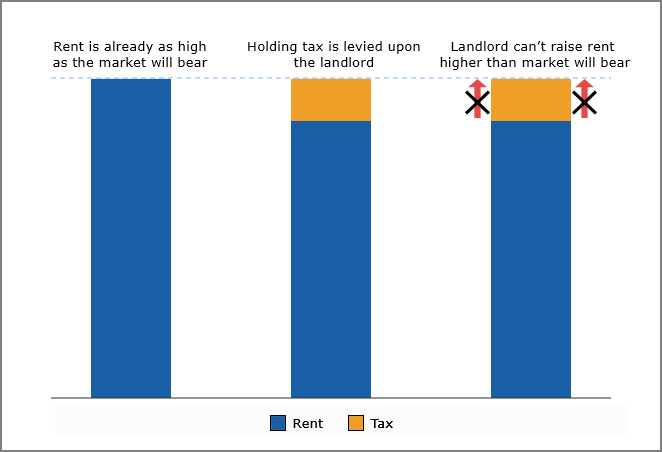
To raise rents in response to taxes, the tax must affect the supply of housing somehow. For taxes on buildings, this mechanism is obvious. Taxing buildings reduces the labor and capital spent producing and maintaining them, just like development impact fees. Less supply of buildings, with unchanged demand, means higher building prices.
Land, however, is not built. Land is inelastic in supply, and landowners don’t “provide” land the way laborers provide labor and investors provide capital; they un-provide land by excluding others from using it. Building supply can change in response to a tax change, but land supply cannot.
The Nielsson, et al. paper’s finding does make me discount the older Danish paper I cited in my second article somewhat, and I’m updating that there is at least this one exception that policymakers should be aware of. However, I don’t think Nielsson, et al. have made a convincing general case outside of these specific conditions, because the Danish case is only one data point among more than a dozen others, and the pass-through mechanism they describe is so narrow, specific, and clearly explainable.
An explanation sufficient to convince me otherwise would need good answers to these four questions:
Why don’t landlords cut rents when their operating costs fall?
When landlords threaten to raise rents in response to a future land value tax, why don’t they just raise the rents right now? Why do they have to wait until the tax is enacted?
Why do property developers subtract all holding costs (which would include both land value taxes and conventional property taxes) from their net operating income, which fully capitalizes into a lower offering price in their discounted cash flow pro-formas?
Will rents/housing prices, ceteris paribus, rise or fall in response to all property taxes in a jurisdiction being suddenly abolished?
I’ve always been happy to concede that the research on conventional property taxes has been more mixed, with some studies finding full capitalization, others finding partial capitalization, and yet others finding full pass-through. My understanding is that in those cases, local results depend on how responsive the supply of buildings is to marginal tax changes, which varies considerably from place to place. It makes sense that if you’re in a very NIMBY area that never builds anything no matter what, a tax change is unlikely to affect local supply.
Now, on to how I’ve updated my thinking in the final article on land valuation.
3. Assessing the Value of Land
In Part 3, Can Unimproved Land Value be Accurately Assessed Separately from Buildings?, I researched how assessors and academics estimate land value. I concluded: “It’s quite plausible but not a slam dunk. That said, if the objection is, ‘valuing land separately from improvements is fundamentally impossible, and we can never get better at it, so we shouldn’t try,’ I think that’s plainly ruled out.”
This is the article I feel has aged the least well—not because I’ve drastically changed my conclusion, but because for years now I have been studying property taxes, interviewing assessors, and evaluating valuation methodologies as my full-time job, which has given me a much better understanding of the details and procedures.
I have many updates on this topic, but we’ll start with the biggest one, which comes from South Korea, an existence proof that at least one country can do this efficiently and regularly on a national scale.
Maybe Just Send Your Office to South Korea
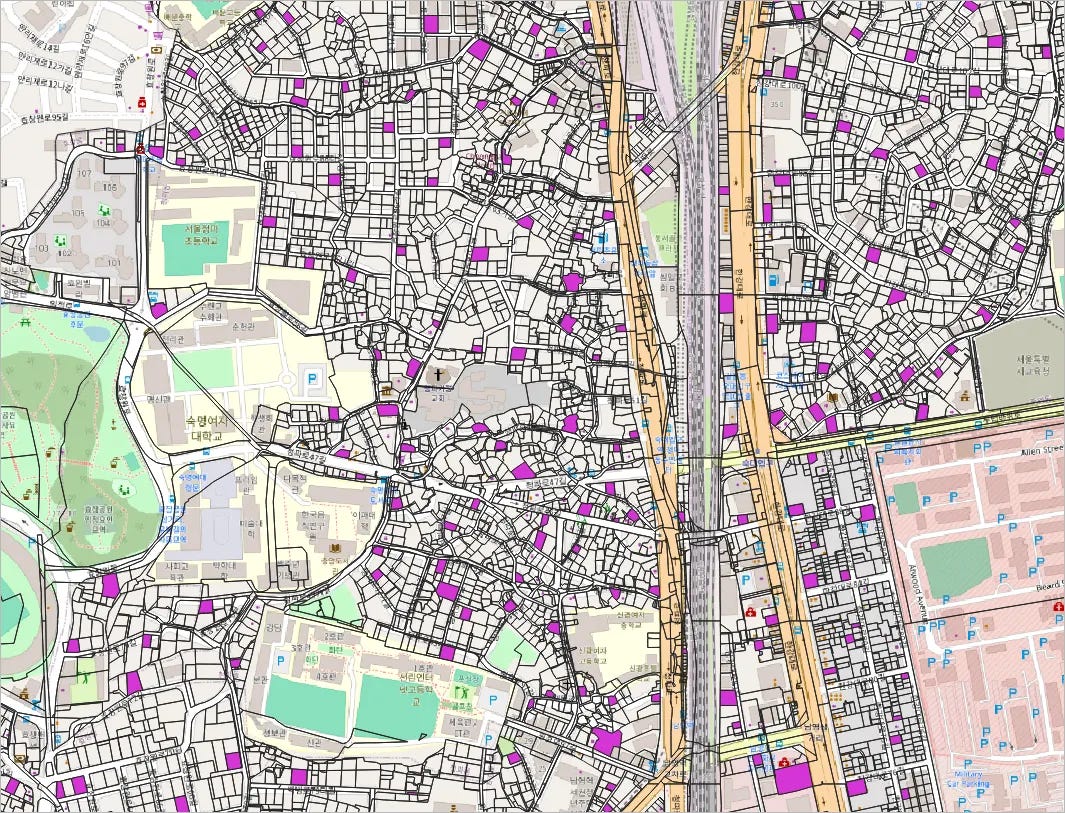
For my article How to Value Land: Korean Style, I interviewed Korean researchers Jinsu Lee and Vitnarae Kang and read hundreds of pages of dense Korean-language6 procedural documents published by MOLIT.7 The short version is that South Korea values all its land—the land value specifically, not just the total value—every year, down to the individual parcel, and gets the entire operation done in five months flat.
This is organized as a simultaneous joint effort by national and local governments, with the national government responsible for 500,000 “standard parcels,” chosen as locally representative parcels of that type in any given area. In all but exceptional cases, each “standard parcel” receives no less than two individual appraisals,8 and the final valuations for these are handed to local governments as valuation anchors. The local governments are then responsible for valuing all other parcels in their jurisdictions. This simultaneous top-down and bottom-up collaboration combines irreducible local knowledge with centralized support and standardization.9
The Korean case reveals that many arguments against land valuation’s feasibility are fundamentally provincial. The first such example is Wales, where a land value tax is being actively considered and where the government commissioned a report on the feasibility of land valuation, employing no fewer than six separate consultants. Although the findings seem comprehensive at first glance, not one of the consultants examines the Korean system, the single most relevant international example, in any detail. The closest we got was a single line in a report by Alma Economics, which buried the lede as follows:
In Korea, for instance, about 1,300 appraisers (2011 data) value sampled plots, with prices extrapolated to adjacent plots.
Another good example is Sam Watling’s “The failure of the land value tax,” published in Works in Progress magazine last March, which details the Liberal Party’s failed push for a UK land value tax in the early 1900s. In “Contra Watling on the failure of the land value tax,” I show that Watling’s assertion that a “pure” land value tax has never been implemented is plainly contradicted by easy-to-find historical examples, several of which even occurred at the same time as his singular UK episode. As for his other claim that land valuation is practically impossible, his main proof is simply that the UK couldn’t pull it off more than a hundred years ago, paired with the unevidenced assertion that the UK can’t manage it today. As of this writing, the UK’s per capita GDP is $24K higher than South Korea’s, and it has 18 million more people. The state capacity limits that he asserts prevent Britain from successfully implementing LVT would be a specific local dysfunction, and would presumably impede any reform the country pursued to address its housing crisis.
As for the Korean methodology itself, I was surprised at how little “magic” I found when digging into the details. The key differences from what I was used to were procedural and organizational. The valuation techniques themselves were no different from what you would expect to find in a particularly well-run Texas or North Carolina appraisal office. This brings me to my next major update.
There’s No Single Magic Algorithm
This will come as no surprise to anyone with a background in data science, but data quality and running a tight ship matter far more than which cutting-edge predictive methods you pick. South Korea is a great example, but other things I discovered kept pointing to the same finding.
First, I’ve learned that there’s a vast gulf between the world of academia and the world of working assessors. This gulf is not necessarily about knowledge or skill—I know many equally brilliant assessors and academics—it’s simply the traditional divide between pragmatic practitioners and theoretical researchers. Whereas academics are obsessed with r-squared metrics and pristinely crafted multivariate regression equations, assessors are obsessed with whether Jimmy has uploaded new sketches for the River Heights neighborhood yet, if Nancy’s new model can produce adjustments compatible with the new comp grid meant for valuation defense, and if anyone can get the damn CAMA10 vendor on the phone about whether that bug from six months ago has finally been fixed.
I’ve tried my best to help bridge that divide. My Mass Appraisal for the Masses article series is meant to help outsiders understand assessors, and my open-source Python library OpenAVMKit helps assessors understand and use academic machine learning models. I also routinely attend industry conferences; come see my presentation this year at IAAO National in Calgary, or next year at GIS/Valtech in Louisville, Kentucky!
Second, in Amateurs talk Algorithms, Professionals talk Data Cleaning, I explain that the single most important thing any office can do to improve its results is to check its data for invalid and anomalous sales, as well as mismeasured or unobserved building characteristics (particularly physical condition). The most valuable part of OpenAVMKit turned out not to be the fancy machine learning predictors, but simply better heuristics for detecting and diagnosing bad data inputs.
Third, I’ve changed my mind about the cost approach and now believe it is basically fine. For context, the “cost approach” estimates a building’s value by using construction cost tables to calculate the cost to rebuild a property, then applying depreciation based on age and condition. This was a method I criticized somewhat naively in my last article without fully understanding how and where it should be used. In fact, the prevailing methodology used in property tax offices in the United States, the “sales-adjusted cost approach,” yields reasonable land values as a side effect, at least when it’s performed correctly. I describe this method in How Appraisers Value Land, an interview conducted with veteran North Carolina property assessor Thomas Holding, who has thirty years of experience on every side of the appraisal industry, public and private, fee appraisal,11 and mass appraisal.12
Fourth, in How Georgists valued land in the 1900s, I researched how land was valued in the United States before the advent of computers and discovered a method favored by turn-of-the-century Georgists called the Somers system. Their secret? They just asked people what the land values were.
The Somers system sounded crazy to me at first, but the historical records indicate it was a serious method used for decades throughout the United States. The facilitators held a series of meetings where they gathered locals together and asked their opinions about relative land values, street by street. The whole assembly would argue back and forth until it reached consensus, which the moderator would record on a gridded map on the back wall. The goal was to encode relative values based on irreducible local knowledge, then calibrate them against market evidence to produce absolute valuations. This method gradually waned sometime around the 1950’s, but you can still detect tiny vestiges of it in the IAAO’s modern land valuation course.
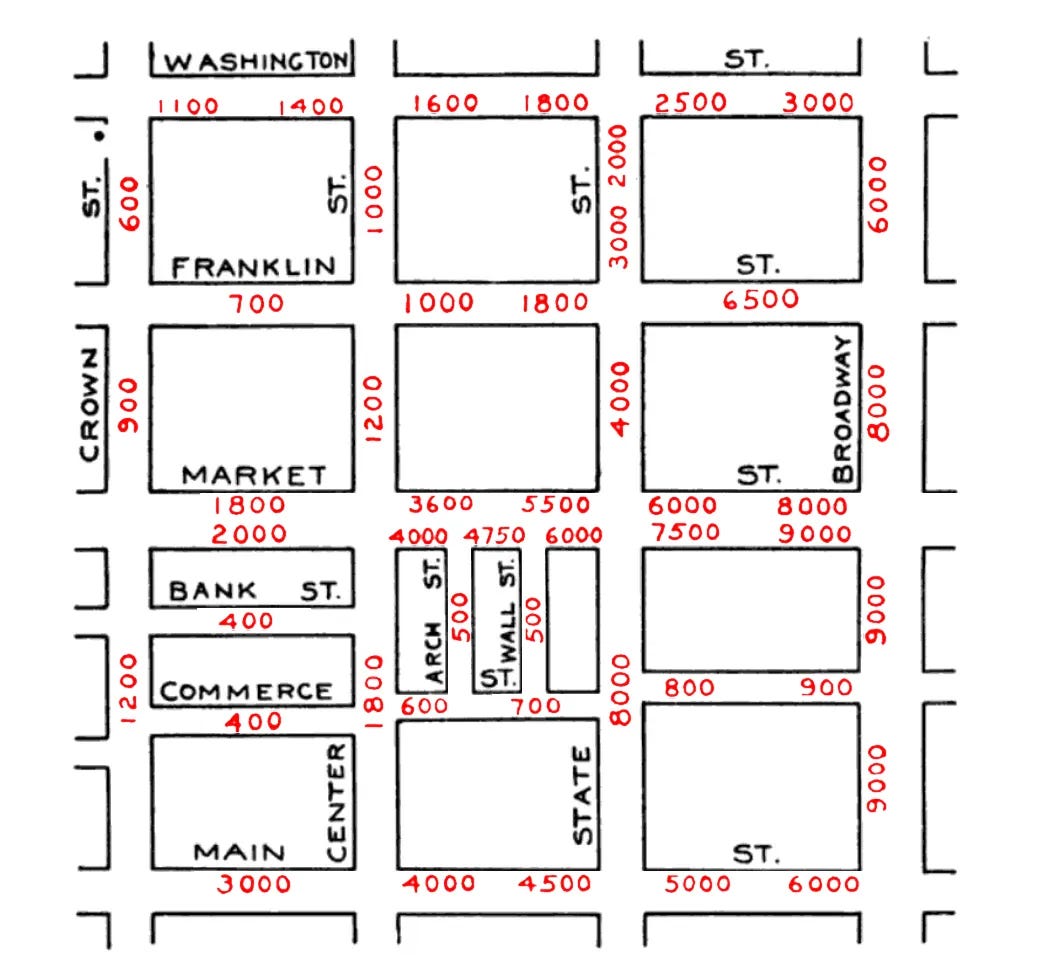
The most striking feature of the Somers system is that it was specifically optimized for maximum community buy-in. It did this by inverting the usual process of doing valuations first and then hearing citizen protests. Here, the “protest” phase came first, and valuations themselves flowed directly from citizen feedback. Although the Somers system is no longer in use in any jurisdiction I know of, more than one appraiser I’ve interviewed has said they have independently re-invented some variant of the method for areas with thin sales by gathering locals together and asking them to assign values to different areas by consensus.
Fifth, I discovered that even surprisingly crude land valuation methods can still work. In the late 1800’s, the German colony in Qingdao, China, instituted an aggressive tax on the unimproved value of land. Although Imperial Japan eventually conquered it and ended the LVT experiment, the regime lasted long enough, and the LVT was levied at a high enough rate (a whopping 6%), for the expected theoretical effects to be clearly observed. The case of Qingdao is well known, but a researcher recently discovered new German-language primary sources, including meticulous budget records and even full-color land value maps. These documents reveal that the land valuation methodology was to simply carve the city up into tax districts which locals judged to be of similar value and assign the same flat land value rate to all parcels within them.
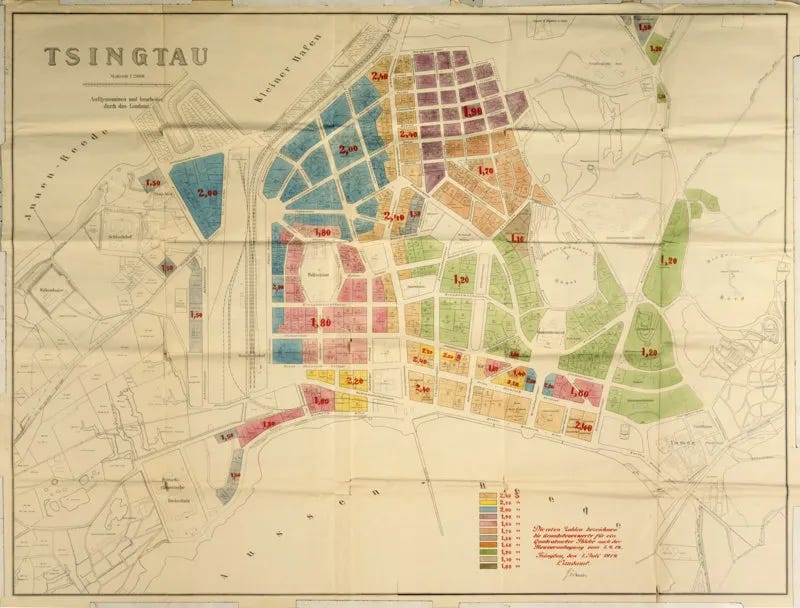
One of the chief things this style of land assessment gets right is ensuring local uniformity of land valuation for all parcels locals judge to be economically similar. This gives a potential answer to the question I raised in the last article: how good do land values have to be to be “good enough?” The Qingdao case, as well as other cases I’ve encountered, has led me to believe that the most important features of good land valuation are to:
broadly track market value and stay up to date
comport with local common sense expectations
be locally uniform across similarly situated and zoned land
Horizontal Uniformity
One deputy chief assessor told me that one category alone—complaints about unequal side-by-side property valuations for neighboring properties—accounts for fully 40% of his office’s annual protest volume. We uncovered exactly these kinds of horizontal inequities in our report on side-by-side land valuation anomalies in Baltimore, Maryland. Vacant lots in neighborhoods were valued at nominal rates, while equivalently zoned, similarly sized improved lots next door would have their land valued for ten times more on a dollar per square foot basis, providing a large subsidy to vacant lot owners and shifting the tax burden to homeowners and businesses.
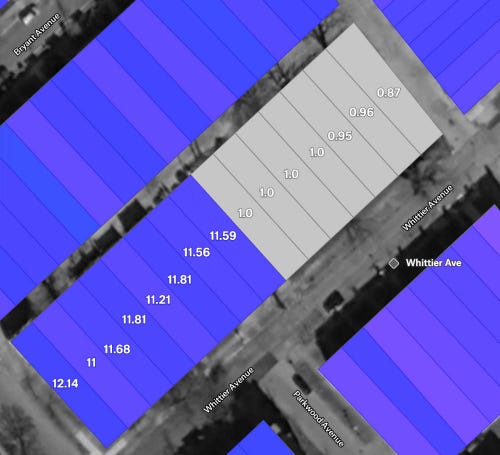
This error was simple to explain and easy for local stakeholders to understand. Shortly after our report went live, SDAT, the Maryland state agency responsible for valuation, announced an initiative to address the problem and has now begun correcting the undervaluation of vacant land.
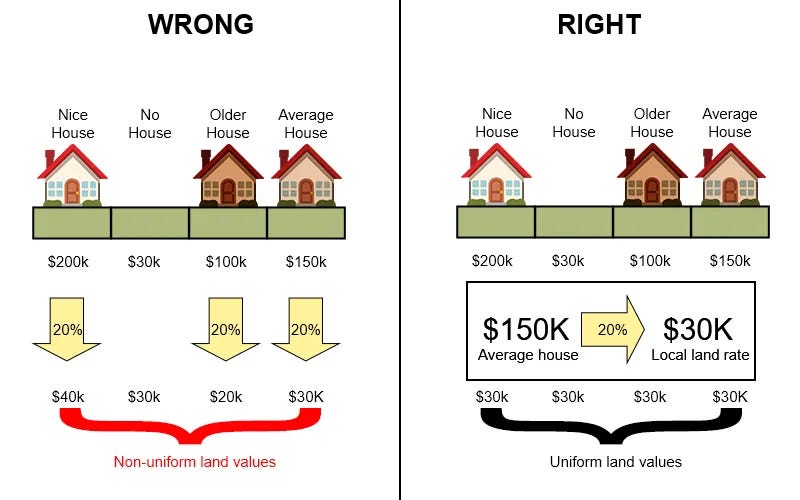
Another common mistake is treating vacant land as having only nominal value and misapplying the “allocation method,” where land is assigned a fixed percentage of total property value, such as 20%. Assessors are supposed to apply the allocation rate to the prevailing median property price in the local area, thereby arriving at a uniform local land rate. When using this method, all similar land in the same area should be assigned the same local land rate.13 Instead, some assessors will mistakenly multiply each individual parcel’s total assessed value by the same fixed rate to arrive at a land value, resulting in land values that jump sharply from parcel to parcel, even when they all have essentially the same size, zoning, and location. This diagram illustrates the difference.
I demonstrate in my article Valuing Land: The Simplest Viable Method that, although we can and should value land more precisely than this wherever we are able, even this dead-simple land valuation method is sufficient to achieve the economic incentives of LVT. Qingdao provides us at least one empirical proof of that approach working in real life. Jurisdictions should make sure baseline land valuations meet this minimum standard.
Whatever you do, keep values up to date
I’ve also updated big time on what the single most dangerous mistake with land valuation and property valuation in general is: not updating your values. The North Star of property tax valuation is “equal and uniform,” and massively out-of-date valuations make a mockery of this principle.
“Equal and uniform” means everything should be valued by the same consistent rule, and similar properties should be similarly calibrated to their revealed market value. Even when mass appraisal methods involve estimates or errors, those estimates and errors should be applied consistently under a transparent rule.
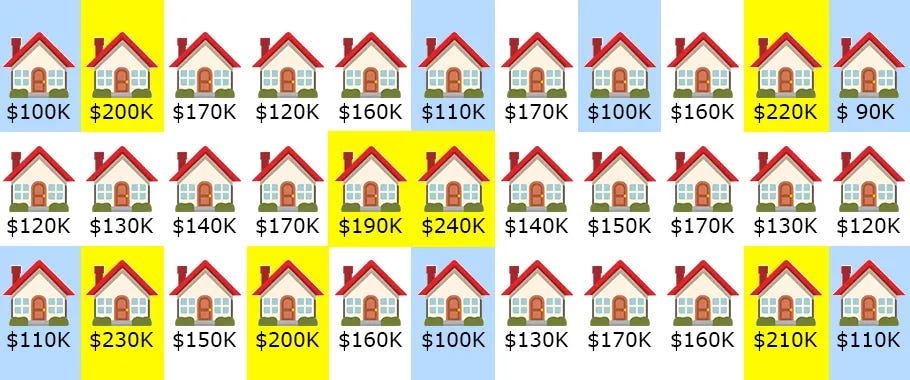
However, if property values haven’t been updated in twenty years, then the valuations have almost no relationship whatsoever with what the market is currently paying for those properties. Some people will be paying far more than their house is worth, and others will be paying far less. This is also why “just value the house at exactly what it sold for” is such a bad idea, because not every home sells every year. If you were to do that, a neighborhood full of identical houses, all starting at $100K, with prices going up by an average ~$10K a year, will look like this after ten years, with massive side by side inequities in valuation based purely on when a home sold, even though they all would sell for about the same price today.
Simple fairness and equal treatment under the law should be enough to establish regular reassessments for property tax purposes. If you’re an LVT advocate, however, the stakes are even higher, and there’s no better illustration of the cost of stale valuations than the repeal of Pittsburgh’s LVT.
Pittsburgh is one of several Pennsylvania cities that have historically had a split-rate property tax. However, long-delayed valuations followed by a poorly implemented revaluation triggered a tax revolt that led to the policy’s reversal. LVT advocates need to honestly grapple with this failure case if we hope to avoid it in the future.
Stale valuations create several problems at once. First, when valuations were finally updated, taxpayers got sticker shock because they had gotten used to values never changing. Second, the local government had become dependent on an outsourced vendor to perform the valuations. Third, public messaging was poor, and the outsourced valuations were opaque, drawing sharp criticism and widespread protest. One thing led to another, and the split-rate property tax was repealed.
This is another place I notice the provinciality of objections. In the Northeast, where many jurisdictions revalue infrequently, many see revaluations as inherently fraught, expensive, and politically risky. At the same time, I know plenty of jurisdictions in the Sunbelt that uncontroversially revalue on three-, two-, or one-year cycles and efficiently process enormous volumes of routine property tax protests.
Revaluation only seems daunting for the same reason that going to the gym does when you haven’t done that in a decade, either. The more frequently you revalue, the more quickly you notice and fix errors in your data, bugs in your process, and anomalies in your algorithms. You’ll have better accuracy, better horizontal uniformity, and better vertical equity. You’ll also get better at explaining and defending your values to the public. If you do the reps, you’ll get the gains.
On the other hand, if you let revaluations slide four years, then six, then 10, soon no one in the office will have been around for the last revaluation, let alone anyone who gains compounding experience and knowledge year over year. Before you know it, you’ll be on the phone with an outsourced vendor who knows they have you over a barrel, insisting on a multi-million-dollar contract, take it or leave it.
The good news is there’s hope. Decades after Pittsburgh’s LVT repeal, members of Pro-Housing Pittsburgh got so tired of the mounting valuation inequities that they took matters into their own hands. They downloaded OpenAVMKit, fed it local public data, and built their own AVM. They generated fresh valuations, ran statistical tests, and proved that their values tracked market value more closely than the outdated official figures.
Finally, the last thing I’ve learned is the answer to the last unanswered question.
V. Why did Historical Georgism disappear?
The short answer is cars.
The long answer is that America is a nation with a frontier mentality which has lost its frontier.
The looooong answer is so long it takes two articles to explain: What happens when America’s Monopoly board fills up?, and The Housing Ladder’s Broken Promise.
Let me summarize key parts of those here.
The frontier was always America’s answer to the land problem, and it still is in many people’s minds. “Just work hard, save money, and buy cheap, high-opportunity land, as I did.” The first American frontier was literal: “Go West, young man.” It worked out great for the settlers, and less great for those excluded from it (Indians, slaves, and others). When the first frontier closed, the first Gilded Age dawned, as did the scarcity and inequality that stirred Henry George to action.
However, in the century that followed, amid two world wars and a great depression, we also invented the automobile, and with it the ability to sprawl. Whereas before you had to live close to your job, fighting over scarce supply and struggling under crushing land rents, now you could keep a nice paying job in the city but live cheaply out in the suburbs. The power of sprawl released land-rent pressure for about a century. Ironically, George should have predicted this effect, as it’s a straightforward application of Ricardo’s Law of Rent.
To be sure, sprawl came with a cost—massively inefficient use of land, environmental damage, fossil fuel consumption, weak municipal finance, redlining—and it also had natural limits, because commutes can only get so long. However, America was happy to pay those costs, and it served its purpose for as long as it lasted. Unfortunately, the second frontier is now effectively closed. Pressure is mounting again, and a time has dawned that historians are already calling the Second Gilded Age.
Switching gears, I’d like to take a moment to talk about how weird it is that talking about land value tax is somehow my full-time job.
VI. I Guess This is My Life Now
Everything happened so fast.
After I wrote the LVT articles, my social media feeds suddenly blew up. My DM’s overflowed. Famous personalities like Noah Smith, Vitalik Buterin, and Scott himself endorsed my book. I got cold calls from prominent writers and politicians wanting to talk to me about land value tax, and I even got invited on a tiny up and coming podcast by some guy called Dwarkesh. Scott gave me a research grant from ACX to study land valuation, which led to an opportunity with a venture-backed property valuation startup.
Then, barely a year later, tragedy struck.
On October 20, 2023, while undergoing a routine medical test, my 7-year-old son, Nikolas, suffered a catastrophic brain injury, leaving him alive but severely disabled and in need of constant, intensive care. We were shocked, devastated, grief-stricken. There are no words profound enough for such a loss, and yet, there was no time to process or mourn. Overnight, my wife and I were thrust into the relentless world of full-time caregiving, all while parenting our other two children, working full-time, meeting family and community obligations, and battling the medical insurance industrial complex to avoid going bankrupt. On November 8, 2024, a little over a year after his brain injury, Nikolas died suddenly from cardiac arrest. I quit the startup and almost everything else in my life.
At this point, I was forty years old and had just lost my beloved son. I had no idea what I’d do next or how I’d take care of my family. I gave up on the movement, my career, and every dream I’d ever had. That’s when I got a call from a young man named Greg Miller.
I remembered Greg. He had originally reached out while I was still working for the startup, when he was working for the federal Department of Housing and Urban Development (HUD). This was in the immediate wake of the Lahaina wildfires in Hawaii in August 2023, and Greg wanted to discuss policy recommendations for deterring “disaster speculators” who liked to take advantage of families’ grief to buy their land for cheap right after a disaster.14
It had been more than a year since then, and Greg had just taken over as head of the Tom Johnson Foundation, another ACX grantee I had helped get started as an outside advisor. Greg’s pitch was that with my theoretical and technical background, and his policy chops and personal network, we should be able to make significant progress in getting LVT policies enacted throughout the United States. Besides, I needed a job anyway, right? I said yes.
We re-christened the Tom Johnson Foundation the Center for Land Economics, revived the then-sporadically updated Progress and Poverty substack with a new weekly posting schedule, and got to work. The results are chronicled above.
On behalf of my wife and me, I’d like to say that Greg Miller was there for me in the darkest and most hopeless moment of my life, throwing me the lifeline I needed to pull me out of the deepest emotional pit my family has ever been in. If it wasn’t for him, however things would have turned out, I certainly wouldn’t be involved in the LVT project today. I will forever be grateful to him.
So, how have we accomplished everything we have in the (less than) two short years the CLE has been around? That was another big lesson.
VII. It’s not who you know; it’s who knows you
All of this started with writing blog posts, and much of what came later at the Center for Land Economics also came from writing blog posts.
Getting even one local land value tax implemented in the USA requires many stars to align. You need a jurisdiction with surmountable legal barriers, decent land assessments, a persuadable local government, and a capable and motivated local activist. If you go searching for that needle in a haystack with your bare hands, you’ll never find it. However, if you stop searching with your hands and start searching with a magnet, you’ll find it immediately, because then the needle finds you.
I could never have accomplished any of this without the people who have helped me along the way. I also could never have found those people by myself, because I wouldn’t have known to reach out to them, or how. Instead, they reached out to me. Not because I’m rich and famous, or well connected and influential, because I am none of those things. Nor was it because I lived in one of the cool global cities where such connections are naturally forged just by going to parties, because I can’t afford the land rent, so I live in some Texas town nobody outside the state has heard of.
No, the only reason I’m writing this today is that I wrote a book review for a contest, and a lot of people liked it.
But why did they like it?
Why did so many people reach out to me?
Why did the LVT movement hijack my entire life?
I don’t think it’s because I’m particularly smart or persuasive. I think it was something else. I think my articles took off because I put into words something many people were already thinking.
VIII. Why I even care about any of this
When my son died, I spent a lot of time thinking about what I wanted out of life and whether it would be better to give up on this whole LVT project, whether it was all in vain or just some pointless, ego-stroking pursuit.
Then I thought about how much AI is driving real estate prices up. I thought about how politicians in Texas and Florida are trying to abolish property taxes, and the disastrous effects that will have if nobody offers a credible alternative. I thought about how many young people say they’re putting off getting married and having kids until they can afford a house. I thought about how my house has nearly doubled in value, even though it’s definitely not in any better shape than when I bought it. I thought about how I could never afford to buy a house today in the same neighborhood I grew up in, and how there are no trick-or-treaters there on Halloween anymore. I thought about how little my wife and I used to pay in rent, how lucky we were to buy a house at just the right time, and how expensive housing will surely be by the time my daughters grow up.
Land is a big deal.
By George, let’s do something about it.
If not for ourselves, then for all the children counting on us to share the earth with them.
Sincerely,
Lars A. Doucet
Center for Land Economics
Progress & Poverty Substack
Although the single tax was a bold proposal in its own time, it was not quite as audacious as it might sound today. Back then, government spending was much lower and highly dependent on tariffs, and the modern federal income tax had not yet been enshrined.
This is almost certainly an underestimate, because our current algorithm relies on Open Street Map tags, which we know for a fact misses many surface lots.
OpenAVMKit is our open source mass appraisal library, which also serves as a community for like-minded technologists.
Mike Bird, writer for the Economist, would later cover this subject in his book The Land Trap.
Formerly the Robert Schalkenbach foundation. Also, Progress and Poverty Institute should not be confused with Progress and Poverty Substack, which is run by us, the Center for Land Economics. Yes, I know it’s confusing.
Ministry of Land, Infrastructure, and Transportation
These are individual appraisals, equivalent to what would be called “fee appraisals” in American assessor parlance, which is distinguished from mass appraisal.
This is not to say that the Korean system is perfect–a search of Korean language sources easily turns up complaints and controversies, much like any mass appraisal system does. Among other concerns, Korean Georgists insist the official land valuations understate the true value of land, while others complain the specific valuation mechanics that led to each individual valuation are not fully transparent.
Computer Aided Mass Appraisal, the name for the software packages assessors use; basically glorified databases with valuation features.
This is when you get an individual appraisal, typically to secure a loan from a bank for a property you want to buy.
This is when you need to value a whole bunch of properties at once, either for government tax purposes, or for real estate websites like Zillow or Redfin.
This is a simplification, glossing over procedures such as selecting the appropriate land unit (fixed lot, linear frontage, frontage with depth curve, square foot/acre, etc), as well as applying additional adjustments for deviations and hyper-local effects.
Incidentally, Greg and I finally put together a post-disaster anti-speculation policy together, you can read it right here.


Land tax or building tax....either way the implication is that you aren't the owner. The state is allowing you to use these things but really, they own it all.
Does an income tax imply the same thing about your body?
I think a land tax is distinct from an income tax because you at least theoretically have the option to stop working, work below the taxable threshold, or work under the table. It's not quite the same as the government taxing your body simply for existing.
That said, I'm not necessarily against Georgism. All taxation is on some level a form of violence and theft, but I don't see any feasible ways to do away with it anytime soon unless we're willing to risk total government collapse and the much worse forms of violence and theft that would follow, so it's a matter of picking the least bad option available, and there's a possibility that some form of Georgism is that option.
>I think a land tax is distinct from an income tax because you at least theoretically have the option to stop working
Don't you theoretically also have the option of owning nothing?
I, for one, have the theoretical option of owning landing.
Well, that one's not so theoretical since I already own no land, and since I don't have taxable income I don't really have to worry about taxes at all right now, so for me that part's not actually so theoretical either. The point is that to avoid the income tax I didn't have to stop owning my body, I just needed to stop using it to generate an income flow which was legible to the state.
At the same time, just because a meaningful distinction can be drawn between an income tax and a land value tax, that doesn't necessarily mean the LVT is invalid. There's definitely a case to be made that we shouldn't be able to own land in the same sense that we own our bodies.
I'm glad you are open to Georgism and I don't want to discourage that by being adversarial, but I have to ask with regard to "taxation...violence and theft" - have you evaluated this view in light of the "non-central fallacy"?
Oh, absolutely. I'm basically just repeating what Scott wrote about it in 2012. But strictly speaking, the fallacy part isn't calling taxation theft, it's insisting that we have the exact same reaction to the IRS as we have to a burglar in our house.
I don't know if "exactly the same between the IRS and a burglar" is the cutoff for the fallacy. My reaction to a shoplifter is different than my reaction to a burglar, but still not a justified reaction to taxation. My question is this: if the goal is not to convey a negative value judgment associated with theft's central cases of which taxation is not one, why would one bother to make the technically tautological statement "taxation is theft"? And if one made the statement why would one not add for clarity, "but only technically, and not the kind of theft that we object to by default" if the hope was not to inspire theft-appropriate negative reactions about taxation?
Well, I'm not the one who brought up taxation being theft in the first place, I was responding to the thread, not coming here with the purpose of crusading against taxation. I effectively have the same position as you, but there's two points where I differ.
1) I don't think being technically or tautologically correct is a bad thing, generally.
2) I think it's important to remember that, as Mao put it, all political power grows from the barrel of a gun. In peaceful times most people never see this firsthand, because most people are compliant enough to never have the gun pointed directly at them, but it's always there. We shouldn't by default be opposed to laws, taxes, and government policies, but we should by default be wary of them. When we let our guard down, we get nonsense like 1.7-million dollar toilets, school districts spending over $40K per pupil with little to show for it, subway lines that somehow cost billions per mile, unsustainable spending on social security, and a national debt that gets bigger each year. And the solution to all of this, according to some people, is even more taxes. Don't forget that we also see horrors like years-long prison sentences for nonviolent drug possession, abuses of civil asset forfeiture, and bombs killing children in places like Gaza. There's even a possibility (though if you don't buy it, fair) that American tax dollars accidentally funded the creation of Covid. On the other hand, the burglar is probably just looking for electronics to pawn for a little fentanyl money, or something like that.
I feel like wariness of government is just a proxy (not a bad one necessarily) for bad leadership, or something like that. Clearly, there is only a conceptual vague entity of "the government", and all the corruption, incompentence and theft is perpetrated by people with the necessary power and ties. Getting better people in those positions reduces the bad effects and makes government a good thing.
I'm not arguing against you. I just wonder a lot about how we can avoid, break out of, or reverse the current historical moment of the rise in theft, incompetence and abuse. And I am not talking about the US, it affects a few other western countries as well.
The entire point of saying that taxation is theft is that yes it is technically theft *and yet* you don't react to it negatively. The purpose is to point out that taxation implies coercion and so isn't legitimate in a certain moral system that forbids coercion.
You are right except that we do react to it negatively. It's just that we don't do anything publicly about it other than vote against increases and vote for people who claim they will decrease it.
You "have an option" to not own land. It's even less likely to be fatal than your proposed means of evading income taxes.
Honest but pragmatic. This is my view too.
Regarding "taxation is theft," most Georgists would likely apply that thinking to income and sales taxes, but would vehemently disagree with applying that to land taxes.
The reasoning being, land is not something created by human hands, therefore it's not something anybody can rightfully own; therefore, all land is the common property of humanity. The act of appropriating the commons is the violence/theft.
So rather than land tax itself being theft, the land tax is the landowner compensating the community for what they took.
I don't expect this to change your mind, but hopefully this explains the Georgist viewpoint a bit.
Bryan Caplan argues yes: https://econfaculty.gmu.edu/bcaplan/service
I think maybe it's okay to admit that pricing in opportunity is difficult and abstract, and that doing it imperfectly is naturally going to lend to certain perverse interpretations.
Indeed it does.
At a certain level it does. But the weird thing about an income tax is that if you don't HAVE to pay it because you do not work, eventually the government will give you some of the money that other people are forced to pay because they DO work.
It's almost like the injustice of tax is nested inside of the little good it does, but somehow is also conflated into a shell designed to protect the empty husk of graft and corruption that is government. Terrible metaphor but I get awfully annoyed when I think about all this.
It's not just that the government gives you money out of their good will, it is that you have a right to get that unemployment pay.
At least in my country, that money is not even tax money, but a common public insurance pool paid by mandatory surcharges on income. Long-term unemployment pay then comes from tax money, but is considerably less and only constitutes about 5% of federal tax budget. There are much, much larger parts of the tax budget that are being actively misappropriated for non-tax activities (like backing up the pension system, which is supposed to be a pay-as-you-go system, but gets a 20% federal tax budget support, because it is politically "unwise" to alienate the dominating receiving demographics, but thereby killing the future).
Your theft argument falters a bit, considering that you have certain rights flowing from the tax that you pay, and even when you don't or can't pay them (in sheer numbers, the don't is an aberration, the can't is the default).
While I understand all that theoretically, there is a deep underclass that understand it practically and abuse it. And the main thing they pass down to their children is this understanding of how to milk the system and get something for nothing. This has been going on for *generations*. One can have "certain rights" as you say, but the taxpaying middle class who have and keep their jobs seldom exercise those "rights". And if they do, it is for a very short period because they actually *want* to be employed and useful.
Did you notice that there is also a deep overclass that does the same?
Your description of the middle class is, sorry but this is not meant as a personal attack, laughably naive.
The middle class itself is divided between the heirs and the non-heirs in many places. They work, because they still need to pay the bills, but the jobs are also relatively comfortable for most. Once you got that sweet middle class pay, life's better then being unemployed, despite work. Not because of it or being useful.
The latter point specifically is funny, many white collar people have a hard time seeing their specific job as useful, but they do it anyway because it pays well.
And middle class people have no compunction against avoiding tax either, just less opportunity or a higher threshold because of the bad payoff/tradeoff.
Correct! No one owns land. However, land is rivalrous so we have to establish a social contract in order to offset the opportunity cost of land ownership. (Though I imagine you'd hardly consider our government a just social contract!)
Ooo, rivalrus is a great vocabulary word. Is there anything else that I should look up on the subject to be enlightened?
Excludable is the other interesting word there, in that a public good is one that is neither.
Who owns the moon?
Realistically, whoever arrives there first with enough guns.
Not sure in this case. The moon has no atmosphere which makes orbital bombardment exceedingly easy. Since the surface is pockmarked from impacts, you're not even changing the landscape very much.
So realistically, you have to own and defend earth orbit, then you basically own the solar system.
Oh ye of little faith and vision...
The year is after colony 195 Operation Meteor...
Chairface Chippendale, by the Lockean theory of him acting to "improve" it by writing his name on it.
Legally, I believe Spain and Portugal have a time share on it under the terms of Papal bull Aeterni Regis (1481), the Treaty of Tordesillas (1494), and the Treaty of Zaragoza (1529).
What is their reaction to the constant incursion of espionage drones on their territory? To my knowledge, both parties are part of NATO, have they considered Article 5?
Article 5 only covers territories in Europe and North America. That's why NATO didn't go to war to defend Portugal when India invaded Goa in 1961.
Nice, so the moon is up for grabs
The whole concept of ownership and property is essentially a state-created, state-backed project that would collapse without the state (and all ancap claims to the contrary are just based on the reinvention of State By Another Name), so yes, if you want to phrase it this way, sure! It just means that the whole term "ownership" becomes largely meaningless, whether we're talking about the current society or a hypothetical society with extensive LVT.
I think a more useful (and also philosophically correct) way to think about it, is that if you insist on "owning" the land without paying taxes on it, you also shouldn't expect police to help you control what other people do to it, or the courts to decide disputes, or anything of the sort. Essentially you get to fend for your "own" land if you don't want to enlist public goods to do it for you.
Yes, if you can't be bothered to pay for the system that gives sanction to your ownership then the results might not be entirely to your advantage.
the system you're describing is one of user fees, not taxes. the police don't care if you paid into social security, they care if you paid into police salaries.
It’s not that you’re necessarily wrong it’s just that what exactly is necessary for a functioning state to work correctly is not that clear cut; and if there is something that is clearly unnecessary for the state to function, maybe it shouldn’t be part of the state at all? I’m all for having that discussion, but some kind of opt in system where you only pay for what you want, obviously isn’t going to work.
"nd if there is something that is clearly unnecessary for the state to function, maybe it shouldn’t be part of the state at all?"
I agree fully. and under a system where the solution to nonpayment is "armed agents of the state put you in a cage" we have no incentive to get there.
Under a system where the solution to nonpayment is "Thou art an outlaw, whose existence cannot be acknowledged or aided by the state" (practical implementation: your phone doesn't connect to 911 and you are not entitled to raise complaints in court), the state has at least some incentive to ensure that it is of some sort of use to payers (calling 911 has to accomplish something in this world, or no one will pay). a single sunray of optimization pressure can do a lot of work, given time.
Hmm I have to admit it’s an interesting idea. Aren’t you just punting the problem though? What if the carrier lets your phone dial 911 anyway, do armed agents tell them to knock it off?
I think you’re kind of trying to avoid the problem of the state’s power coming from its monopoly on force, and that it always bottoms out in armed agents coming and doing something to someone who aren’t complying.
"What if the carrier lets your phone dial 911 anyway, do armed agents tell them to knock it off?"
You don't implement the block at the carrier level, you implement it at the recipient level. just like your cell phone can block a number, so can the dispatcher's phones (a tech probably not currently installed, but not difficult to install). If the tech doesn't work, they switch tech providers, and maybe armed agents do sanction the old one for fraud or whatever, sure. If you spoof your number to get around this, yeah, armed agents are gonna sanction you for fraud. This isn't a permanent recipe for world peace, it's a marginal step in a better direction.
"I think you’re kind of trying to avoid the problem of the state’s power coming from its monopoly on force, "
That's an insoluble problem. Of course I'm trying to avoid solving insoluble problems, and hence limiting myself to soluble problems. The state will always be violence, but we can work on better incentives at the margins.
Well, that's sensible, until you start building in auto-defenses. Rat-things in Snowcrash are reasonably well-behaved, but I don't take that to be a reasonable inference for real life.
The right to own property comes from the right to own your own body, and thus the fruits of your labor.
If I work to create a product, and then someone steals that, then effectively that time and effort I spent creating that is arguably slavery.
Land is not the fruit of anyone's labor. All the land in the world existed before any man labored. The origins of land ownership comes from putting a fence around what belonged to everyone and threatening to stab anyone who crosses that fence, arguably stealing from everyone else.
I don't think a right to own Land is necessarily the same as the ownership of goods
I've never heard it put like this but it really resonates with me. Thank you
Your argument is solid.
One small blind spot: the tangible products you create also existed in the world before you. You own the added value from the fruits of your labor, I'll give you that. But that also means you own all refuse, trash and waste you produce, basically the other side of the coin: The refuse of your labor, the devalued parts.
This is often conveniently overlooked, or simply externalized if you can get away with it.
I do agree and think this is why a Carbon Tax and other sorts of externality taxes dovetail quite nicely with Georgist thought
Yes I fully agree. I have not thought about LVT as an "externality tax" before, but it makes much more sense this way.
if no one ever owned land, you can't possibly be stealing it from anyone else. that's a completely impossible argument. you can only talk about stealing land if you first have a notion of land ownership.
You put a fence around land because it contains the crops you planted, or whatever. the fence itself is not your claim (although it is notice of your claim). the immovable goods you created, which trespassers are likely to take or damage, are the essence of your claim to land. and note that if they don't damage anything.... well, when you sue them for trespass, what damages will you even claim?
(none of which is to say that Georgism fails at its central task-- which is to at least be less bad than other taxes, whether or not we can call it good).
>if no one ever owned land, you can't possibly be stealing it from anyone else. that's a completely impossible argument. you can only talk about stealing land if you first have a notion of land ownership.
Replace “Stealing from everyone else” to “depriving from everyone else that which you have no claim to”. Stealing might not be the precise word, but it is a deprivation to that which one has a right to
>You put a fence around land because it contains the crops you planted, or whatever. the fence itself is not your claim (although it is notice of your claim). the immovable goods you created, which trespassers are likely to take or damage, are the essence of your claim to land.
It is true that in order to realize fruits of your labor, you generally need land to do it. You can’t work as a farmer without farmland.
That doesn’t, however, change the fact that the first farmer to put up a fence, or the first farmer to plant a seed, had no more legitimate right to that land than the other farmers who wanted to find land to farm on — especially when not all land is equally good to farm on. If the good land lets you produce 3 food units, and the worse off land only lets you produce 1 with the same labor, there’s no real just reason that the first farmer ought to have a right to the best land. Sure, that’s the land Farmer 1 labors on, but other people also wanted to labor on that land too, Farmer 1 just called dibs and threatened to stab Farmer 2, pushing Farmer 2 over to the worse land.
The fact that you generally need land to realize your labor, and that you generally need exclusive access to the land in order to make efficient use of it, is why I think a LVT model makes sense, rather than some sort of communist model of communal grazing/farming/land sharing. The LVT in this case works less like a tax, and more like paying Rent to the real owner of the land — everyone else.
This lets us answer the question of “Why does Farmer 1 have a right to exclude everyone else from the good land?” with “Because Farmer 1 is compensating everyone that he excludes with the value he is depriving them of”
either someone has a claim to it or no one does. "everyone has a claim to it" is meaningless because it is impossible.
"The LVT in this case works less like a tax, and more like paying Rent to the real owner of the land — everyone else."
so I suppose it will be equally distributed to "everyone else" then, rather than used to fund a state?
"Sure, that’s the land Farmer 1 labors on, but other people also wanted to labor on that land too, Farmer 1 just called dibs"
no. Farmer 1 did not call dibs. Farmer 1 just started planting. Farmer 2 could have started planting, but he didn't.
"Land is not the fruit of anyone's labor..." Anyone here ever heard of the Dutch?
Base matter/energy and location in spacetime are the ultimate "land", since they predate human action in a way that literal land may or may not, as you note. But there is still a need to determine how or whether someone owns the material that was used to build a chair, or the tree that the wood came from, or the air and nutrients that the tree came from, etc. There are different ways we could do that, but one of the simplest is just to say that everyone owns all unworked material, energy, and location proportionately, and Georgism pops out of that as a fee for use paid to all other people.
The overwhelming majority of land's value is absolutely the fruits of everyone's labor. I can see using your argument to maybe set a low, base rate for all land everywhere. But the reason an acre of land on Manhattan is almost exponentially more valuable than acre of land in rural North Dakota is that tens of millions of human beings (probably hundreds of millions over its multi-century timespan) have built gigantic network effects on Manhattan. Including the physical buildings themselves! Then all of the companies, finance, wealth. Literally all, 100%, human labor-created- exactly 0% of this existed 'before any man labored'. Agglomeration Effects Rule Everything Around Me.
This is one of many things Georgists are confused about. They say that they're taxing 'land'. But the huge percentage of what they're taxing is just value created by a network of other humans within a relatively small area. You're disincentivizing future building, because no matter how much the developers build, their tax rate will only increase
I agree that urban land's value is in fact, value created by labor. A plot in Manhattan is valuable not because of its natural agricultural potential or whatever, but because of the value created by the combined labor and productivity of all New Yorkers.
Importantly, though, the value of the land in Manhattan is mostly valuable because of OTHER PEOPLE's labor. When I own a lot in Manhattan, and then lease it out to a builder or developer, and then you tax my land, you aren't taxing the value of *my labor*. You are taxing the value of everyone else's labor, which I was trying to gate-keep and take for myself.
When I own land and rent it out, I am taking part of the general value created by the agglomeration effects of everyone's labor, and keeping it for myself.
A Land Value Tax, in this regard, is taking the value that is created by the community as a whole, and returning it to the community as a whole, instead of letting that agglomeration value pool in the hands of landlords who had no part in creating the community value
As for the idea that Georgism disincentivizes building, this just doesn't empirically bear out in the facts or in theory. It makes the assumption that the value of *my* land* comes from the value that *I* have created. When in reality, the tax on *my lot* is actually pretty uncorrelated from what I build on it, it mostly depends on what my neighbors build. And most empirical studies show that it increases building and density
1. OK so, in the space of 1 comment, you went from 'Land is not the fruit of anyone's labor' to 'I agree that urban land's value is in fact, value created by labor'. Which is fine- I just, like, wanted to note the shift
2. On a philosophical level I don't agree that the government/taxing authority is necessarily synonymous with 'the community'. I prefer to take a much more practical, consequentialist view of taxation. This is obviously a classic liberal/conservative difference, so we may not achieve much by arguing about it. This is why stuff like 'A Land Value Tax, in this regard, is taking the value that is created by the community as a whole, and returning it to the community as a whole' makes me throw up a little bit in my mouth
3. Just extending your quote out- you could make this argument for, like, literally everything in society. My argument is not necessarily against an LVT, but a *high* LTV. Seeing as virtually all of value is created within a government-created legal structure, why not have an 80% or 90% income tax rate for everyone? 95% corporate profit tax? 120% sales tax or VAT? Just because you can philosophically justify these taxes, doesn't mean that they're very practical
4. ' And most empirical studies show that it increases building and density' sure, I would certainly be open to seeing those
1. I don't think this is necessarily a contradiction. *land* is created by nature, but *urban land value* is created by communal labor. The main things that harmonize that are
A) When something is the result of Labor, we can make more of it by committing more Labor and more Capital towards it's construction. We can't do that with Land. There are only 22 square miles of Manhattan Island. This land was created by Nature, not by Man. Man's labor might have made Manhattan Island worthwhile to live on, but Man's labor did not make Manhattan Island itself.
B) If the origin of property comes from the right to "own the sweat of one's own brow", there's no person you can really point at and say "THEY created the value of Manhattan" or even any lot you can point to and say "they created the value of that lot" (And if you could, it almost certainly would not be the absentee landlord collecting that lot's rent). The labor that made the land valuable is the diffuse value of everyone in the city - so while Rural land belongs to nobody because Rhetorical God created the land and its value, Urban land belongs to everyone because Rhetorical God made the land everyone collectively created its value
2. I definitely understand your aversion to the idea that the money taken from taxation is truly 'returned to the community as a whole', but I'd say as long as we live in a functional democracy, it's the most reasonable way we have to do it.(Other than, I guess, entirely defunding all Gov't services, roads, subways, etc. and use that money as a UBI). I think if you lived in a society that was autocratic or otherwise not a functional democracy, it would be much harder to philosophically justify (and as much as it does have problems and people complain, the USA is, in fact, a functional democracy for now)
3. The distinction between LVT and Income Tax philosophically is that I do think you can point to one person and say "They created this value" when it comes to Income, or for Sales. As for the worry being excessively high LVT, I will agree that I have made a philosophical justification for a 100% LVT, but realistically tax rates are not set by spherical economists in a vacuum. The city calculates how much money it needs for its budget, and then sets the rate such that it can fund that budget. My city (funded by property taxes, not LVT, but realistically it would be the same in that regard) just lowered its tax rates because the overall increase in property values kept the same tax dollars received, for instance. And if people felt they were overtaxed, they would generally vote for politicians with lower taxes
4. I promise to get back with you regarding this as this as I know I have read them and they exist, I am just giving my initial thoughts and responses right now. That being said, it does seem very reasonable in pure theory-land that LVT would encourage building more than Property Taxes, which most cities rely on, since building directly increases your property values and thus taxes, as compared to what you allege with LVT where, at worse, building contributes very indirectly to an overall increase in value to the community, which diffusely increases the taxes for everyone around me (possibly including myself)
>f the origin of property comes from the right to "own the sweat of one's own brow", there's no person you can really point at and say "THEY created the value of Manhattan" or even any lot you can point to and say "they created the value of that lot"
1. But you could say this about literally every field of human endeavor. All aspects of human existence were 99.999% created by other people in their field before them. Why don't we raise taxes on (spins wheel) astronomers? Their whole field existed centuries before their birth! How about those freeloading (spins wheel) car mechanics? They didn't invent the cars, the parts, the concept of an automobile or anything else- their field only has value because of the work of millions of others. Why do *they* deserve their wage?
Like, you seem like a smart guy. Sit down and try to name a field of human existence where there's only 1 person you can really point at say and they created it. It doesn't exist! So why we don't impose 90%+ 'value' tax rates on everyone then?
2. Landlords pay not only property but capital gains and income taxes now. The more 'value' they capture, the more taxes they pay. What does an LVT do that capital gains or income tax on the landlord's income doesn't? If you really feel like they're paying too low of a rate, simply advocate to raise it. You don't have to reorder society or invent an entirely new field of land valuation to do that
If you asked a medieval nobleman if you owned the land, they'd say "no". You have neither the power of low nor high justice on the land, the first of which is intrinsic to ownership. Whether the second is intrinsic to ownership was contested between those noblemen (who thought it was) and the kings (who thought it wasn't).
You hold the land from the state - as freehold ("fee simple"), not as allod.
That idea that there is a simple and universally agreed set of rights over a piece of land that we can call "ownership" is just not true. There is sovereign ownership, the form of ownership that a state has over the land within its borders, there is proprietary ownership, there is the right of access, there is the right to let or sublet the land, there is the right of quiet enjoyment, there are rights that neighbors have over each other's land (e.g. what level of noise are you allowed to make in your own land), there is allod (the right not to pay taxes on the land), there are the rights of low and high justice, etc, etc.
Do you own land more if you can mortgage it or less because a mortgagor can seize possession from you?
If you own land that you cannot access because it is in a country where you cannot legally enter, do you really own it? What about if you can't access it because there's a tenant and the tenancy contract says that you can't access it? What if that contract is a 999-year contract at a peppercorn rent that was signed by the previous owner and you inherited the landownership?
Technically you can buy an "allod" in Nevada, but that just means paying all your property taxes up front as a lump sum.
Does that mean that the allod can be sold or inherited and retains the absence of taxes in perpetuity?
Does it also mean it is exempted from eminent domain and from seizure by a mortgagor?
That’s classic allodial tenure.
> Allodial titles were subject to exemptions from seizure in debt or bankruptcy under homestead laws; however, a property could be seized if used in a criminal enterprise.
> Upon the death of an allodial title holder, the heir or heirs can reestablish allodial title by using the same procedure that the original property owner used.
> The title shall be relinquished if the property is sold, leased or transferred by the allodial title holder; the allodial title holder no longer occupies the dwelling for 150 days; or the home is converted to anything other than a single-family dwelling occupied by the owner.
Partial credit for Nevada.
https://en.wikipedia.org/wiki/Allodial_title#Nevada
And that makes sense - someone who built a building can legitimately say they did something to own it (and so can someone who sponsored them to build it, either before or after the fact). But I’m not sure what can persuade me that some random guy should count as the owner of land that neither he nor the previous owner did anything to create.
If there is a government, then you aren't. Landed property is a subset of sovereignty, that's unavoidable unless you're an anarcho-capitalist.
These kinds of comments smuggle in a whole theory of property that is not explained or justified. Rather, the commenter just assumes certain facts about what it means to own something, which is usually a projection from personal items to any kind of property. This view takes property as an absolute all-or-nothing "property" of an asset with respect to the owner. Well, it's not. The common analogy used in the theory of property literature is that a property is a bundle of sticks. It's not "this person own this thing and can do whatever they want with it," but a specific set of claim rights and usage rights that varies based on the specific situation. For example, for fee simple, at a minimum, the government maintains police power, eminent domain, taxation, and escheat. You can't just say "nah uh, taxation is theft." You have to explain why. In order to prove the case, you have to develop a theory of property that justifies acquisition of unowned resources based on some rules and that grants certain rights based on that acquisition. Libertarians claim to have developed such a theory based on John Locke (mostly by Robert Nozick and Richard Epstein). But once you start digging into the reasoning, it turns out to be a complete misinterpretation of Locke that throws away the starting axioms and just keeps the some of the conclusions. The whole libertarian exercise rests on this house of cards and it hasn't been brought up often enough.
In conclusion, no, getting taxed does not mean you are not the real owner. Not according to the common definition of the term. You are making up your own meaning for the term "to own" and then imposing that meaning onto others.
People already pay property tax. This is true now, today, in many places in the world, including most of the US. An LVT doesn't change it.
I really like this writer. I am also really sorry your son died. I remember reading your prior essay about that. Peace eternal, and many kitchen mixers, to Nikolas.
Ever since I learned about it from the original post, I have thought Georgism seems like a terrible idea, for none of the reasons listed here, but lots of other reasons. It seems like such a terrible idea to me that it seems like I must just be completely missing something. But I'm not totally sure I am.
I don't really want to get into a really long discussion about it (I don't have time), so I'm not going to try to list all of my issues with the idea. I'll select one.
Humans live for a long time. They build up families, and ideally they build up neighborhoods. There are social ties formed. The presence of this is what makes cities good and livable; the absence is what makes them alienating and awful. When they do it well and build a nice city, the land value will tend to go up. And then, under Georgism, they will have to leave their land and move off and disrupt their community, because they were only actually leasing their land from the government, and now the rent is too damn high.
This might just sound like ordinary NIMBYism. The thing is, though, it's not. Georgism is far more radical than most YIMBYism. At least as far as I can tell, it is. It's so radical that it makes it virtually impossible for anybody to live in one place for a lengthy period of time unless they are also exponentially growing in wealth. And it makes all but certain that their children will have to leave and live somewhere else, because there is no way they will afford to stay (and there is no generational wealth to pass to them).
NIMBYism does the latter thing too, of course, and that's why some moderation is required (but at least there, there's some wealth to pass to your kids).
In short, I feel that, like many ideas that are popular in the rationalist community, it ignores how human life actually works.
Of course, it's still possible I'm missing something or just misunderstanding.
It is also notable to me how this article names the automobile as humanity's most important technology for escaping crushing land rents… after denouncing at length parking as an "inefficient" use of land that a more enlightened tax system would make economically infeasible. This mirrors general YIMBY sentiment that new construction should be build without much parking, seeking to undo the progress where at least not all of your housing and workplace and retail and education and recreation have to be in a pre-automobile radius, with high downtown rents priced in.
We could build parking structures in the most valuable locations. They're much more efficient than surface lots and provide lots and lots and lots of very valuable parking in the most desirable locations. Unfortunately our current tax structure punishes those who provide the most parking.
I could sign onto anti-empty-lot pro-landscaped-park anti-surface-parking pro-multistory-garage-incentives pro-surface-street-expansion pro-tunnels georgism.
🤝
How do you get pro-landscaped-park out of Georgism, though? It doesn't make money. Unless you charge for it, but... that seems kind of sad, to exclude those who can't pay.
For all the "waste" of vacant lots in expensive areas, those areas are doing important work allowing rain to enter the groundwater system, return as evaporative cooling during the summer, and providing habitat for plants and animals (often invasive plant species, but I'll take what I can get).
Same way you get parks under pro-property tax. Parks increase the aggregate land value of surrounding parcels by more than the land value you give up from making the park itself exempt and undeveloped.
After reading further I see you've talked about this at https://www.astralcodexten.com/p/does-georgism-work-five-years-later/comment/344508376
So, basically still a city service, except it will have a higher sticker price. Yes in theory the incentives all work out for the city to continue providing parks at some optimal ratio to houses, but, I don't trust the budgetary office to take effects other than sticker price into account. I guess we can see how this works out in practice now that people are trying it, though.
My experience with YIMBY types has been that most of them are (to put it mildly) not the biggest fans of parking decks. Perhaps I am being paranoid, but I am unconvinced that a policy regime that implemented LVT would not also disincentivize parking structures in some way.
You can also put parking underground. In new construction in dense German cities, this is the standard option. Because many permits come with a certain parking-to-housing ratio, adding underground parking is often the only solution left. This even applies to relatively small multi family homes of 2-8 units (which can be a split between underground and a few overground spots).
It's costly, but I find it optimal in many ways. The cars are "just gone", well stored by themselves, and all kinds of other basement problems go away (usually underground parking is very well ventilated, which also reduces radon exposure for humans, and no flooding of valuable homes possible). Underground parking also lends itself much more to be electrified for charing of BEVs, which is likely the future anyway.
The incentive effects of LVT don't depend on what YIMBY types do or don't like. If YIMBY types want to disincentivize surface-only parking, LVT will do it. If they also want to disincentivize multi-level or underground parking, they would have to pass a different law.
FWIW, I tend to support laws requiring new developments to add parking, and I'm a YIMBY type.
Off the cuff, I see lots of tradeoffs here. (So you aren't wasting your time, I'm a city attorney for a town so small that I will never be called upon to counsel them on this issue, so you don't really have to persuade me.)
Say you concentrate parking to a number of high rise garages, obviously that's expensive to both build and insure versus a surface lot. The construction disrupts local business. The resulting structure (by having absorbed the capacity of several surface lots) necessarily is further from the numerical majority of the workplaces or retail locations that those lots serviced although it may wind up close to whichever had the largest volume of workers/customers.
I would also note that surface lots are very inviting and convenient to people coming into the city center from the suburbs, they're straightforward and easy to navigate and low-stress. When we pile 5 big dudes into an SUV to head down to see the St Louis Cardinals, the ample surface parking in the area is very inviting, no need to worry about clearances or navigating a tight garage space. Now I imagine surface lots would still exist at premium locations and prices, such as the ones right behind Ballpark Village (who are a weird example, because they had massive tax breaks to begin with and are getting a cut of a CID sales and use tax -- but then most metros would be filled with examples like this today.) If I go to the Plaza in Kansas City, they have an interesting setup with surface parking on the top/backside of the buildings themselves, and dotted with some very modest 2 level "garage" like structures which are more like a single elevated parking layer . The availability of this surface parking right along the strip of shops is certainly attractive to people driving in from wealthy Johnson County as it makes shopping at the Plaza very easy. It also means there are multiple spots and approaches to the Plaza, different places you could turn off, rather than having a single large parking structure act as a traffic locus and create bottlenecks. The availability of surface lots is therefore to some degree increasing the value of surrounding locations.
I feel like this is an almost "unhinged" take, given my own completely opposite experience of multi-story (sometimes underground multi-story) parking. But it's not meant as an offence, just to illustrate the gap in our perception and experience.
Since space is much more at a premium where I live in Germany, surface parking is almost unheard of. And even where it is technically available, I always choose a covered underground lot if available, since it protects me from rain and sunshine. I find the latter much more convenient when dealing with shopping. The distance I have to push my trolley is also smaller, due the vertically stacked parking.
Cramped spaces in parking lots is usually a problem of older construction when cars were smaller. Newly built parking is generous, and sometimes even older parking here gets rebuilt in some key bottlenecks plus wider parking markings on the floor to make them compatible. But I admit that this can sometimes be a costly problem.
Generally, the attractive malls here have some kind of integrated vertical parking, below or on top, to minimize walking distance from car to shops.
Other effects of surface parking are just the eye-sore they produce and they are heat islands in warm summer months (glider pilots here seek surface parking as sure-fire ways to find thermals that lift them, it's taught in hour 0-10 of glide training).
Personally, I cannot see why any surface parking shouldn't be replaced by park, with the parking itself moving to the buildings that require them (new buildings here have to provide their own parking to be permitted), or a public underground parking if possible.
The US is a lot more "car-brained" than even Germany, for worse or better. So I understand that in the short- to mid-term there will always be a large gulf between our perceptions. So please see this purely as a window into a different world, not an adversarial comment.
That's not exactly how I read the section on cars. I think it's clear from that section that cars merely delayed the inevitable. Moreover, the same thing could be accomplished much more efficiently (and without the need for parking in downtowns) with trains and other forms of transit. And even if you do decide to build parking, there are much more efficient ways to do it than having surface lots in the middle of downtowns.
Which is why it is so odd to say that Pittsburgh, of all places, is a "success story" -- Pittsburgh had downtown lots for all the time it's being praised for. And it has a Very Small Downtown.
With transit you can spend less resources on the same thing and accomplish less of it. (With trains you honestly often can spend more resources on the same thing and accomplish less of it, low curvature requirements drive up land cost a lot compared to cars and busses for what you get, though outside the anglosphere some countries manage better. And anywhere extremely dense the low marginal unit economics can still work out)
I do think american cities need more stories of road for private vehicles and more of the current roads repainted as bus-only and more subways, all of them help you not be stuck places. Even if yes in global acreage-per-capita terms we are inevitably* poorer every year, and need to come up with ever better physical and social technology to stay on top of it.
Georgism's promise, much like the automobile's promise, is to better handle the scarcity of land.
> With transit you can spend less resources on the same thing and accomplish less of it.
Transit is typically more efficient in and around cities.
It seems the crux of your disagreement is this:
> And then, under Georgism, they will have to leave their land and move off and disrupt their community, because they were only actually leasing their land from the government, and now the rent is too damn high.
That's a testable hypothesis, and in most of my models I show that if we shift the tax burden towards land and off of buildings, in most cases the median single family home owner *saves* money. The chief loser is the owner of highly undeveloped land downtown.
Perhaps I misunderstood what Georgism is. I thought that it was not only "Tax land more and buildings less," but "Charge the entire (annual) economic value of the land to the current user every year." That is, if somebody could be making $20k rent a year for my land (leaving aside buildings), then that's what I should have to pay.
Did I misunderstand?
If you're equating Georgism with maximalist Single Taxism, then yes. I am not a devout Single-Taxer for the record (I hold it as an interesting ideal that even I'm not sure is actually possible in a modern economy).
The policy I actually advocate for is not the Single Tax, but this:
- Reform the existing property tax in place to remove taxes from buildings
- Increase the land tax in exchange
- Keep revenue raised from property tax the same
To give the Single-Tax it's fair shake, however, you should also consider you'd be paying no income tax, no sales tax, no investment tax, no import duties, etc. etc., so it's quite a different world from anything we have today. The closest we've ever gotten in real life was German colonial Qingdao, and even that fell short in some ways (it had some significant tariffs).
Oh, OK. Sorry. I think I was going off your original book review, which I strongly remember describing Georgism as one-tax or at least setting tax = full value (but I could be wrong; as alluded to earlier, I'm busy and so not going to go reread at this moment).
I'm definitely against that. Perhaps I misunderstood, but anyway, hopefully you understand why I considered it a bit utopian (or dystopian).
I'd want to study it more, but I don't have the same strong dislike of what you're proposing here. Honestly, it seems like most of the tax ends up being for the property anyway (where I live), dominating the assessed structure value pretty seriously once age sets in.*
Thank you for clarifying!
*Note on edit: I do think parking lots are more valuable to society than you seem to, though, so unlike you I might want to tweak things already with that in mind.
No problem! If you take Georgism to mean "exactly what Henry George believed," it's a fair interpretation. However, nowadays in common parlance "Georgist" by itself is a bit of a big tent, generally meaning someone who likes George's ideas and LVT and wants to reduce other taxes in exchange, and "Single Taxer" means someone who wants the maximalist policies (the purists will dispute this, but I'm a linguistic descriptivist, and that's clearly the most prevalent usage). That said, someone who simply likes LVT (especially as an *additional* tax) doesn't fit the definition of "Georgist."
RE this:
> *Note on edit: I do think parking lots are more valuable to society than you seem to, though, so unlike you I might want to tweak things already with that in mind.
To be clear, I don't hate parking lots and cars per se. I live in the suburbs and I drive a car. I think 15 million dollar parking lots *downtown* are a bit of a waste, especially when a nice multi-level parking *garage* could provide way more of that sweet sweet parking right where it's needed the most, but our current tax structure directly punishes that behavior and favors the owner of the surface lot instead.
I think it would be helpful to state this explicitly any time you mention surface parking. Many of us who are new to the topic won't notice the distinction unless it's spelled out for us. My first thought while reading was "but where will people park?" until I eventually grokked it.
I don't know anything about real estate or urban development, so arguably I shouldn't be commenting at all, but still: I suspect that the devil's in the details regarding parking. The big question is: if parking garages are so much more efficient than parking lots, why aren't people already building them everywhere ?
You say this is because our current tax structure punishes parking garages, but I think the "punishment" is warranted to some extent. A parking garage, being a large structure rather than a piece of painted asphalt, requires many more resources: safety inspections (e.g. earthquake/fire/flood as well as basic structural safety), power usage, security (criminals love parking garages), etc.
And yes, I understand that the standard Libertarian objection is that we should do away with all that stuff and let the market take care of it, but 1). a parking lot will always be cheaper to build and easier to use than a parking garage, and 2). When I die in a parking garage collapse, the fact that my death led to an important market correction will be scant consolation.
The argument is simple: the current tax structure punishes you for every unit of building you produce because it increases your property tax. (It also taxes you for just about everything else you do -- every extra unit of income earned, everything you spend, everything you invest). However, if you build less, and just buy a very valuable piece of land (such as a 10 million dollar surface parking lot right in the center of the city) and hold it for decades, then you will pay less taxes than if you did something productive with it. I think this is a poor use of land.
The punishment does not come from regulation (which is fine), but from the tax structure.
So you're saying that the increased tax burden due to the parking garage will overwhelm the revenue I could've made from that garage ?
> The punishment does not come from regulation (which is fine), but from the tax structure.
I understand that, but my point was that regulation isn't free, e.g. fire safety inspectors need to get paid, and the money usually comes from taxes. Therefore the increased taxation for parking garages over lots (under the current system) is not arbitrary (at least not entirely).
No, because if that was the case then the land wouldn't hold any value at all (land has value because of development that *could* occur on it, that would be profitable). What I mean is that land is a rival asset--if you use it, I can't--and when land in a growing city predictably increases in value year over year, then it becomes an attractive asset for speculators to grab it and hold it out of use. Since they have no intent to develop, they want to minimize holding costs, which under conventional property tax means building nothing or close to it.
I see, so your main goal is not to improve parking functionality, but simply to prevent land speculation (and parking is just one manifestation of that). If that's correct, then thanks, it makes sense.
I notice you're still getting baited into deep internet arguments. You seemed ambivalent on this in your OP, both suggesting it was a waste of time but also talking up the power of your "magnet". Thoughts?
It's not that a potential parking-garage-owner couldn't make *some* money building a garage, it's that the current speculation-empowering system makes it such that their marginal dollar is best spent acquiring and holding more (nearly) vacant land instead of *any* development.
Parking garages are remarkably efficient. But everyone who wants parking garages also wants electric cars, which are the primary destroyers of parking garages.
Could you elaborate? Are you implying burning BEVs destroy parking garages regularly? Is that a real thing?
Perhaps they destroy them by exploding (or catching on fire at least) ?
That should not be a new failure case. After all, ICE cars are filled with fuel, any multi storey parking garage contains 10,000's of gallons of highly combustible fuel at any point in nothing but single-walled plastic containers.
Lithium batteries burn fiercely, too. I just don't see the difference (there are some differences in the details of firefighting, but it's not relevant to the strength of the structures themselves, and then in any case they are insured).
They're too damn heavy. Most parking garages were made in the 1970s, and really weren't designed for electric cars, which are significantly heavier than normal cars.
4-5 thousand pounds per car.
Ok, that's at least a partially self-inflicted problem. It seems to be mostly the US-american drift of what is bought as a "normal" car over the decades plus the general trend of cars getting heavier.
A standard Chevy Impala from the 70s (1.6-2.2 metric tons) weighs just as much as a Tesla model 3 today (1.7-2.0 metric tons).
"Cars generally" were lightest in 80s until the early 00's.
But I guess the current trend towards SUVs and Pickups, now electrified, makes the weights go up? Let's check, all numbers in metric tons:
Tesla Model Y: 1.8-2.0
Tesla Model X: 2.5
F-150 electric: 2.7 - 3.1*
F-150 ICE: from 1.8
GM Escalade IQ electric: 4.2 (lol)
-------------some more cars to calibrate expectations:
Toyota Prius: 1.4-1.7
1970s F-150: 1.4-1.8
*check the F-150 lighting specs: 90-130kWh battery, and around 400kW power. Similar to model X, so why is it so damn heavy? Also thats high-end luxury specs, not "normal".
Cars have gotten heaver in general. BEVs are generally heavier *all else being equal*, but not as much as you'd think - 300-500kg. Compare the Model 3 to the Prius and tell me to my face that's what kills parking garages. Additional finding: 1970s cars can be surprisingly heavy. The Impala is not an outlier.
The trend of heavier cars is general. And since they are also wider, those old parking garages might need to be lower density to increase individual parking lot space. And if it becomes unprofitable, I guess you build a new one.
I have a similar objection to SMK's, what I've generally heard proposed as the Georgist solution is to move to a scenario where unimproved land would have essentially zero value, because the tax on it is equal to the return you could get renting that land out. I've heard this called a 100% LVT because you're extracting 100% of the return on the value of the land. This is an interesting steady state, but trying to get there from where we are completely ruins everyone with a current mortgage, who would still be stuck paying their bank the agreed amount even though the property in question has lost much of its value (and could never be sold for enough to pay off the mortgage). The likely next result of that is a wave of defaults and foreclosures that takes down many banks and decimates the economy.
Your proposal of keeping total property tax the same while shifting burden from buildings to land seems good on it's own, but if we're conflating both of these proposals under the name Georgism then it seems too dangerous to risk giving momentum to the 100% LVT version that would be catastrophic for many.
Foldvary suggests issuing current mortgage-holders depreciating government bonds sufficient to immediately pay off their mortgages (the depreciating nature keeps them from becoming long-term assets).
Presumably you would transition slowly to such a regime, not all at once. But also, I don't follow the argument that individual homeowners would lose out so much. They own land with a house on it. The house still has value. Moreover, the value of the property doesn't force them to default. They default if the total cost is too high, and according to the post, total taxes go down for the average property. Lastly, lots of people buy (instead of rent) because they want to own specifically (e.g. so they can do whatever they want to the building). Having a consumption good whose value is negative is fine and even expected--this is exactly how cars work, for example.
People who bought a house at massively inflated prices because they're engaged in what is essentially land speculation would lose out, but I don't think that's the median homeowner, and there's nothing that says the government has to guarantee that your speculative investments have no risk.
Right if you're transitioning slowly that's a more reasonable approach, similar to how I mentioned that OP's proposal where overall property tax is held roughly constant is good on it's own, the situations that lead to ruin are the 100% LVT proposals more commonly associated with Georgism. In those proposals it's absolutely not the case that average taxes go down. Let's look at some purely hypothetical numbers for the area I'm in (CA bay area), these are very rough numbers just to give an approximate idea.
Suppose you have a 1M home, with 300k of that being building and 700k being land value (yes, this proportion would be very different in lower demand areas). A 100% LVT looks at your 700k land value, says you can get a 10% return on that, and gives you a 70k per year LVT, replacing your current 15k per year property tax. This is on top of the mortgage payment you owe to the bank. Naturally you can't afford that so you decide to sell your house. It's value on the market is now 300k (by design, the 100% LVT removes the benefit of the land value so only the improvements are worth paying for). That doesn't come close to paying off the mortgage, so the current homeowner is ruined. Yes, the new homeowner, who was perhaps renting at the time the LVT was passed, is doing just fine, the lower mortgage payment on the 300k house plus the LVT probably comes out to about what they would have paid under the old system. As I said it probably works in the steady state, but you do ruin lots of current homeowners, as you've taken the land they're still making payments on and essentially given ownership of it to the government.
I do not think it is reasonable to say that everyone living and working in a high cost area is an evil land speculator if they own the house they're living in. These are not "massively inflated prices" under the current system, it's what the land plus the house is worth. A 100% LVT takes away the land part of that without compensation, this isn't about the government ensuring your investment has no risk, under a 100% LVT the government is actively seizing your investment.
One more comment here to give some context to my concern. The OP has explicitly framed his approach here as using these existing proposals to be evidence showing that a Georgist LVT can work. So the details of a specific proposal not being a full 100% LVT is not reassuring if the goal is to use the results of that proposal as evidence that LVT works in general.
I agree Bay area homeowners wouldn't do well under an overnight 100% LVT, but the Bay is a wild outlier in how much of property value is due to land (10% of the land's value per year as rent sounds really high though). In fact, what your example shows is that people who bought houses years ago and then fought for NIMBYism have been absorbing a huge fraction of the productivity of the Bay through pure rent extraction.
> So the details of a specific proposal not being a full 100% LVT is not reassuring if the goal is to use the results of that proposal as evidence that LVT works in general.
I don't know what this is supposed to mean, since it sounds like you already agreed that the issue is not whether 100% LVT can work, but how to get there.
This isn't about people who bought houses years ago, I'm all for repealing prop 13 and assessing on current values. Under an immediate 100% LVT someone who bought the house yesterday at the current value gets absolutely wrecked.
The quoted statement was meant as a response to your observation that the post had a proposal where taxes go down for the average property. That's not reassuring when the OP's goal seems to be using positive results from these moderate proposals as evidence in support of further LVT proposals, which could potentially be much more radical. This is why I'm opposed to using the same term "Georgist" to refer to both the radical 100% LVT proposals it has often been used for, and the more moderate proposal in the post to merely shift some current property tax burden from buildings to land. This is a big enough shift to be a difference in kind, not just degree, so a different name should be used to avoid confusion.
For the record in our actual advocacy we just say “Land value return.” We say Georgism here because of this series’ origin in the book review. An actual single tax is a wildly ambitious goal that isn’t really on the table anywhere and would require much more political capital than we have. If you think I’m being confusing I’ll cop to that sin but I assure you I’m not being dishonest - I was clear in the original series that I don’t think a single tax is viable in the US and that remains my position, because I’m not convinced of the ATCOR thesis as some of the more purist Georgists are.
If you want a case study of the empirical effects of the closest we ever got to a single tax, read my piece on Qingdao, which had a 6% tax rate (on assessed land selling price)
https://blog.landeconomics.org/p/the-curious-case-of-qingdao-chinas
Fwiw I was under the same misconception as SMK. When I think of Georgism, I do not think of a slight reordering of the property tax. I think of people who think I should be de-facto forced to use my land for the most valuable use (as determined by the government) or else pay taxes on rent that I am not actually collecting
>I think of people who think I should be de-facto forced to use my land for the most valuable use (as determined by the government) or else pay taxes on rent that I am not actually collecting
That's still the general idea though, what changes is how "forceful" the government is being about it(the more you rebalance towards taxing 100% of land value the more forceful it is).
Every benefit of Georgism, even the lighter version, comes from increased land use efficiency and increased land use efficiency comes from direct monetary (dis)incentives.
Oh for sure, but there is a pretty big difference of degree. There is a lot of stuff the govt does that is acceptable based on how pointy the proverbial stick is. Land use is not the exception
Rather than "modern economy", I would say it is a "modern government budget". The economy itself doesn't require, for example, Social Security, but the government adopted it so here we are.
If we already lived in a laissez-faire regime where the main barrier to development were that, because the future building will be subject to property taxes, less development pencils than would pencil under a land-centric property tax regime, then I think this would be an improvement.
However, if the operative barrier is that NIMBY neighbors shut down development that already would make sense even under the existing land+improvements property tax regime, then shifting property taxes such that any new development that raises surrounding land values effectively raises the tax burden on those very neighbors, then I would expect the NIMBY opposition to development to increase.
Under anything near today's regime, getting things built requires paying off the neighbors with various bribes and goodies that they get to keep. If you not only take away the property taxes the community gets from new development, but also you raise their taxes in response, they will rationally act even more NIMBY.
All of your argument seems to apply just as well to standard property taxes, which also rise in the same way as market prices rise. Perhaps you could more carefully distinguish what about Land Value Taxes that you specifically dislike, as compared to standard property taxes (= LVT + building value taxes)?
I was misinterpreting Georgism as meaning not only LVT, but *full* LVT (the full economic value of the land every year). This would be enormously larger than property taxes, and so would hugely amplify the effect that (you're right) property taxes already have to some degree.
I consider property taxes as we have them a reasonable compromise between stability and dynamicism. As discussed in the other subthread, I was misinterpreting what was being advocated, and so don't actually have a big problem with the proposal after all.
I guess I owe an apology to the rationalist community. This time.
FWIW, I think your mistake was reasonable given the information available in this essay and the previous ones on this blog, and also that most people who are sympathetic to Georgism are in fact in favor (at least privately) of higher effective property taxes after rebalancing, even if they are not quite Single Taxers.
“This time.” Still giggling. ☠️🤣 (I realize no one is gauche enough to use emojis on ACX except for me, but sometimes a picture is worth a thousand words.)
The amount of land you need to live isn’t a fixed quantity. A rising land tax leads to more backyard cottages, duplexes, triplexes, and, in the most valuable downtowns, high rises. It allows housing density to follow demand, which is what keeps the neighborhood affordable. LVT doesn’t force anyone to move, only to stop holding so much land. Where the land values are low, you can hold much more.
I also had a feeling LVT was probably a cranky and terrible idea, and seeing Google AI's detailed response to the question "What are the disadvantages of land value tax (LVT) ?" I am now convinced we are correct - It is a terrible idea, for several reasons.
The main one, to my mind, is that it would encourage development of every scrap of land, to maximise its use, so an entire country would eventually end up like an human ant hill completely concreted over with buildings like a scaled up version of Hong Kong.
Another disadvantage is that land values would be dependent on the state of the economy, and would dip during a recession. The resulting loss of tax revenue in that event would presumably deepen the recession, meaning that the system was unstable and swings, whether up or down, would be reinforced.
>>>> Another disadvantage is that land values would be dependent on the state of the economy, and would dip during a recession. The resulting loss of tax revenue in that event would presumably deepen the recession, meaning that the system was unstable and swings, whether up or down, would be reinforced.
as oppose to the current taxation regime [income, property tax] which is immune to recession?
>The main one, to my mind, is that it would encourage development of every scrap of land, to maximise its use, so an entire country would eventually end up like an human ant hill completely concreted over with buildings like a scaled up version of Hong Kong.
If population density is high enough for this to be an efficient use of land then what's the alternative? Having 90% of your population be homeless?
And if population density is not that high then why would this happen? It would be an inefficient use of land.
Additional interesting tidbit: Hong Kong is so dense, that you're often just a few minutes of walking or a very short subway ride away from real forests and parks, in whichever high-rise you start. I'd much, much, much rather live in HK than in any of the low-density sprawling concrete yards of the US, or a relative concrete yard like Berlin (as an example closer to home).
Encouraging development is an advantage, not a disadvantage. People like living in Hong Kong!
Income taxes also depend on the state of the economy, and dip during recessions. The central bank isn't constrained by that, they can print money to stimulate aggregate demand.
As Lars has said elsewhere, parks often increase the aggregate land value around them by far more than the value of their particular parcel. Green space is actually incentivized under LVT.
Who is incentivized to build the park and why?
Presumably whichever government collects the tax revenue.
> The main one, to my mind, is that it would encourage development of every scrap of land, to maximise its use, so an entire country would eventually end up like an human ant hill completely concreted over with buildings like a scaled up version of Hong Kong.
Only if all land were privately owned, which is absolutely not true. There is such thing as national parks, and equivalents on the state and municipal level. And under LVT, if you do own some completely unproductive mountainside, the rational thing to do with it is to donate it to the government as a nature preserve -- and a tax write-off.
Land value goes up because the city is more productive and the city being more productive tends to push wages up as well. If the city isn't actually becoming more productive then land valuations should just follow inflation.
>. And it makes all but certain that their children will have to leave and live somewhere else, because there is no way they will afford to stay
This already happens, except it's because of massively inflated housing prices which are in large part caused by inefficient use of land.
A land value tax does not raise the rent?
Why are you assuming an LVT increases the number of people who will get priced out of their communities relative to our status quo?
If anything, I would think it's the opposite? An LVT would increase incentives for multi-family development, which would place downward pressures on rents and allow more people to stay where they want to live without getting priced out.
> Humans live for a long time. They build up families, and ideally they build up neighborhoods. There are social ties formed. The presence of this is what makes cities good and livable; the absence is what makes them alienating and awful. When they do it well and build a nice city, the land value will tend to go up. And then, under Georgism, they will have to leave their land and move off and disrupt their community, because they were only actually leasing their land from the government, and now the rent is too damn high.
Is this not the plight of non-land owners already? They work and improve their community and all of that translates into higher rents. This positive externality is full internalized by landowners and extracted from renters.
I guess I don’t understand why you think this state of affairs is preferable to the one where the benefit ms of increased rents accrues to all of society, not just land owners.
"Humans live for a long time. They build up families, and ideally they build up neighborhoods. There are social ties formed. The presence of this is what makes cities good and livable; the absence is what makes them alienating and awful. When they do it well and build a nice city, the land value will tend to go up."
I find the chain of reasoning here a bit questionable. Is it really true that it's primarily the presence of individual families and social ties that have a causal impact on land value increases? Are suburban land prices in San Jose 20 times that in Pittsburgh because people are more neighbourly? Seems like it's much more to do with proximity to jobs and business investment.
I can agree it's unfortunate if people happen to be caught up in a 'high opportunity' area but don't personally realise that opportunity in their own income. It's basically the same complaint about gentrification. Rents go up, but not necessarily the income of long-time residents. I think in practice though, it's a lot easier to mitigate land taxes on an individual level by subdividing/moving into a dwelling with a smaller effective land parcel (assuming this is legalised!).
Land Value Tax is a policy that seems to sit outside our political divide, and is perhaps destined to have a moment soon. I'm glad you -- and Greg -- are working on it. Forecasting the dynamics of the shift in property valuations when transitioning to an LVT system are quite tricky, as I've found with my personal explorations with the help of Claude. Would love to share more of what I've found, in hopes that it might be helpful. And as I said, thanks for your work! I hope it is fruitful.
I have an objection, perhaps petty, to LVT that has been knocking around in my head for a while. My problem with LVT is this: it doesn't let you go Ted Kaczynski and opt out of society. Imagine that I want to live in the wilderness, so I buy a tract of land and build a cabin on it. Under Georgism, I'd have to pay a tax on my land, which would force me to participate in society and the labor market in order to make money to pay the tax. So opting out of society essentially becomes impossible. On the other side, if the only tax was an income tax, only people who choose to participate in society and work would be liable for taxation, whereas people who live in cabins off the grid would be free from the grasp of the taxman. So, how do you respond to this consideration, that LVT disallows opting out of society, whereas an income tax is more fair because you only have to pay it if you participate in economic society?
Ditto to this. If somebody wants to start a little commune or just live without needing to earn money, they don't get a chance with LVT, unless there are swathes of open-access government land that would allow for that.
They'd still have to pay regular property taxes. Even the Valley of the Drums has property taxes.
Good point, thank you!
LVT has a tendency to pull development inward, making land out on the margins quite cheap, so it would be more affordable than ever to "go Ted Kacyznski" (hopefully only in the hermit like sense).
Is your objection having to be "on the grid" in any legal sense at all, or to the amount you expect you would pay way out in the boonies under the new system?
I suppose my objection would be that instead of a one-and-done land purchase, LVT implies continuous payment needing to be made on the land. But if it makes out of the way land cheaper to begin with, it might balance out, assuming you saved up enough money to pay the land taxes for the rest of your life. I guess I just object to being forced to participate in the economy to make an ongoing payment, which seems to stymie the fantasy of saving up enough for a plot and then being completely done with society from there on out.
> I guess I just object to being forced to participate in the economy to make an ongoing payment, which seems to stymie the fantasy of saving up enough for a plot and then being completely done with society from there on out.
Perfectly reasonable objection! My question then is -- how is Georgism/LVT any different from the status quo, or any other likely alternatives? Is it better or worse on the margin than any of those?
Considering that property taxes already exist in most jurisdictions, I admit LVT is probably a marginal improvement on what most people are already living under, even for this very specific consideration. I guess I'm just imagining an idealistic alternative where the only tax is an income tax or sales tax or other tax on active economic activity.
The problem is that taxes are not just a way to fund the government, they provide important economic incentives. Income taxes and sales taxes provide disincentives to earning money and spending money, which is generally not what you want in your economy.
You can tolerate some level of it to fund the government which is why almost everyone does it.
On the bright side your plan might not be completely doomed even with LVT. Because land out in the boonies provides basically zero income holding it would only be a tax burden. The purchase price of unproductive land would be zero!
So instead of having to save up a lot of money to buy the land and then being able to not engage with society you save up a lot of money for future taxes and can then not engage in society. I guess you could create a trust that would handle the ongoing payments for you.
A thought: Collecting taxes has an administrative cost, and the value of land in the wilderness should be very low. So would it be a good policy under an implemented LVT to have a cutoff for taxation at some low land value? This would make Vittu's dream of going offline without paying any tax possible in practice.
If you are going to make the case that opting out of society is a good thing people should be allowed to do (and Georgism prevents this), perhaps your go-to example of someone doing this should not be a domestic terrorist!
Well next most popular person to do this died in 1862! Typically, dropping out of society isn't a good way to get popular, and the only examples we have is when they interact with society again (Walden, Unibomber), or society forces itself on them (Ruby Ridge), and very rarely does that mean something good is happening.
Eh wouldn't land value there be quite negative? In some places, the state *pays* resident to live there. I think if the appraisal is actually good, you'd be advantaged more!
You already have existing property taxes. Why not compare a LVT to existing property taxes? Isn't LVT an improvement to the current system?
I admitted that further down the reply thread with Lars, LVT is probably better than what we have now even for opting out of society, but is still suboptimal for that purpose compared to e.g. a country that has no property or land taxes and only taxes income.
The whole argument is that Georgists are pushing for *very high* LVTs. Property taxes are on average 1-2% of a building's assessed value. I see Georgists pushing for 60, 70, 80, 90, and even 100% LVTs. Surely you can see the difference.
It's fine if you want to do a low LVT. But then Georgism full of exaggerated descriptions about how transformative their (very high) single tax is going to be. Either the tax is high and transformative and often deliberately extortionate, or it's low and won't arouse political opposition and isn't a huge deal- but then by definition it can't be transformative. Like, pick 1 of these 2 options
You are right to consider two very different options.
Land-Value Taxes are generally designed to be revenue-neutral. So you shouldn't analyze them as an additional tax burden. The question instead is what other taxes do they replace, and what are the economic incentives in the current tax system as opposed to an LVT replacement?
One option is: replace existing property taxes (= LVT + building value) with an LVT tax alone -- raising the same revenue. There's a reasonable argument that this would result in far better incentives, unlock tremendous value in inner cities, and help solving the housing crisis. Would you like to express any opinion on this proposal?
You are right, that sometimes there is discussion about a much more transformative idea: not only implement an LVT, but ALSO eliminate ALL other taxes. No income tax, no tariffs, no sales tax, no VAT. To be revenue neutral, that would require a very high LVT tax rate, of course. That would be such a massive and complex change from the status quo, that figuring out pros and cons (and winners and losers) of such a proposal is quite difficult.
The post that you are commenting on is talking entirely about Option 1, a "low" LVT. The discussion about legislative progress in Virginia and Kentucky, Washington State, New York, the UK. CivicMapper 3D visualizer. Tax incidence on renters. South Korea. 99% of the post is all about a low LVT, merely replacing existing property taxes. There is only a brief mention of George's original ("very high") "single" LVT as a historical note, in the very first section. That is not what anyone is arguing for today. That's not at all what this political push -- or this post -- is about.
It seems like you misunderstood the topic that was being discussed. The topic is a low LVT as a replacement for existing property taxes.
You still benefit from the law enforcement and military of the US, and perhaps benefitted from its public school system, and other infrastructural investments. I think it's reasonable to have to keep paying taxes in this regard. But, if you save up a bit of money (you have to do this anyway to buy the tract of land), you can put it in index funds or bonds or whatnot so that its appreciation covers most or all of the annual tax. Plus yeah, this situation is already the case with existing property taxes so it's not really a change.
The opt out of society move generally still requires you to do so in a jurisdiction whose policies facilitate your particular form of opt out. It doesnt seem like we are in any danger of a nationwide uniform lvt regime. LVT but with federalism salvages your edge case.
Presumably the wilderness is wilderness because it's in a remote area with a land value close to zero.
If you want to fully opt out of the society, you can always go the whole hog - squat!
In practice, the value of the land your cabin in the woods is built on is so little that it probably wouldn't be worth the cost of assessing it, let alone trying to collect the tax. So I suspect those with the inclination could still build their mail bombs in peace.
I’m not sure I understand the objection.
Right now you have to save up or borrow the full purchase price which is determined by the annual rental value plus some amount of speculation on future rents.
Under a full LVT the purchase price of land is zero. So you could just take the money you would have needed to fund the purchase and put it in escrow to pay out your tax burden over time.
Why are we at all concerned with the needs of Ted Kaczynski and the like? OK, sure, lets say what they want to do will be come impossible. Why should this be a concern to the remaining 99.9% of Americans who aren't interested in doing this?
How about simultaneously reducing investment-related taxes so early retirement simultaneously becomes easier?
One thing that confuses me concerning a LVT is the notion of the annual rental value of land. Even if we can separate land value from building value, we still need to extract annual rental income accruing to the landowners. We can think of land value as the discounted present value of all rental income, but what’s the discount rate? Also, the value of land is inextricably linked to capital built on the land. If a homeowner doesn’t own the land, couldn’t the landowner just set rent on the land at $1 trillion and thereby seize the home? I understand that rents reflect a combination of building amenities and location, but I don’t see how it’s possible to determine how much of a tenant’s rent is for the location only. A nicer building will rent for more, but vacant land will rent for nothing - the value of vacant land is derived entirely from structures that could potentially be built upon it.
You can absolutely rent unimproved farm land or grazing land. There are also a number of ground lease options for retail businesses which separate the land value and the improvements a tenant might build on it.
I get that, but it remains unclear how the tax itself is determined. I always find proponents of Georgism vague on this point. The tax is supposed to be 100% of the annual rental value of the land. I accept that we can determine the value of land separate from the value of improvements. However, I don't see how to separate the rental values of land from improvements. Said differently, suppose you and I each own a plot assessed at $100,000. Mine is vacant, yours has a $1 million mansion upon it, but we pay the same tax regardless. The question is, what is the dollar value of that tax, and how is it determined? Is it $10,000, or $20,000, or what? Is there a formula for extracting the annual rents that implicitly accrue to us?
The value of land is directly related to its rental value, they are one and the same. If my land produces $0 in rent, my land has zero assessable value.
So if you are granting that we can separate land value from improvement value, a 100% LVT is the one at which the sale price of the parcel is exactly as much as the improvements are worth because land would have $0 resale value.
You can just set the tax to, say, 5% of the land value by default, and have a process to deal with the small % of land where this doesn't make sense.
The question isn't whether LVT is perfect, but rather whether its better than the status quo
Loved seeing this update Lars, and super glad to know you're still out there fighting the good fight. I'd lost touch with what was going on in LVT world, but very happy to see that Progress is being made!
Lars, I recently became a parent and reading about the tragedy of your son almost gave me a panic attack. Holy shit what a thing to go through. My sincere condolences.
I remember that first book review you wrote about LVT and it always made a lot of sense to me, except… what about gardens? It seems like the natural incentive of LVT is to maximize density which then maximizes tenancy, but this does not make for particularly pleasant cities. Is there a way to not disincentive gardens and greenery in the LVT framework? Thanks!
I appreciate the kind words. I will say, do not be afraid; bad things can and do happen but I'm glad for the years Nikolas and I had together. Congratulations, Dad!
RE: the other stuff-
Parks increase the aggregate land value around them by more than the development value of the land they give up. A city running mostly on LVT will be denser, yes, but it will still be incentivized to produce open space as that will increase their aggregate land value better than developing every square inch.
Also, look at our land value maps on civic mapper. Most of the value goes exponential in the interior of cities. Under current policies, we incentivize wasteful sprawl, which paves over a lot of greenery, because there's an incentive to hang onto high value central land, pushing people further out. Ironically, under-utilizing the best land *raises* demand for more marginal land. This consumes way more greenery and nature in the long run than policies that encourage more right-sized density in the most valuable locations.
See my play dough video for a practical example:
https://www.youtube.com/watch?v=-Qn4iZgQY8k
(This is about zoning and land use restrictions, but current tax structure has a similar effect)
Ok. My mental model of this is that the city wants to maximize aggregate tax revenue, while the landlords want to minimize their tax burden while maximizing rents they can charge.
So the city scatters parks attempting to increase surrounding land values, while landlords build max capacity ugly units, trying to maximize tenancy while dropping land values.
Do you think it will play out differently, or is my analysis about what you’d expect?
Do you see a problem with this?
If you do, is there a way to correct it?
Edit: you could reasonably say these incentives are non-unique, which might be true but it would still be nice to have a solution
Edit 2: I think a large gap is fundamentally not understanding what contributes to land value. If I plant a tree, does that contribute? What if I am next to a busy street? What if I am a block from a cool district, so I can walk there?
I don't see why landlords would be more incentivised to build ugly units under a land tax regime than they currently are? (Arguably it would help a bit since now the tax burden of beautifying your building falls on the neighbors instead of your own property tax, although I wouldn't expect this to be a noticable effect either way).
Ugly buildings can be a problem in either case and while I don't think Georgism solves it I also don't see why it would make it worse.
Because there is an incentive to keep the value of the land low to avoid taxation.
Wouldn't that run afoul of anti-trust laws?
It would, the proposed mechanism only works if landowners form some sort of cartel. The individual landlords would always be incentivized to defect and put land to its highest use (and thus command a higher rent than their adjacent competitors while paying the same tax)
And your contention is that its highest use involves adding gardens and various flora, along with the upkeep that requires?
Yes, Landlords already do this to attract tenants and the incentive structure would be even stronger.
Interesting. That is not at all how I would characterize most downtowns I have been to in major cities. If I exclude city-maintained flora, I think greenery tends to be quite sparse in city centers.
I don’t think small rooftop gardens and sitting spaces are all that uncommon especially on new builds.
I’m not sure what the ask is here. Do you want all urban apartments to have their own expansive gardens or something?
Expansive might be more than I am looking for but I do dislike the glass and concrete approach to downtown so many cities have.
If I imagine my ideal for an urban center, it involves a lot of trees and grass and shrubs linking walkways that are not right next to busy streets. Maybe LVT moves us closer to that, but my guess is that it gets us more of the concrete jungle so prevalent already. Likely still a big improvement, but not my ideal.
Cities have extraordinarily expensive land because of density and other factors out of the control of individual landowners. I doubt you can do much to the value of your land by making one ugly building.
Especially compared to the reduced demand for living in an ugly building.
Building an ugly building on land wouldn't reduce the value of the land. The value of the land is determined by what it's near. I suppose if you built an insanely ugly building you could cause all of your neighbors to flee and that would drop the land value. Hard to imagine that being a profit maximizing strategy.
But this is easily testable, because the one regime that definitely lets you directly reduce your tax bill when you make a building less valuable is the current property tax regime. So if that were a concern, it would be happening already everywhere there's a property tax, which is most places. By excluding the value of the building, LVT if anything eliminates the property tax distortion by which building a more valuable building leads to a higher tax bill. So you should expect fewer ugly buildings, not more of them.
One thing you might not be factoring in is that LVT encourages *inward* development. Right now the most valuable parts of the city are underdeveloped. Because demand is not being met there, development *sprawls outwards* and bids up land prices everywhere else. If you like low density, there will be more of that under LVT, because the high density will pull demand inwards.
See e.g. Vienna, where the city core being very dense also means it's easy to live a bit outside the city in low density areas (in their case it also helps that they have arguably the world's best transit system for a city that size)
Not at all a georgist, but I can speculate some answers to the landlord question:
1. They still want to maximize rents. An ugly building is going to repel potential tennants, limiting their potential income.
2. A building that ugly is going to have a lower valuation then a pretty building. Without being able to rely on the value of their land, people are going to be less willing to have buildings that deliberately sacrifice value.
This is the topic that has always been on the edge of my mind, since it actually sounds exciting and promising, but no one around me knows it (even people literally educated on taxes!) and I'm far away from affecting local tax policy. But your last years experience sounds encouraging. Do you think it'd be useless to try to implement this in a (my) corrupt third world country so we need to wait for successful examples from rich countries, or instead we actually have the best place and time to try this for some paradoxical reasons? We do have one new capital city that could use some sane policies...
Also a tiny question that's still nagging on mind about this, what about people/corps who bought tons of land, improve it, and raise the land value all by themselves? It sounds unfair to tax someone for their own efforts, which is what LVT tried to abolish in the first place by extinguishing building tax. I've heard something about frozen tax etc etc, but it sounds so inelegant I can't help but ignore it, also it sounds contrary to the "constant update" you talk about in this article.
I'm hardly an expert in international development, so it's hard to say.
> Also a tiny question that's still nagging on mind about this, what about people/corps who bought tons of land, improve it, and raise the land value all by themselves?
We call this "the Disneyworld scenario" and although this requires its own entire article, the necessary insight is to realize that in this case, the single landowner effectively just *is* its own city (internalizing the positive externalities of their own development), which changes the analysis somewhat.
Yeah if it hasn't been written yet, I'm really looking forward for that article!
I wrote about the Disneyworld scenario here: https://substack.com/@aroseinthehouse/note/c-319023574
Interesting. Do existing land appraisal values (like that South Korea one) already look like this?
To be honest I'm not the person to ask about comparative analysis of different countries' assessment technique - you'd want to look at Lars's Substack for that. Assessment technique is one Georgist subdiscipline that I mostly leave to others; I'm a political organizer and rhetorician
This is off the main topic, but I'd be interested in a deeper dive into post-disaster speculation, and in particular what the counterfactual looks like. Matt Yglesias defended it in https://www.slowboring.com/p/twisters-nonsensical-villain (paywalled, unfortunately).
See the footnotes, Greg and I wrote a whole policy proposal about it!
I read that, but it didn't much engage with the arguments in favor of speculation and I didn't come away convinced that it's bad.
I don’t have a problem with people wanting to buy land in a free market for whatever purpose to be clear; I do think well behaved markets need to ensure parties are informed
Yeah, Yglesias's post specifically defends the idea that someone who buys the land of someone whose home just got destroyed in a disaster is providing a useful service.
Right, and to be clear I don't fundamentally disagree with that; it's why I oppose rules that completely *restrict* people from buying land in post disaster areas. I just think that we need to be careful and ensure that anyone selling their property under such conditions is fully informed and not taken advantage of because of temporary information asymmetries.
I remember looking this up after seeing Twisters and coming to the same conclusion because housing insurance generally covers tornados, so people should be getting the full value of their homes back PLUS whatever lower price this guy is getting, for a net gain.
Plus Oklahoma is probably full of cheap land you don't have to clean rubble off of.
I would imagine there are other disasters that impact more expensive areas or where insurance doesn't cover it.
Hmm, this is kind of the opposite of Yglesias's conclusion: it's victims who *don't* have insurance who most benefit from disaster speculation, because they now urgently need cash to pay for a new place to live, and can't afford to wait out the short-term effects of the disaster on the real estate market. Whereas if you do have insurance then you might be better off not selling at a depressed price.
Yeah, I don't have access. I feel like that argument seems shakier to me? It's hard to properly value things under duress. But I dunno what his full formulation of it is.
"Does Georgism work?"
TL;DR: Still remains to be seen, but the possibility of resolution apparently isn't entirely illusory.
A land value tax is the least harmful tax because it taxes something that cannot flee, cannot shrink, cannot distort production, and cannot be “un-provided” except by exclusion. It is the most nearly justifiable tax because it targets the unearned component of economic value — the locational advantage created by the community, not by the landowner — and recycles it back into that same community. Every other major tax base introduces deadweight loss: labor taxes discourage work, capital taxes discourage investment, sales taxes discourage consumption, and corporate taxes distort firm behavior. LVT alone avoids that entire catalog of harm. I'm not saying it’s perfect; I'm saying it’s the closest thing to a tax that doesn’t punish productive activity.
This is utterly and absolutely incorrect.
Could you explain why it's incorrect?
Although the thread doesn’t show it, my comment got four likes and one unambiguous disagreement. Your unsupported claim is no more reasonable than mine would be if I flatly denied you were right and offered no evidence or argument. Unlike you, I offered reasons. Since you say my comment is “absolutely incorrect,” I assume you disagree with both the moral and economic points, so I’ll expand them. Economists generally say three factors produce taxable wealth: labor, capital, and land. A tax on labor assumes the worker’s product does not fully belong to him; a tax on capital is indirectly a tax on past labor; only land was never produced by labor. And land value depends overwhelmingly on location — a community-created advantage, not a landowner-created one. If slavery is unjust, then taxing labor is less justifiable than taxing land. Economically, taxing elastic bases reduces their quantity: labor taxes reduce work, capital taxes reduce investment, and both reduce wealth available for consumption. Taxing land has negligible effect on the quantity of land. That’s why LVT is the least distortionary tax. Now it’s your turn: identify a tax base that is at least as justifiable and no more distortionary than land value. If you can, I’ll engage with it. If you can’t, then your claim that my comment is “absolutely incorrect” has no basis.
This is utterly and absolutely correct.
This is a great and comprehensive article, showing both the power and weaknesses - e.g. assessments - of LVT. I posted the intro section to the Common Ground USA Success Stories section: https://commonground-usa.net/does-georgism-work-five-years-later/ and linked that on social media.
How do things like parks, playgrounds etc work in this scheme? Do we just not have those any more in places where lots of people are?
In some places parks are owned by an HOA. HOA dues would have to cover the costs. In most places they are owned by the govt. The taxes may or may not be physically paid, but the accounting would recognize the cost of supporting the parks lvt alongside any other operating cost.
Robin Hanson has a proposal for providing those under a new tax system (although that isn't quite Georgist, as it includes improved value from buildings): https://www.overcomingbias.com/p/fine-grain-futarchy-zoning-via-harberger-taxeshtml
"For example, if a property must be maintained so as to serve as a public park, the only people willing to become owners are those who get paid when they take the property, and then get paid per unit time for remanning owners. In this way, city services can be defined and provided via this same decision mechanism."
His later update to the idea is https://www.overcomingbias.com/p/fix-zoning-via-self-set-tax-package
We would still have them. Government can just choose to have some tax exempt properties, just like we do now. Parks and greenspace tend to increase aggregate land value around them by more than the land value given up by not developing them.
But doesn't that create a substantial perverse incentive to oppose development? I'm fine with a local park being built, even if I wouldn't use it myself, but will I also be billed for the increase in value of my own land due to proximity to the park?
Doesn't this just encourage me to oppose anything that could increase my land value, given it will proportionally increase my tax bill?
Doesnt this incentive already exist under conventional property tax? Does it prevent parks from getting built?
It does, but more half assedly. I don't expect current property taxes to actually accurately track neighborhood improvements, but the whole pitch for georgism seems to be expanding that state capacity
There are compensating financial advantages when the resale value of your property goes up.
I mean, land values near parks are higher:
1. because people like going to parks
2. because it guarantees your view won't be obstructed by construction
Every local will just weigh those benefits against the costs. If the locals don't want parks... well, OK, no big deal
Remember the thing causing your tax bill to go up is that the value of your land is going up. Unless the tax rate is 100%, the development raising your land value will still make you richer.
I think it's important to remember that a land value tax is just like a property tax, except you exclude the value of any improvements on top of the land. So a park works exactly the same as it does in any jurisdiction that has a property tax. (And usually that means the park is owned by a government, government property is typically exempt, and even if it weren't the government is just paying the tax to itself so it's a net zero.)
The idea that land supply is inelastic is absurdly and obviously incorrect. All large urban areas came up and became valuable from nothing, and new urban areas are coming up consistently. This is all new and valuable land. The amount of built up land in any country is typically very very small except in the densest of countries. All of Georgism is therefore just based on a wrong premise.
This is what sucks about the internet: no humility.
You could have said "It seems to me that the premise is flawed. New urban areas are coming up constantly. And isn't that the creation of new valuable land?"
Instead you said, essentially: "You've been working at this full time for 5 years, but I can show you're wrong in 2 minutes, with one sentence."
Man... No sense of self-awareness! No sense of Bayesian logic either. What's more likely: (A) that thousands of people studying and advocating for LVT are dopes and haven't thought of this, or (B) it's probably more robust than that, and probably can't be shot down by one drive-by comment that I came up with after thinking about it for a few minutes? And the pragmatic upshot for you is that makes the reader discount you (for better or for worse) because your rhetoric seems more argumentative than thoughtful or reflective. To the reader, the answer is clearly B, so your comment gets discounted.
(My apologies if you have in fact thought about it for a years and immersed yourself in Georgist and anti-Georgist arguments. But if so, I hope you could construct much more persuasive rhetoric than that! What a waste of years of study!)
(My apologies for the ad hominem attacks. This touched a nerve.)
I understand your pain, but the "in Rationalist circles" part seems needless. Substack is an open place; clicking the Reply button under an ACX blog does not make one a rationalist. Coincidentally, a similar thing happened to me yesterday on Reddit... and my first thought was: this would not happen in a rationalist debate. :D
You're right. I retract that statement (I've edited it out)
I love this comment. It touched a nerve for me, too--and my urge was to respond with equal snark--but instead you pointed out the rhetorical turn and my desire to be snarky evaporated. Thanks!
The thousands of people studying and working on lvt are indeed dopes. I don't want to give away my real life identity, but this is an area of expertise for me. I've had substantial arguments on this topic with Lars in the comments on his original article, and far from being a 'rationalist' about it, he would insist on not understanding what we're fairly straightforward points about state capture of externalities reducing agglomeration incentives and thus making new land development less valuable. Over the medium and long run this is very damaging for the search functions that markets perform. Bryan caplan also has similar criticisms of Georgism. Just because short term elasticity of a quantity is limited does not mean optimal tax policy is to go after that quantity!
Also, if you read my comment carefully, at no point am I attacking georgists, merely the ideas. (I do call them dopes in my reply to you, but purely as a rhetorical response to your use of the word. Apologies if it feels like an attack)
It’s not that it was an attack; it was the (perceived) lack of humility. (I think it’s really important to look at it from the reader’s POV rather than your own; I hope you will do that.) Eliezer says “It is widely recognized that good science requires some kind of humility,” and your post showed none so I discount it. So I would have been 10x more open to your argument if it was framed less dismissively, like “Georgists need to realize that land supply is actually elastic…”
More specifically: my assumption is that thousands of people seriously studying X are *usually* not all dopes, for most values of X. Sometimes this heuristic is wrong, but when I have no other information on the subject, I think it’s a decent prior. So when I see a post that implies that they’re all dopes, it comes across as not very thoughtful (even if it actually is thoughtful!) I mean, if you are saying that thousands of mostly-thoughtful people believe something that is “absurdly and obviously incorrect” then I question your definition of “obvious” :)
Mostly thoughtful people can have a very flawed understanding of economics. For instance, believing that a clearly elastic quantity (land for urban development) with close to infinite supply (cities make up a very small proportion of all land) is completely inelastic and scarce, and therefore it makes sense to tax it.
Look, I have no skin in the game about whether land supply is (1) elastic (2) inelastic (3) somewhere in between (4) we should think about it in different ways, depending on the situation. But, it is a hill I will die on that the answer is not "clear" or "obvious." And that it is kind of jerkish to say it in that way to those people. (And this is only partly because I personally suspect that the answer is probably 3 or 4.)
I mentioned the outside view before: thousands of smart people (some of whom have devoted their career to it) think you're wrong. Obviously, that's not proof that you're wrong! But to me, that is more than enough to show that it is objectively not "clear" or "obvious".
And now the inside view. Here's the simplest possible thing I can think of: I work in mid-town Manhattan, and I would like to walk to work, 30 minutes or less. Obviously *in that very simple framing*, land is fixed. Again, that is not proof that we shouldn't think of it as elastic! Maybe we should! I am 100% sure that you have a very reasonable explanation of why my framing is wrong, but that's not the point that I'm arguing. There are many straightforward framings that suggest (to me) that land supply is often inelastic means that it cannot be considered a clear or obvious question.
I'm sure that you're tired of this, and at some level I understand that probably the answer is "dude relax, when he says clear and obvious, he means to him. Not objectively clear and obvious." I suppose. But I strongly dislike this egocentric definition, so that's why I'm pushing back.
Cities... are built on existing land?
Depending on whether by "existing land" you mean dry land...
https://en.wikipedia.org/wiki/Almere
https://en.wikipedia.org/wiki/Lelystad
https://en.wikipedia.org/wiki/Emmeloord
It's not new land. It's previously undeveloped land. The Earth is not expanding and gaining meaningful landmass, at most volcanic islands are the only sources creating new land. All of your comment is therefore just based on a wrong premise.
For all intents and purposes, there is infinite undeveloped land available for valuable purposes. I would advise you to look up the proportions of built up land to non built up land on earth. By far the largest human use of land is agriculture, which is not a very valuable activity, not cities.
Anyway, the answer is that changes in the supply of land is too slow to track changes in demand; in addition transportation technology places soft limits on how far developments can be from the nearest population center. Therefore, for any local land market in any one year, the supply is effectively set.
This is the wrong answer! Short term elasticity is not the appropriate margin to determine tax policy!
In the long run we are all dead.
In other words you have to pick some timeframe, and whatever you pick isn't the longest timeframe possible.
In the long run we're all dead, so why not smoke crack?
In real estate terms, that translates into only caring about this month's mortgage payment. Lots of people do!
I find this confusing. None of the land is new, just newly developed. But that's the whole purpose of LVT, to exclude the value of improvements from taxation. If you are talking about actual land creation, for example from landfill of submerged areas, that is indeed a more difficult case where it is more elastic and likely should be handled under a special regime. But that is not a meaningful portion of development in most areas. Moreover, even if it were handled in the standard way, the disincentive to create new landfill has to be balanced against removing the disincentive to building improvements. In any existing metro area, that will dwarf it by several orders of magnitude.
If you are talking about large multi-plot developments where the developer would pay little as the single owner but individual plot owners would have to pay more because of the value of the surrounding lots the developer created, this is indeed a theoretical issue and there are frameworks to handle. But in reality land value is so concentrated in the urban core that the taxation level far enough out where this is happening is not meaningful enough to be any more distorting that a property tax would be.
If you are talking about a brand new city in the middle of nowhere, then that's similar to the development issue above, but with the added benefit that the new city can control its tax regime.
Thank you for the update, I am hopeful there is more to follow.
In the does lvt work section i was hoping to see something empirical since the enactment of some new policies. But I guess we are getting ahead of ourselves? Are any of the cities in VA and KT implementing anything that would enable that type of analysis?
This seems to be a policy change which could both get implemented in many places and actually improve people's lives there. Thank you.
It seems a much simpler solution than trying to appraise the value of land is to just have an algorithm assert the tax rate as a function of on land utilization (ownership/vacancy).
In its simplest form: for any given area, you look at the % of lots that are currently owned. If more than 95% are owned, then the tax rate (which is just a flat amount, not a percentage) goes up by a bit the next year. If less than 95% are owned, the tax rate goes down the next year. You can have a smooth curve that is a function of % ownership so areas sitting right at 95% ownership have a stable tax rate.
The net effect is that the tax rate will increase until the owner(s) who derives the least value from their land vacates. If the system overshoots, then many will vacate and the taxes will decrease until they are attractive enough to move back in.
Lots of work would need to go into optimizing this algorithm of course, and you can do all sorts of fancy things like looking at "distance to nearest vacant lot" and weight your utilization percentage based on that, or having a giant continuous function rather than discrete neighborhoods.
The big win here is that you need about 0 bureaucracy and the entire system for an entire nation can be fully automated by one computer. The algorithm can be public and well known, and is essentially immune to corruption (which is a big problem for any appraisal based taxation system in low trust societies). No one can say that the system unfairly targeted them, and no one can engage in tricks or bribery to curb their tax rate. A user can run the model on their own computer and find out what their future tax rate will be depending on future predictions they make about who will vacate or move in.
I am a huge fan of Georgism and LVT, but I am pretty strongly against standing up a massive bureaucracy that is ripe for corruption and special treatment when we could solve the same problem with one computer and a handful of mathematicians spending a year coming up with a sufficiently clever algorithm. I live in a society where appraisal corruption is rampant, both by homeowners/buyers and politicians. A system of taxation that is incorruptible on either end of the spectrum is far superior in my eyes to one that requires a large number of participants to behave honestly.
I think in theory there's merits to this system, though it's a bit too simplified for real-world complexities. For one, you have to tax 100% of the land rent before you can begin to observe tax-induced parcel vacancy; you can't have a partial LVT. Second, when there's structures on a parcel, the owner may still want to hold the parcel after the LVT is over 100% since their capital (the building) is tied to the site. The tax then cuts into the building. And third, parcels vary greatly in how much they're worth. You might adjust the absolute tax level according to this heuristic, but you'd still need to sort out the relative value differences between different locations, frontages, lot sizes, and zoning codes.
These issues would be lessened if it was easy to move improvements (buildings) between parcels, so that the value of each individual parcel, or small cluster of similar parcels, could be observed by its occupancy rate. Paid street parking often uses this mechanism: high occupancy updates the system's fees for that hour of the week to be higher, while low occupancy lowers them.
Yes, this system results in the around the maximum value of the land being extracted by the state. One could imagine a state that capped tax increases when they had "enough" money raised, but most states prefer to raise as much as they can from the population. Prospera has some interesting stuff in their laws that limit how much of GDP they can extract, so in theory there is non-zero appetite for self-limiting states, and that could be combined here to allow 100% land utilization without maximal land rent extraction.
I also agree with you that this system can be painful for owners at the bottom of the value ladder. Having the rate changes be very predictable and slow can go a long way to mitigating this pain somewhat, but I think it is necessary to allocate resources effectively in a society, which sometimes means taking resources away from people who are ineffectively utilizing them relative to the potential that resource has.
The parcel-to-parcel variation is a hard one, but I don't think it is a huge problem. It just means that in a given area, there will be that "one bad parcel" that no one wants and as long as no one buys it, the system stays at or below the target threshold (e.g., 95%). That parcel has value though, because it sets a floor for the area. A bad parcel in the middle of downtown New York is still worth *way* more than a good parcel in rural Alaska. The only problem that arises I think is if you somehow end up with a crazy high variation in parcel valuation, like 100x difference between two neighboring parcels. One could imagine this happening on the ocean, where ocean front is worth 100x more than a parcel that doesn't touch the ocean, and perhaps this can be addressed with a clever algorithm that uses natural resource lines (like ocean/river fronts) to bundle parcels for calculation in clever ways.
It would be cool if LVT/Georgism resulted in people figuring out how to build more "mobile" improvements to properties! I would love to see more construction that is relocatable and fluid.
Yes. You might like another way of framing this system: auction the rights to use the land for a fixed period, such as a year or two, and then re-auction land. It runs into the same mobile improvements issue, but it's like your system in that it's very simple to administer, with no need to approximate how different parcel characteristics and how they influence the value, since you're directly valuing and taxing each parcel individually. I built an auction platform for administering this kind of LVT for small scale uses where improvements are rare, like tenancy within a building, booth locations in a pop-up market, and room rents when rooms are different and roommates need to split the rent. These small scale cases face many of the same issues as land does on a larger scale.
Wouldn't auctioning off parcels result in the improvements to the land being necessarily included in them? Or are you imagining a future where 100% of improvements can be trivially moved off the land, so the value of a parcel is strictly limited to its location and size?
I would love a world like this, but even if we could move large structures easily, there is still the problem of improvements to the land itself (e.g., a deep well) that necessarily are coupled with the parcel.
Yep, which is why traditional mass appraisal is the way to go for those situations.
Though if you want to take the idea further, one way to see regular auctions is that they set a firm deadline for when improvements get absorbed into the land value. That makes sense on some timescale. Roman ruins are as much a part of the land today as a valley cut by a glacier. What number you pick depends on what time horizon of investment you're ok with disincentivizing, for the sake of having land values update. But those goals are in tension, which is why I think it's better for cases when improvements are rare or easily moved.
I agree with you that what I proposed above is suboptimal compared to pretty much any appraisal based system, and in some cases the difference may be significant. I believe it is worthwhile to accept a suboptimal solution (potentially significantly suboptimal) in order to get rid of the opportunity for corruption and reduce the ongoing implementation costs to ~0. When considering both aspects in a holistic plan, I think the incorruptible option wins out as long as its implementation details are "good enough", which I think we could achieve.
My biggest fear with any appraisal based system is that it will eventually be corrupted, gamed, loopholed, etc. and I would hate to see the experiment with LVT/Georgism fail because of the ugly realities of human coordination. Maybe a well run country can avoid corruption/exploitation for a while, but I am skeptical they can avoid it indefinitely (at least, not until we humans figure out how to solve corruption generally).
Do you think that a purely algorithmic system would be "good enough" (significantly better than status quo, all things considered), or do you think the difference between it and an appraisal system is big enough to make it so an algorithmic LVT would likely fail due to poor resource allocation?
If you think it is not good enough, what do you see as the likely failure modes and how will those failures manifest?
I'm with you. I think of it like a hardline LVT: things you do that permanently alter the land get absorbed into the land value at some point. Figuring out how to make improvements movable then becomes an engineering problem. You'd have a clear line between the fixed infrastructure that is community-owned and rented, and the privately-owned modules that slot in and out.
In many ways, it makes a lot of sense. Investment in permanent improvements is risky since they’re fixed to the location, and can't be moved in the event that the neighborhood declines, land values go down, or they’d simply be better used in another location. That dilemma is probably a contributor to strict zoning and urban stasis: owners can't easily react to a changing environment so they choose to freeze the world instead.
Concretely, I think you could test this in a new city consisting mostly of mobile homes. There are still moving costs, and the shape of private improvements gets constrained. But the benefits are also significant: land gets reallocated for its best use quickly and easily, land valuation is transparent and works from the beginning even when there's little sale data, and you never end up with a constituency of landowners with a standing incentive to argue land valuations down.
How does a lot become unowned? So far as I know, the only way to get rid of real estate you own is to sell it to someone.
Die intestate with no heirs and there's no owner.
In this model, any lot that doesn't pay the tax returns to the state. If *someone* is paying taxes (the system doesn't actually care who foots the bill), then the lot remains owned by the current owner. You can, of course, have grace periods and whatnot to deal with real-world difficulties, but conceptually a lot that is paying its tax is owned, and a lot that is not paying its tax is unowned and available for someone to take ownership.
Presumably you could also allow people to pro-actively relinquish ownership, but this is an implementation detail.
Thanks for both replies.
What I was always wondering about: Have you ever looked into https://en.wikipedia.org/wiki/Freiwirtschaft by Silvio Gesell?
The way I understand it, it combines Georgism with demurraqe / "rusty money", i.e. money loses value over time. A hundred years ago this was done by buying little paper stamps to stick on banknotes, but today with electronic money this would be much easier to implement. The effect is that people spend their money more quickly, which cranks up the economy. It also works as a wealth tax.
The idea suffers from his way of writing, which is a rather annoying anthroposophical esoteric blah of its time. But I still wonder what are the economic merits of this proposal?
You don't need a mechanism to "crank up the economy". The central bank can handle that by printing money.
Well yes, that causes inflation which has some similarities to a demurrage. But there are some crucial differences, as described on https://en.wikipedia.org/wiki/Demurrage_currency
What I'm looking for is some economist who has investigated these ideas and can explain with foundation whether they are any good.
Would it work as a wealth tax? Wouldn't the wealthy just invest their money in instruments that don't depreciate and therefore shield themselves in ways the poor aren't able to?
Yes, perhaps they would invest it in companies, which would be good for the economy. Or buy land, but that's what the land lax is for. Or buy gold or art, but these must be stored and guarded, which costs money, too.
Poor people could do such things too, buy company shares etc., on smaller scale, but then, they are not that much affected by the demurrage. And then, if we take the demurrage gains to fund a Universal Basic Income, they would come out positive.
Can't I just convert all my moldy money into non-perishable currency and hold that until I need to buy something? This sounds like it would cripple monetary velocity and tank the economy.
So, just the way it is now. But in circulation, Gresham's Law says bad money drives out good money, so for spending, they would rather use the moldy money.
This article came at just the right time. I've been talking with coworkers about wanting to reach out to the local government about LVT: Providence just ousted the incumbent mayor for a new guy whose main selling point was Rent Control, so at least nominally they're concerned about housing affordability, but of course they could just be paying lip service to the extremely prorressive local politics, since they're going with the policy which will only hurt housing availability in the long term.
Anyway, I'd even considered putting up LVT posters before the primaries to try and educate people, but never got around to it. Maybe there's still time now, with the tools you've linked here, to make a case for the more rational policy.
We'd be happy to provide our expertise!
> However, I’ve since found at least one condition under which LVT can be “passed on” to tenants: when housing is pervasively rent-controlled, and landlords are granted a special exemption to raise rents in direct response to tax increases.
If I had to guess I would have guessed that this, in the business, is known as "WTF are you doing Germany?, but apparently not.
For point 2, you believe that the case of Denmark is an exceptional situation because it's a outlier in your data points. Let me give you additional data points which make me doubt that Denmark is quite so exceptional, at least in Europe.
In Switzerland, there is a "Referenzzinssatz" (reference interest rate) issued by an government agency. I see it in my own rent: whenever this interest rate goes up, my rent goes up by a precise percentage specified in regulations. Whenever this interest rate goes down, I write an email to my landlord, and my rent goes down by exactly this specified percentage. This is a clear indication that my personal rent is not governed by demand and supply, but by regulations.
Is Switzerland a lone exception in that? I don't think so, at least not in Europe. A very good indicator is that they is a huge difference between "Bestandsmieten" (existing rents, rents that people pay who have been living in their apartments for a long time) and "Neuvertragsmieten" (rents in new rental contracts, of tenants moving into a new apartment). The rents in new rental contracts are much higher, and the difference remains very big if we control for everything else (location, size, quality and condition of the flat). Existing rents are very sticky and do not follow the Econ 101 laws of supply and demand. I do not fully understand the reason, probably a mixture of regulations and of landlords who are not 100% capitalists. But the effect is very real, and it causes practical problems like making the housing market less fluid.
You asked in question 2 in Section 2 "When landlords threaten to raise rents in response to a future land value tax, why don’t they just raise the rents right now?". I do not know the WHY, but I can empirically observe that they don't raise the rents right now even if they are way below the market price.
And this effect is not limited to Switzerland. The other country that I know well is Germany. Big German cities differ quite a bit from each other, but in most of them there is a substantial spread between existing rents and rents of new contracts. This tells us that the above effect exists in Germany as well. Otherwise the landlords would not just wait for new tenants, they would just raise the rents as market dictates. But they don't. That makes already two additional data points against one of your assumptions.
German and Swiss people are a bit of outliers in Europe in that a much higher fraction of them rent than in other European countries. I don't think the spread between existing rents and rents of new contracts is high in ALL European countries or cities, let alone non-European countries, but I don't think Germany and Switzerland are the only two countries either. This may be a good marker to look into.
I think it's some combination of people owning individual flats instead of whole buildings(so the landlord you're dealing with is often a regular person, not a corporation that specialises in renting – that regular person is not going to be 100% capitalist), general risk aversion (a long time tenant is a known factor while a new one carries some risk – they could end up damaging your property) and switching tenants requiring a lot of investment and work that creates this big gap between long-time tenant rent and new tenant rent.
> I do not know the WHY, but I can empirically observe that they don't raise the rents right now even if they are way below the market price.
> This is a clear indication that my personal rent is not governed by demand and supply, but by regulations.
Yes, as the article points out, LVT can be tricky for places that have rent control. Its just one more reason for why rent control is a horrible idea
Hm, is it, though? It certainly depends on how rent control is implemented. I am not a fan of the Berlin model of rent control. But in cities like Zurich and Vienna, where rent control applies to a subset of apartments, you have essentially two independent markets in the same city: one with strong rent control, one with no rent control.
My impression is that this gives the best of two worlds, not the worst of two worlds. Newly built apartments go (mostly) to the market without rent control. Here, prices form by supply and demand, so the incentive to build new housing is as strong as in a market without any rent control whatsoever. In Zurich, lots of new housing is built, as one would hope.
On the other hand, you have the rent-controlled sector. This allows some people who can't compete on the other market to also live in the city.
There are many more people (probably at least an order of magnitude) who want to live in Zurich, than there is housing. So, the question is: by which mechanism do we select the people who get their desire satisfied and can live in the city? The traditional economics answer is: whoever is willing and capable to pay most. This rule has some good effects: it selects for people who want more strongly to live in the city, because those are willing to pay more. But it's also pretty clear that this selection on its own does not produce good results, as the capability to pay more does not produce a mix that is healthy for the city. You also want to have families, students, and so on. It's neither optimal in terms of individual utility (picking those who desire most to live there), nor in societal outcome.
Let's say that half of the housing market is rent-controlled. (The official number is ~25%, but the true number is higher. I am a tenant who doesn't pay market prices even though my flat is not counted as rent-controlled.) Then that means that half of the population of the city is picked by economic strength, and half of the population is picked by other criteria, which are usually strongly regulated by the city. My impression is that this gives a better mix than if the whole market is uncontrolled.
This does not mean that the picking procedure is fair to the individual. Most people who would be eligible for rent-controlled housing are not picked, because there are fewer houses than willing tenants. The split market does not change this. And the picking procedure is crude, it's neither optimizing for the most favorable family for the city, nor for the family who most strongly desire to live there (though those families may try harder and have a better chance), it simply picks some family mostly at random. But still, I think the result is better than if ALL the market is uncontrolled. And also better than if ALL the market is controlled (as it was in many Eastern European countries during the cold war).
I'm against taxation on principle, but IF there's going to be taxation, I think a land tax would be most tolerable.
Not a land VALUE tax. A land tax. That is, an acre is an acre is an acre, and the tax on every acre is identical and low enough to be affordable for any desired land use.
Letting bureaucrats decide how much each parcel is "worth" for taxation purposes is madness.
Sounds like a big win for everyone who currently owns valuable land in the city at the expense of everyone else...
Person A not giving money to the state isn't something that happens "at the expense of" Persons B, C, and D. Taxes are "at the expense of" those who pay them.
Under the theory of communal land ownership, Person A depriving person B of the use of an acre of land in a is doing so at the expense of person B, so person A should pay person B for it.
If you're going to switch to a low-budget libertarian government, then you can still get the efficiency benefits of an LVT; you just pay the excesses to those who are claiming exclusive-use of a below-average value of land: the community owns the land, and those who wish to use it pay rent to the community.
Note also that bureaucrats are not strictly necessary for assessing land-values. There are various other options (e.g. everybody self-assesses their land values, but cannot refuse an offer to buy at some multiple of the assessed value).
Also, land out in the wilderness would have negative value, in that nobody would want to own it because the taxes are more than it's worth
That depends on how high the taxes are. A night watchman type state shouldn't require much revenue at all, and I can think of several types of buyers who would love to own lots of land in the wilderness at very low tax rates. Conservationists, for example, who want large wildlife preserves. Mineral extraction enterprises who are willing to bet a small annual tax payment that they'll eventually find gold, uranium, oil, etc. under large tracts.
Also, there are already property taxes on land "out in the wilderness" that is privately owned. While it's hard to get REALLY FAR "out in the wilderness" in Florida, I've been looking at remote lots that are 20 miles from the nearest town of any size, at the end of things referred to as "roads" but are really just old game trails that humans have put ruts in with their vehicles. And every one I've looked at has an estimated annual property tax payment in the listing.
That's kind of my point - you're proposing that a conservationist who wants 7000 acres in Florida swampland should pay the same amount of taxes as the entire city of Miami Beach. That seems pretty silly.
I'm not proposing that "the conservationist" pay more taxes. I'm proposing that everyone pay the same taxes on the land they take out of the public domain, regardless of what use they then put that land to. If taxation is to be allowed at all, it should be allowed only to the extent required to fund an ultra-minimal night-watchman state, not to "soak the rich" for every idiot project some social engineer wants to try.
Sure, but you're still proposing someone who owns 7000 acres in the middle of nowhere pay as much taxes as all 80k people in Miami Beach pay combined, which seems silly.
"Seems silly" is a contentless statement.
Is there some particular reason why I shouldn't pay $1 an acre in taxes on my 7000 acres in Montana, or that the 80k people in Miami Beach shouldn't pay $1 an acre on their pro rata portions of Miami Beach's 19,920 acres, other than that it "seems silly" to you?
If you think we can run a government on 7 dollars per person per year then sure I guess.
The $1 per acre was just a hypothetical/placeholder.
To have a government funded at 10 percent what it is now, the tax would have to be 400 dollars per acre per year, seems high
I'd rather see it smaller than that, but that would amount to $128 for the average US residential lot (0.32 acres). Does that seem high to you?
For a 20-story apartment building with a one-acre footprint and 150 rental units, land tax as a percentage of rent would come to a little less than $3 a year per tenant. Does that seem high to you?
If I want 7000 acres, I guess I'd just have to decide whether those 7000 acres were worth $2.8 million in annual taxes to me, or not. That's the same decision everyone else makes about every purchase all the time.
No 3 dollars a year is way too little. And pastureland goes for 2k an acre, so you'd be taxing its full value every 5 years (although in actuality, its value would go to less than 0 since nobody would want to deal with that) our food prices would probably double (and/or we would just import all of our food, which is dangerous) Meanwhile people in our wealthiest cities, the ones who get the biggest benefit from government, would effectively pay no taxes. Does this actually seem like a good idea?
"Way to little" _for what?_ Ten dollars is "way to little" to buy a car with, but more than enough to buy a mid-range fast food burger with.
You seem to be assuming some specific bundle of things that absolutely, positively must be done by political government and also absolutely, positively must be paid for through taxation. It may be that I don't share those as yet unspecified assumptions.
It seems like the burden is on you to argue why we *should* pay the same taxes for every acre, given that it's a pretty arbitrary metric for taxation. What does land area have to do with the amount of taxes you should pay?
The Land Value Tax has a pretty solid justification, whether you ultimately agree with it or not. The ethical argument is that rent/land value is money collected by someone who did not earn it, for a fixed resource that no one produced; the land value tax compensates for that. The economic argument is that it is the system that incentivises making productive use of land, which is (argued to be) ultimately a benefit to society.
I don't think we should pay the same taxes for every acre, except to the extent that I advocate a rate of $0.00 per acre. I'm against taxation on principle.
Paying money to a government does nothing to compensate other people for your land use. Governments don't act on behalf of those other people, governments act on behalf of governments.
As for the economic argument for incentivizing productive use of land, a flat land tax wins on that metric. With a land value tax, the more valuable you make the land the more you have to pay. With a flat per acre tax, ever bit of value you add to the land goes to you, not to the state.
The libertarian case for Georgism is that allowing individuals in high-value areas to profit from increases in land value amounts to theft from the community--everyone in an area contributes to the desirability (or lack thereof) of that area, so it's unfair for some lay claim to any land value that results from that. A flat land tax doesn't solve that problem.
You could avoid the "overbearing government" issue by means of the Somers system Lars mentioned, or Harberger auctions.
I do think any LVT implementation would need to be paired with data transparency, in which case it would be trivial for you to look at a map and say "it sure is strange that the mayor's parcel is valued at half his neighbors -- what's going on there?"
There are various libertarian cases for Georgism, but I wouldn't classify your argument as one of them.
As for libertarian cases AGAINST Georgism, the only one I've come across that holds together very well is the opposition to any taxation on principle. Apart from that, my only real problem with taxing land "value" as opposed to a uniform tax on the amount of land taken out of the prospective commons is the problem of establishing value. Which, as you point out, there are some solutions to, however imperfect.
All of the things you realized you were wrong about seem to have either caused you to update even more in support of Georgism or (for someone not stepped in this world) seemed like pretty minor wonkish side-points.
Since this because your life, have you encountered any evidence that has made you less certain in Georgism? Or any policy downsides that you know will be a downside (when if you still think this policy is a net positive?)
Sure. I remain skeptical of the feasibility of the single tax and the maximalist interpretation of the ATCOR thesis (“all taxes come out of rent”). American spending levels have only increased, further distancing single tax viability, at least here.
Overcoming transitional issues is difficult and may be insurmountable in certain countries where policies are absolutely pathological, absent generational reforms.
Great update. Thanks Lars!
Point of fact - Andy Burnham wasn't elected Prime Minister of the UK, he took over the job after the former Prime Minister, Sir Keir Starmer resigned.
https://www.bbc.co.uk/newsround/articles/cnvnjle79qdo
Strictly speaking, the UK doesn't elect Prime Ministers at all, they're chosen by the MPs, which effectively means they're the head of the party in power. But in this case, there wasn't even a general election, only a local election which reinstated Andy Burnham as an MP to make him eligible to serve as PM.
Minor quibble, doesn't matter, particularly to the article, but you know...
Came here to say the same thing, but since someone else said it I will immediately pivot and take the opposite view.
The UK never elects anything at all, it is an artificial state entity incapable of genuine action. In any case like this, 'UK' is used as a metonym, whereby the entity which actually took the action is contextually obvious. In this case, 'UK' was used to refer to the Labour Party, which controls a majority in the House of Commons on behalf of the British people, and was thus in a position to elect the Prime Minister.
This made me laugh
This made me laugh
It's not contextually obvious to Americans, who are so bad at understanding the Westminster system that even many Canadians are infected by osmosis over the border and talk about "voting" for a particular *party leader* for *Prime Minister* when they live in a different riding.
Even more pedantic and constitutionally accurate would be to say the Labour caucus in Parliament acclaimed him as their caucus and party leader, which makes it obvious to *the King* that he should be invited to attempt to form government, as the MP most likely to be able to command the confidence of Parliament. Famously, there needn't be any electing involved, and George VI could just ask Churchill to attempt to command the confidence of Parliament and form government rather than holding another inconclusive election.
Canadian parties have unfortunately adopted a silly Americanesque system of popular leadership elections, and this interferes with the principle of representative democracy at the level of individual Members.
At the risk of re-litigating fights in the comments from previous articles: the answer to “why don’t landlords raise rent now, instead of waiting for a tax increase” seems obvious. Any landlord who did so would find himself undercut by his/her competition. If everyone’s expenses increased en masse (say, because of a property tax increase) that is not necessarily the case.
That’s still not how it works. The equilibrium pricing of a good has two determinants, supply and demand. Increasing or decreasing costs for landlords only moves the equilibrium price if it changes available supply.
You can’t just unilaterally charge more than the market will bear, you can only pass on costs if you reduce available supply and shift the equilibrium cost along that curve.
Implementing a LVT will decrease the value of land. This would be a reallocation of wealth from current land owners to everyone else. Perhaps it is economically efficient but it strikes me as expropriation nonetheless. If we want to reallocate wealth between capital and labor, we can do that but it’s important to acknowledge that’s what we’re doing and not couch it economic efficiency arguments.
LVT is functionally equivalent to expropriation, though this is true for many forms of tax.
Note that you can easily convert from current LVT to a one-time payment to "buy" rights to a piece of land, free of LVT, in perpetuity. So even if we had LVT, the state could still offer these deals, for people to upgrade from serf ownership to true ownership. You might even argue that's what the state did, the first time it started giving away land.
The key difference between serf ownership and true ownership is that with LVT, the state doesn't just de facto own the land at its current value, it also lays claim to all increase in value (except that which can be ascribed to direct improvement of the land).
Wherever property tax already exists, it's a reallocation from people with more desirable less developed land to people with less desirable more developed land
Land value tax is at best a misnomer. It makes some sense when applied to agriculture or mineral extraction, where a functional equivalent has been used probably since the dawn of history. Land isn't what makes real estate valuable in dense, modern cities. It's overwhelmingly network effects, basically access to markets of all forms: goods, jobs, food, schools, dating, culture.
Most of the clever arguments for land value tax only really apply to actual land value, i.e. agriculture, not to market access. Farmable land can perhaps not be created, but good, peaceful and productive communities very much can. Surely nothing could go wrong if you disincentivize it!
You could argue that land value tax is a decent way of distributing access to good communities. That's basically how the real estate market works today, except now you're getting the state even more involved.
But the valuable commodity is access to a good community, and what you are taxing is unimproved land, and this is going to give you absurd results. The first thing that is going to happen is a race to the bottom in terms of nominal land footprint. This happens, regardless of whether the densification is useful (i.e. improves or expands market access), because the land value tax basically follows from the value of the community, while the tax burden gets split based on relative land use.
Maybe cramming everybody into mini-apartments in skyrises accidentally gives us great communities? Maybe we will manage to restructure the entire economy to fairly appraise not just the capsule hotels people live in, but also how much space they indirectly use, in the form of plumbing and streets and the metro?
But also, maybe not?
If property A gets more valuable because property B is nearby, then taxing property A more doesn't disincentivize B.
In a normal world, properties A and B are allowed to capture the value add of their mutually beneficial proximity. In LVT world, the state captures it instead. This obviously disincentivizes both A and B, though you can obfuscate this with bad accounting.
Incentives operate at the level of the individual. If the same person owns both A and B, then they might be dissuaded, but usually people make decisions to improve a property without factoring in the effect on other properties.
The business model of a power plant is that access to power is valuable enough that it can turn a profit selling power. Unfortunately, if it allows its customers to capture any of the consumer surplus, then it will get baked into the land value and captured by the state's land value tax. The same also works in reverse, if the customers allow the power plant to capture the surplus. You don't see how this could be a bit of a problem?
Let's run through some scenarios. A power plant developer is considering whether to build a power plant in some location.
In one scenario, there is no land-value tax, just the usual mix of taxes. The case where the developer doesn't think they'll make enough money selling electricity nearby is relatively trivial, and doesn't need to be further examined now. The contrary case is one where they do think it's worth it and build the plant, so nearby customers get power from it. Your take is that the land of those customers will become more valuable, so if there's a property tax (on buildings plus land) they'll pay more for that, and if this power plant encourages more economic growth there might be more sales taxes & income taxes. This is consumer (plus tax authority) surplus not captured by the power plant, just like other cases of consumer surplus.
In another scenario, there is a land value tax. If the power plant got built, the corresponding scenario above has the land of customers getting more valuable, so surplus is shifted to taxes rather than landowners. Should the power plant care about that one way or another? I don't see how it affects the decision to build the power plant or not.
An aspect where a land value tax might be relevant to a power plant developer is that it discourages things like vacant land or surface parking lots, and encourages density and building vertically on a limited floorspace. This could mean less public infrastructure for things like powerlines per customer, and more private infrastructure within buildings.
The claim of Georgism is that land value tax is particularly good, because unlike other taxes it doesn't disincentivize healthy economic behavior. This claim is based on some special properties of land (its supply is fixed and inelastic). I'm not trying to show that land value tax is uniquely bad, that depends on what tax you're comparing it with, and there are lots of stupid taxes around. I'm trying to show that it is effectively just another tax on economic activity, with essentially all the same problems as the more familiar taxes.
Yes, the land value tax ends up taking a cut of (or, if fully realized, the entirety of) the power plant's profits, just like a normal corporate income tax would do. But the conceit of Georgism is that corporate income tax is bad and should be replaced with something better, not that we should give it a new name and a new coat of paint.
The particularly ugly feature of land value tax is that it penalizes positive externalities. Imagine for a moment that our power plant produces infinite energy at no cost, and that we build it in the middle of barren desert. Obviously, nearby land will be developed quickly and unimproved land values will skyrocket.
Imagine that we wanted to run this power plant as a charity, just giving away free power. Land value tax says no: the land in the area will become enormously valuable and the power plant won't be able to afford its own land value tax.
Of course, land value tax similarly rewards negative externalities. Build your power plant as ugly and noisy as you possibly can.
It is not effectively a tax on economic activity. It does not discourage people from taking actions they otherwise would have (unless you count leaving land undeveloped as an action).
> Yes, the land value tax ends up taking a cut of (or, if fully realized, the entirety of) the power plant's profits
I don't know why you wrote "Yes", because I never agreed that it took any of the plant's profits. I said it was taking consumer surplus from the landowners receiving power.
> The particularly ugly feature of land value tax is that it penalizes positive externalities.
No, it doesn't penalize the producer of positive externalities. It "penalizes" the recipients.
> Land value tax says no: the land in the area will become enormously valuable and the power plant won't be able to afford its own land value tax.
The unimproved value of the land the power plant sits on would be basically worthless, since the value comes from the plant itself.
Okay, we disagree on what seems to me to be completely obvious second order effects.
Economists have looked into land value taxes:
"One consistent empirical finding is that land taxes lead to higher levels of building. Sally Kwak and James Mak detail Hawaii’s experience when they introduced a land tax in 1963 - income went from 20% below the national average in 1959 to 25% above the national average in 1970. Although this point does not meet modern empirical standards for identifying causality, it is notable that the tax was largely abandoned in 1977 primarily because officials perceived it as having resulted in too much growth, with its critics citing environmental concerns about high density building. Apparently Joni Mitchell’s “they paved paradise and put up a parking lot…” was inspired by this very problem! Pittsburgh, Pennsylvania had a similar, albeit more positively perceived experience after near-quadrupling its land tax relative to other cities nearby in 1980. According to Oates and Schwab it was “the only city to have experienced a large and significant increase in levels of building activity during the 1980s”, despite being on a downward trend (along with the rest of Pennsylvania) before the tax. They run regression analysis to rule out alternative explanations, though it is unsophisticated by modern standards."
https://www.exploring-economics.org/en/discover/its-the-land-stupid/
It may seem completely obvious to you, but in practice it does the opposite of deterring development.
Against my better judgement, I decided to look into this, and wow, it's more tenuous than I could have imagined.
Hawaii used an almost bog standard property tax, but with a slight (20%-ish) emphasis on buildings. Property seems to have been taxed at roughly 1.5% of land value and 1.25% of building value. Property taxes were not trivial, but still a single-digit percentage of the total tax burden.
This is homeopathy-grade land value tax and it's farcical to suggest that this explains the growth in Hawaii relative to the rest of the US.
A is super interested in keeping taxes stable and will lobby hard to do so. A, may be homeowners or a corporation - there is no constituency for higher personal (ruinous) taxation. Essentially, a system predicated on evicted the less well to do to make room for the more well to do is a very hard sell. If it were an easy sell, generally we wouldn’t be in the current mess in the first place.
What current homeowner do you expect would be down for this? Who wants to see their neighbors, friends, or family evicted via tax burden to make way for an apartment on their doorstep?! The opportunity for insane political shenanigans is enough for me to vote it down- imagine how easy it would be to weaponize this system.
"We have our existing policies because they are popular" is not a very good argument for them. If a policy was enacted and people "voted with their feet" against it, that would be a better argument against it.
I agree of course. It’s a very good argument why you won’t be able to change them. See prop 13 - truly the opposite of a LVT and absolutely ruinous for the state for a feasibility study. California loves new taxes, but hasn’t touched this one with a ten foot pole.
> a system predicated on evicting the less well to do to make room for the more well to do
As opposed to the current system? LVT incentivizes density. Density drives down housing prices. You can place many poor people on land that would otherwise only be affordable to a single wealthy person by building apartments.
This is interesting, but an alternative way to think about it is that it encourages the state, which seems to me to have much more control over network effects and good communities, to care more about these things since it increases thier tax base.
Taxing solar power also encourages the state to care more about it, to increase its tax base. Does it follow that taxing solar power is a good way of promoting more widespread adoption?
An interesting point. The difference is whether the individual or the state has more control. Taxing solar power would make the government try to encourage it, but they don't have a very good non-tax way to do so (less regulation? PSAs?) while it would make individuals want it less, and they're the ones choosing whether or not to buy it.
For things that make a place somewhere people want to live, the government has lots of levers (schools, police, zoning, business regulation), while individuals have few (serving on PTA? Neighborhood watch? Being friendly? Starting a cool business?). For the first 3, people do them altruistically, and probably aren't dissuaded by thinking "if I do this, people will like living here more, which will raise my taxes". For the last case, in almost every case, people are starting the business because it will make them money, the fact that it makes people want to live there more doesn't matter, even if it slightly raises taxes. So in this case it makes more sense to tax since this aligns the governments has a bigger part in creating and control over how good a place is to live than any individual
What you're saying might be valid if we tried to fund the entire government by land taxes, but it seems pretty clear to me that simply only taxing land, then increasing the tax rate such that the money generated is the same as it is under current property tax laws would be an unalloyed good.
Many have proposed the term "location value tax" instead, which would seem to mitigate some of your concerns. Despite the existence of telecommunications, most networking, community, and access to the markets you mentioned rely on meatspace proximity.
Call it what is actually is. The land value in a city is basically just a sum of the externalities produced in the surrounding area, with everything to do with terrain and geography being a rounding error. A land value tax is a direct tax on being in position to receive positive externalities, and an indirect tax on producing positive externalities. You are basically taxing prosocial behavior and cooperation.
You're right, however, as long as you're not fully taxing those benefits away I think people are still going to want to do them and live somewhere that has them.
I don't think LVT taxes cooperation. If it does so, it does so indirectly enough that the benefits far outweigh the costs. It taxes rent-seeking behaviors like speculation and the unfair return on other people's labor that landowners receive. The ability to reinvest those funds into the community from which they came would produce far more value (and far more sense of community) than any marginal loss of cooperation from whatever indirect taxation you mentioned.
How much cooperation is lost in the current system because people say "what's the point of working harder than I do; my landlord takes 40% of my paycheck!"
I think you are envisioning a much more radical change. We already have property taxes that tax the combined value of land and the improvements on the land. This is just a shifting of the tax base to the land portion of that. It's not going to radically alert land use overnight. It will remove a tax on building things on land, so people will build more things on land on the margin, to the extent there aren't other constraints. But that's on the margin. It's not going to turn Topeka into Tokyo.
We have a property tax, but it is widely understood that it is economically destructive and must be kept very low, typically less than 1%. Land value tax pretends to fix this, but it doesn't. If you keep it very low it's not a particularly big deal, but the OG Georgist literally wanted a 100% land value tax, and I suspect Docuet's political program isn't half a percent land value tax.
I'm really impressed this is actually managing to get some traction in real-world politics.
I'm already very sympathetic to Georgism , but one question I have is if one of its primary goals is to force the cities that already exist to develop even more intensely, is it at odds with people who think that the degree of population concentration we already have is represents a collective coordination failure to distribute population rationally.
I'm not sure if Georgism makes a distinction between land that is scarce for real geographic reasons and land that is scarce just because that's where a city happens to already be built. Since only a small percentage of total land is actually developed in even very densely populated countries, the former is a much weaker constraint than the latter.
Would Georgism make it easier to establish new cities? https://notnottalmud.substack.com/p/the-challenge-of-building-new-cities
Cities have network effects. The higher the population, the thicker the job market, the more labor specialization, and the higher the per-capita productivity. The rational distribution of population would recognize these density effects and allow cities to densify according to demand, especially the most productive superstar cities.
And yes, by taxing land value, LVT largely treats land value as the thing that's scarce and rivalrous that needs to be allocated well. Land value isn't actually fixed, a growing city's land value increases in aggregate. But that's the macro-scale effect. Land value at the parcel level is relatively scarce and rivalrous.
So would you expect Georgeism to increase the population of existing cities then?
Yes, I'd expect the most valuable parcels to be put to better use, which means LVT would increase the density of city centers. However, some of the biggest cities will grow faster than others because their advantages are so much greater, and they could pull people away from other cities. Anywhere it's expensive to live will tend to increase housing supply to match that demand, so the distribution of population could change dramatically. Imagine if housing costs were perfectly neutralized: where would everyone move? Probably the large coastal metros.
Dear Lars,
Thank you for this insightful piece. And I’m very sorry for the loss of your son Nikolas. I lost a child too, some 30+ years ago, and it is as devastating as you say. I’m glad that you found something worthwhile in its wake. All my sympathies to the rest of your family too.
This LVT stuff is all new to me and I am a recent-comer to ACX so I didn’t read your original review or its follow-ons (yet – when I have time I’ll go back and read them), so if you addressed these already (and I see some other commenters are asking similar questions), my apologies.
But at the beginning of this piece, you summarized your original review as Georgism being concerned with poverty and wealth disparity. I can see how an LVT would smooth those out a bit, especially the latter if landlords are truly the wealthy. But I don’t see in this update how LVT really addresses poverty, or especially wealth disparity, other than on the margins. You sort of elide this later when you seem to link the Gilded Age to the end of the frontier, and the new Gilded age to the end of the second frontier (the limit to how far away the suburbs can get from the city center). But we now have tech workers living halfway around the world from their putative workplaces, and I wonder if either the early-1900s Gilded Age or the one that’s arising now is best explained by this, and not by more classically Marxian critiques of labor vs. capital. I’m someone who believes that rising wealth disparity is bad per se – it leads to deprivation, political distortion, and social unrest and violent conflict; it must be addressed directly (I’m not saying I know how to do that).
I was anticipating jumping on you about surface parking lots – I absolutely agree that they are wasted space, but also necessitated by our sprawl – and then you brought up cars. Without that mention, your article would be much less strong. But how does an LVT in itself address the need for a resurrection of mass transit? Just by making the city center more affordable so people move back and there’s less need to commute? The people who don’t move back still need places to park. (agree though, about multi-level garages).
But I think my main concern is the focus here on the economic value of land as opposed to other values: historical, environmental, socio-cultural. I wonder how a shift to LVT would affect open space, which is essential for our bodily and spiritual health, not to mention for the web of non-human organisms that we are a part of. A couple of commenters brought this up, only to be pooh-poohed as not caring about homelessness or that HOAs would take care of it. I do see that you answered Nicholas Rook on this question, but I’m talking about wilderness, which is under increasing pressure by the Trump administration and its enablers (but really they are only continuing what has been the situation for centuries if not millenia). Put more briefly, do LVT and other YIMBY ideas overemphasize the economic value of things to humans, and underemphasize non-economic value of things to non-humans? Are we monetizing everything, and failing to consider that some things should not be thought of in terms of economics?
Thanks again.
Enablement is not adoption. A law that permits a jurisdiction to levy the tax pushes the decision down to the level where the landowners sit on the council. Five years of argument settled the economics, and the economics were never the obstacle. The incidence falls on an identifiable, organized, local group and the benefit is diffuse. What changes that?
Land supply is inelastic, but surely there are substitute goods which don't have inelastic supply, right? Cars allowing longer distance commutes is one, but nowadays there is also remote work. Land value existing incentivizes the market to allocate capital efficiently to these substitutes.
I love this post and the work Mr Lars is doing here. I have so many questions - for anyone able to answer. I've been hovering around the edge of embracing Georgism for several years now, and do as a local experiment - still debating but closer to embracing as a real solution not only to the housing crisis, but to the tension between high-cost government and reasonable aversion to high-taxes. I'm still trying to understand the issue better. So if anyone can answer any of these questions:
1) I'm not a Single Taxer, but I am kind of an "optimal taxer" - fund everything enough, tax fairly, and tax without burdening growth to the extent possible. If LVT is that, then why not be at least a little ST about it? Is there a good reason? If so is it something to do with # 2?
2) For the US, under the federalist Constitution, states and municipalities have the power to tax land. I don't think the Federal government does. Is there some way to fund the Fed using LVT, short of a Constitutional Amendment? How much impact can LVT have if it is addressing one of the least impactful forms of revenue collection overall?
3) Will localities use special exemptions to push tax burdens away from major investors and onto consumers in order to attract those major investors away from purer LVT areas? Will this undermine the project?
a) is it worth thinking about Constitutional amendments defederalizing revenue, and pushing the lion's share of revenue collection to a federal LVT / possibly even redistributing national revenue to states and localities to replace directly collected revenue? (1)
b) is it worth thinking about keeping revenue collection local, but making changes so that state and local governments fund the national government? (1)
(1) I'm hoping these two questions can be answered without slogans or cached wisdom from the last 40 years of libertarian/progressive taxation debates
4) Going back to the Single Tax / optimal tax idea - Mr Lars points out that Land Value in the US is "only" 200% of GDP and therefore not enough to fund a single tax - is there a reason land value couldn't be taxed at higher rates if the repeal of other taxes offset the additional burden - rates high enough that the actual land value doesn't have to be a magic (high) number to fund a single tax?
It's very difficult to tax 100% of anything, which will drive massive evasion efforts. There are also other distortions of political economy at very high rates. For example, parks increase surrounding land value. At low to moderate rates, landowners are still in favor because the landowner captures more benefit than they pay in tax. At higher rates they don't, and higher tax payments start to cause liquidity issues.
Better to just start by shifting the existing property tax to a revenue neutral LVT. Let people get used to it and see the benefits, especially that the vast majority and especially residential owners see their taxes go down. Then start making the case for raising the rate while reducing other taxes, incrementally.
Incremental changes let you find problems and fix them before they create major distortions or entrenched objectors.
I was one of the commenters on the earlier posts raising valuation, incentive, and public-choice objections to high-rate LVTs. Replacing existing property taxes with an LVT seems overall positive. At those rates, valuation doesn’t need to be perfect; close enough for government work is fine. The incentives for local politicians and officials to game assessments are also much smaller. I’m just not sure evidence that a revenue-neutral property-tax swap works tells us very much about the harder problems with a 100% (or near-100%) LVT.
Mr. Lars - I tried to open gameofrent.com on my work laptop. I first had a message that it does not support secure connections. The second was that our firewall excludes it as "category: games". For wider distribution, if you can address at least the first issue, you may get better traffic.
>> Why don’t landlords cut rents when their operating costs fall?
Sounds like a question from a person who never touched that particular market with any of his own body parts. Or from someone with a religious belief in Adam Smith style free market.
Sorry for your loss, glad you found a road back.
Not sure if you've addressed this before, many jurisdictions, including already dense US cities like NYC, tax homesteads, especially modest owner-occupied homes, at effective rates well below commercial property, often 1.5-2x lower and sometimes more. Moving to a single rate LVT would presumably erase that classification preference, and depending on land shares, could shift burden onto homeowners, who are the bulk of the voters. How do you see LVT surviving politically when there could be massive losers under reform? Or are differential rates on zoned commercial v residential land still feasible?
Ok, I have a dumb question, and apologize if it was answered in the original article (I read that back when it came out, but don't remember it addressing this):
If 100% of the value of the underlying land is taxed away, why would the market assign any value at all to that land? Note, I'm not talking about improvements - I understand that the value of the improvements on the land would not be taxed away. But how would the market determine the value of an undeveloped plot of land if every potential buyer knows that 100% of the return on any capital spent acquiring that land will be taxed away? And if the market can't assign a value, then how would the government determine a value?
I would say it was partly addressed in Part 3 of the original series. At least one of the methods listed didn't directly take into account any transactional data at all; instead, human experts input weights for various factors affecting value, and those weights would then be applied to each parcel. I guess this does indirectly take into account transactional data inasmuch as the experts got their experience by evaluating for transactions, but if we run into a world where so many places have applied 100% LVT that nobody has paid a dollar for land sales, I think we'll be in a much better place to figure out a lot of things anyway as we ride around in our flying cars.
Another point I can think of is that it should be possible to just keep using the same model going forward. We have decades of sales data in many places, and those data won't go away, so we can always build new algorithms and test their validity using old data before applying them to the $0 empty lot future.
I think that any system that relies on old data will drift and become unworkable at some point (I suspect the mechanism of unworkability here would be 'As there's no longer any underlying reality about land values, the taxable amount will be assessed by a combination of the political and bureaucratic clout of the land owner, or lobbying group of owners).
The reality is that property has value based on the rights that owning property confers. If we raised the normal property taxes we have now too drastically, we could tank property values. If 'owning' property excludes the right to economically benefit from that ownership, the actual value of ownership of that property goes to zero pretty quickly.
I haven't read up on the latest from Lars' website, so I can't really further address the valuation except to note that it is extremely unlikely we'll run into a situation where even a significant portion of the developed world has implemented 100% LVT before somebody has thought of a solution, assuming they haven't already.
The benefit of owning the property is the exclusive right to occupy and build on that property. A landlord can still charge rent for services rendered, and a factory or a farm can still sell goods it produces.
I was thinking about this too. It seems like in the extreme the goal is that land would be "worth" zero dollars - but in that case fluctuations might cause someone to not want thier land at all - presumably we'd let them give it back to the government for free rather than force them to pay a private buyer to take it off thier hands, but that seems like it gets pretty wild fast. So probably better to only tax away 50 or 80 percent or something of land value. This also solves the valuation problem.
100% LVT is functionally equivalent to all land being owned by the state and leased out. In that case land value comes not from transactions between "owners" of the land, but from the economic value of such lease. The simplest way to determine this value is through market competition for this lease. However in practice it would still need a lot of regulation and/or subsidies to improve incentives.
The valuation based on selling prices that we think about now is in fact a proxy that we have to resort to because we don't have this lease explicitly, not the true measure of value.
This was a beautiful, informative, and awesome piece that is also a clinic in the discipline of policy entrepreneurship - how to go about doing the work of actually getting a policy enacted by making it as easy as possible for the relevant decisionmakers to make the relevant decisions. Thank you for sharing this.
I have been a Georgist since I learned of it and will continue to introduce the idea to my students. Wondering how many people who resist the idea also profited off a home's unearned value.
Lovely, well written, and surprisingly moving. Thank you for your work.
I think that Georgism makes sense within the standard economic paradigm, but also helps expose some of the flaws with the standard economic paradigm—in particular, the way it undervalues long-term autonomy.
For example, if land value taxes had been applied to universities, then I expect many of them would have needed to shut down as their land grew far more valuable. Now, we can exempt various charitable causes on a case-by-case basis, but a) this makes the government the arbiter of who can carry out long-term land-based projects, and b) this creates enormous incentives to ensure that the most valuable land is owned *somehow* by a charity, which then would actually reduce the efficiency of its allocation.
As another example, I expect that shifting the tax burden from income taxes to land value taxes would decimate communities like the Amish which are highly autonomous from the external world due to internal non-monetary transactions.
My full critique here: https://www.mindthefuture.info/p/economic-efficiency-often-undermines
Oh, actually, a more pointed critique is that Georgism without the ability to build new houses/buildings would be actively bad—an "incentive" placed on someone who's legally banned from following the incentive is just a punishment. But NIMBY restrictions on construction are so pervasive in most cities that it seems reasonable to summarize the situation as "people are legally banned from building new housing in a reasonable amount of time".
So it seems like you should almost entirely be focusing on upholding people's property rights (of being able to use their own land as they wish). If we had that, then that by itself would solve the housing crisis with or without Georgism.
Universities generally don't pay property taxes because they're nonprofits, so this incentive structure already exists (Brown buys up a little more of Providence every year). Changing from improvement to LVT doesn't affect that, but it does get the land speculators out of the market, greatly decreasing demand and competition for people who actually want to use the land they buy.
You make it sound like enacting LVT would make it impossible for someone to, say, build a factory and still make a profit, but the entire point of Georgism is that the current system does this way more by penalizing development through improvement taxes.
So excited about this, as I was when I first read Land is a Big Deal. Also so happy that you have found a passion and a peace after the loss of your beloved son.
I'm friendly to the idea of LVT, and I think a revenue-neutral replacement of income tax with LVT would be beneficial in many ways. My concern with a lot of the examples I see cited of actual or proposed LVTs is that they seem too small-scale to matter much. An LVT just in one city can't meaningfully replace other taxes like income tax because those mainly aren't municipal taxes, and so they can't be set as high as they ought to (~90% of land value annually) to allow the tax to achieve its potential. It seems to me that to really make it work, such a system would have to be implemented at least on a state/province level, if not a national level. But I would love to be convinced otherwise, if anyone wants to try.
Property taxes are still a major component of the tax take in most jurisdictions. It makes a significant difference on the margin, particularly in urban areas with respect to vacant land.
"Rents are not set by a landlord’s costs or desires but by supply and demand."
"if landlords reflexively pass on costs (including holding costs like land value taxes) as higher rents, doesn’t that also imply they should cut rents when their costs decrease?"
I stopped reading there. The supply curve for rental housing, like the supply curve for anything else, is based on the costs of providing it. The demand curve is based on the preferences and capacity to pay of the people seeking it. With very few exceptions, suppliers will charge as much as they can, and users will pay as little as they can. The equilibrium price, which the market price moves toward over time, represents the point where those two objectives are in balance. Neither of them determines price on its own.
If someone doesn't understand that, or refuses to acknowledge it, then nothing they say on any economic topic should be taken seriously.
I'm not sure you understood Lars' argument. He's arguing in favor of the supply and demand model (you literally quoted him saying this) and against the supplier costs model.
One of the main differences between the two is that the supply curve is about marginal cost of production. Fixed costs (such as taxes) do not shift the supply curve in the short run. Look it up if you don't believe me.
There is still the concern that fixed costs can change the behavior of potential new market entrants in the long term. But then you have to consider other second order effects and it gets complicated. But there is actual research which Lars linked to:
https://drive.google.com/file/d/1rlJDIB1uClw-EmCDTFK02bWGsCF1fFZI/view?pli=1
If he was "arguing in favor of the supply and demand model," he wouldn't have asked the question I quoted. And as someone who has actually studied economics, I'm not impressed by your attempt to sound clever while completely missing the point of the comment you're replying to.
He was point out that, in fact, owners do not lower their rents when costs decrease, therefore the "passing on the costs" model of rent increases is weak.
There is no " 'passing on the costs' model." It's simply an observation. The cost of supplying something sets a lower limit on the price, and people's willingness to pay sets and upper limit on the price. The lower limit moving (which doesn't happen instantaneously, because rent is sticky) doesn't change the price unless the price was already at the lower limit.
Then you are agreeing with the author.
Ah, the brilliant 'it doesn't matter that I can't address your objection, you ACKHSUWELLY agree with me because I say so' approach. Is it lying? Or deliberate failure to comprehend? Or does it really matter which, since both are just different forms of dishonesty?
I pity your students.
> As of this writing, the UK’s per capita GDP is $24K higher than South Korea’s, and it has 18 million more people. The state capacity limits that he asserts prevent Britain from successfully implementing LVT would be a specific local dysfunction, and would presumably impede any reform the country pursued to address its housing crisis.
But we know they have at least this level of state capacity gaps in other areas. For example South Korea can easily build cost effective nuclear power plants and high speed rail lines while the UK can barely do them at all, and what they do build takes ten times the time and money as it does in Korea. We shouldn't a priori expect UK state capacity to be able to do what's easy for Korea.
Still doesn't address the political realism argument. One of the most powerful forces in American politics, homeowners, are simply not going to tolerate an overall tax increase. Homeowners are- the entire middle & upper middle class. Judges. Doctors. Attorneys. Rich People. Ultra-rich people. Business Owners. Politicians themselves. Basically, all of the people with actual political power in America.
Ultimately, you're proposing to increase their taxes, however you justify that to yourself. The white-hot nuclear rage that will result could power a fusion reactor.
I do see some of the proposed workarounds, but this just runs into the fundamental contradiction of Georgism- it's 'efficient' because it forces middle class, PMC, and rich people to sell their homes due to a ruinous tax increase. That's *where the proposed efficiency comes from*. You can try to shelter homeowners from that, but I don't think merely passing the tax bill on to the heirs is going to work guys. A high LVT is, ultimately, about forcing people to sell homes due to high taxes. Imagine the media/social media campaign against it- "and now we have the Jones family, who have lived in their home for generations. But the arrogant politicians in State Capital propose are raising their taxes so high as to force them out. Let's interview Mrs. Jones, who's sobbing right now". You'd get, like 95% opposition. It'd be less popular than data centers, NAMBLA or the bubonic plague.
A high LVT- great idea, wrong species
Also- really??? Is this a joke? "if landlords reflexively pass on costs (including holding costs like land value taxes) as higher rents, doesn’t that also imply they should cut rents when their costs decrease?"
He was pointing out that, in fact, owners do not lower their rents when costs decrease, therefore the "passing on the costs" model of rent increases is weak.
These people already pay property taxes. How do you think they might react to a revenue-neutral substitution of property tax by LVT? As an upper-middle-class working professional myself (albeit Canadian rather than American), I wouldn't mind. And I'd be ecstatic if I found out tomorrow that my income tax would be reduced or eliminated, to be replaced by an LVT.
Also, I think most of the efficiency does not come from homeowners, most of whom would wind up paying less tax as this blog post points out. It comes more from things like vacant lots in urban areas.
> How do you think they might react to a revenue-neutral substitution of property tax by LVT?
disbelief
Lars already addressed this. Suburban land tax would be lower than their current property taxes. And it would allow people to remodel their homes without worrying about the effect on property taxes.
The actual losers in the transition from property tax to land tax, are decrepit commercial properties sitting in high value land.
When has any new form of taxation ever resulted in less taxation after a couple of years?
It's not a new form of taxation. It's just changing the tax base of the property tax to take out the value of the improvements on top. I don't think people find this that hard to understand, and if it needs a referendum you bundle the two together.
You wouldn't start with 100% LVT. You'd start with a revenue-neutral substitution--which, as Lars points out, would result in most people's tax bill going *down*. Once the benefits of that swap are realized and seen by the general public, you can start creeping up rates with hopefully less backlash. Paired with more revenue-neutral swaps for other taxes, it might prove quite popular. I can imagine plenty of doctors and lawyers saying "sure, you can tax my land at a higher rate in return for allowing me to keep a higher percentage of my income".
Another point: most of the benefit of LVT would come from applying it to high-value land; e.g. downtown city centers, which don't tend to have a lot of single family homeowners. It might be more politically feasible to institute "LVT zones" around highly valuable areas that would soak mostly businesses.
This stuff is so deeply politically unrealistic. I don't think a bit of this would work, especially in the US
Truly, a thoughtful and reasoned response 🙄
LVT has been the law in several places in the US over the years. Off the top of my head: Arden Parish in Pennsylvania and Honolulu. There's an argument, I suppose, that it's impossible in this particular political climate, but that's downstream of the particulars of current sclerotic politics, not LVT itself.
I just wanted to say that I was so terribly sorry to hear about your son. I can't begin to imagine. May his memory be for a blessing
I'm lucky enough to live in Virginia, one of the states that has recently legislated to allow local governments to implement split-rate property taxes. I live in an apartment in a prime downtown location, so LVT would probably increase my rent a little, but I still think it's the right thing to do.
I'm not very tech savvy, so "here's a python package" is not the way to get me started putting together a one-sheet for my city council. But I would like to advocate for such a thing locally. Advice?
The practical weakness of Georgist tax is separating land value from improvement value without subjective, high-stakes appraisal. A Harberger-style system can reduce that problem by combining owner self-assessment with a mandatory sale rule and documented improvement costs. The result is less theoretically precise, but simpler, more auditable, less lobbyable, and still broadly fair.
Owners self-assess the total value of their property and must sell at that value to any willing buyer.
This eliminates discretionary government assessment of the whole property. No attempt is made to determine why the property value rose or who caused the increase. This eliminates lobbying over the assessor’s valuation of the whole property.
The forced-sale rule disciplines deliberate undervaluation.
Some overvaluation is likely to be widespread because most owners value avoiding an unwanted sale, helping preserve broad fairness even if the effect is not uniform.
Taxable value equals self-assessed total value minus documented qualifying improvement costs.
Qualifying improvements are defined by simple statutory rules and supported by invoices, permits, contracts, and similar records.
Original documented cost is used rather than recurring estimates of current improvement value.
This avoids repeated disputes over depreciation, replacement cost, obsolescence, and embedded capital.
Some successful entrepreneurial value creation will therefore be taxed. That is an explicit cost of avoiding subjective attempts to separate capital-created value from land value.
If improvements to one property raise the value of another, the increase is taxed wherever it appears, regardless of ownership.
The system does not claim to measure pure economic land rent precisely.
It deliberately uses an auditable proxy rather than a theoretically cleaner but contestable appraisal process. Prefer simple, mechanical rules over theoretically perfect measurement.
Some overtaxation, undertaxation, and classification error are accepted in exchange for simplicity, predictability, and low discretion.
Keep the definition of qualifying improvement costs narrow, explicit, and uniform.
This remains the main area vulnerable to lobbying.
Rules should therefore be statutory and general rather than negotiated property by property.
The goal is to confine disputes to verifiable accounting questions rather than open-ended valuation judgments.
Harberger taxation could work well for properties that do not contain anyone's primary residence. Forced sale rules for primary residences are intuitively obnoxious due to the idiosyncratic, hard to quantify, and emotionally resonant ways people value their own homes. We already have enough political problems with allowing landlords to evict tenants, especially longtime tenants, even when the eviction is a fairly clear overall win value creation wise. Allowing sufficiently motivated rich people to buy anyone's home and force them to move would be 10x as politically toxic. As difficult as it may be to make "standard" assessment techniques work for residential land values, it is probably much less difficult than that.
I understand that LVT encourages development when combined with YIMBY policies. But it seems to me that LVT changes the political landscape such that NIMBYs are incentivized to fight pro development policies even harder. If you own land, then suddenly, any economic developments close to you will raise your taxes significantly.
This is still true of property taxes, but LVT would amplify the effect about two fold.
Hang on, doesn't this make NIMBYism worse?
For example, let's say that I am relaxing on my ancestral plot in the countryside, enjoying relatively low land rent, and I get wind of a plan to build a business park 1/2 a mile away. The value of my land now goes up (more people want to live nearby), followed by my rent, so I would oppose that development.
This would happen all the time.
> we illustrate how conventional property taxes punish those who improve properties and invest in the city by providing housing and business, while those who own vacant lots or surface parking lots are rewarded for holding land out of use.
I agree that LVT creates better incentives here. However, I predict that you would see the objection that these different uses have different costs: An apartment building full of people requires infrastructure, schools, services, etc. An empty lot does not have any of these costs, and so it is reasonable to tax the apartments more. What's the answer?
Is it to accept this, and have a separate tax system that scales more with population? And if so, what tax system would that be?
Is the solution to say that it doesn't really matter, because once you implement LVT, similar land will have similar uses and therefore similar costs?
Something else?
It's like you've not seen Groundhog Day. I mean, putting aside the problem of valuations getting stale, surely they weren't all that stale in 1991 or 1992 -- you're mentioning the change in 1989 that should put a premium on LVT. Pittsburgh is one of the few American cities that has continued to have parking lots in downtown. That's something that existed, and you can see in the movie footage.
It's not, exactly, that I object to parking lots. But I do want to call out "pittsburgh as a success story" when you're looking at parking lots in these "theoretically high value" areas. Given that Pittsburgh has an extremely constrained downtown, due to three rivers intersecting there, one would expect parking lots to be unheard of.
Edited to add:
Georgism seems to be a solution in search of a problem. Our current problem is not "taxing the hinterlands too heavily" -- it is that the city core is maladapted. It used to be used for commercial business (Banks, Insurance, FIRE), but would probably be better used Right Now and In The Future for residential purposes. Given that you're trying to put Georgism into public currency, this seems a singularly poor time to do so -- in that it would decrease the premium put on the "city core" because of falling usage, and thus falling land value. This would necessarily lead to more taxes on the hinterlands -- and While This May Be Necessary, tarring Georgism with that brush is Not A Good Look.
Re: Georgism is a solution in search of a problem, I think we can safely say the problem is “governments would like more money, please.” I notice for all the talk of places getting on board the LVT train none mentioned abolishing other taxes in favor of it. Governments love many tiny taxes because no particular straw seems like the one breaking the camel’s back.
Thank you for your work and for this extremely well written article. I am impressed with the way you mix logical arguments with references to published literature that exceed the scope of the piece, and by your integration of practical wisdom gained by attempts to implement LVT related policies in past and present.
One thing that struck me based on your presentation is the need for 1) in house government expertise, 2) comparisons to and learning from all worldwide examples, not just a few convenient local examples. These same two appear to be the main focuses of the Transit Costs Project - perhaps there is a general lesson for policymakers!
I also have a question regarding the urgency of LVT. It seems to me that in places where we need development, land value is already the majority of property value, so most of the value of a LVT is already priced in, and LVT while beneficial would not be a dramatic change. Do you find this reasonable?
Lars, since you did a study for my hometown, I'm curious about your thoughts on the 12% commercial tax on parking lots implemented by Spokane, WA this year: https://www.spokesman.com/stories/2026/mar/16/spokane-council-approves-12-parking-tax/
Obviously this is far cry from a properly implemented LVT, but it does take direct aim at the surface parking lots that represent a huge source of wasted value in the downtown core.
There were a few common objections I heard. One is that a single family owns/operates a huge portion of surface lots in the region so the market for off-street parking is not very competitive. Therefore, it is far easier for them to raise prices and pass the tax increase off to consumers (I believe that has been the result of the tax thus far).
The second, and more pertinent objection was that if off-street parking prices increase, then it will result in lower traffic downtown, which makes it even harder for businesses to survive in an already struggling downtown core.
I am curious if you've seen any research on parking price increases specifically being passed on to consumers? Does an LVT alleviate the problems caused by the parking tax that the city of Spokane implemented?
For context I hate surface parking, and am very sympathetic to pro-LVT and YIMBY arguments. But at the same time a sprawling city like Spokane cannot magically reduce the parking requirements of its downtown core. Since covid it has felt like the core has been in a death spiral. The downtown vacancy rates are incredibly high, the city suffers from a lot of issues beyond proper allocation of tax burden, and I don't think that business owners are lying when they say any increase in parking prices could push them over the edge. Either to leave the downtown core, or out of business entirely.
I have a follow up question more related to Georgist theory. What explains why property is developed at all? If you have positive incentives for free riders to leave land under-developed then why would anyone develop at all?
I think it's because the incentive to leave a parcel of land under-developed only arises once the surrounding land has been somewhat developed, since this increases the value of the parcel itself above ~0 due to the opportunities it creates to interact with surrounding tenants, businesses, etc.
I did some more research and I think considering a parcel of land as an option to build is helpful. The developer would consider return from appreciation, or return from exercising the option now. There are plenty of regimes where the economics of exercising now (rent growth, cost structure) exceed the returns of equity appreciation.
There are some regimes where equity appreciation of land exceeds the return from exercising the option to build. Even in this regime some developers may choose to exercise their option to build due to the individual factors of their firm. For instance you could imagine cash poor owners being unable to pay for development whose returns exceeds the cost so they leave the parcel raw or under developed. Whereas cash rich owners can extract the full economic value of the parcel and would still choose to build, even though the returns from appreciation might be very high.
I remember your original review.
I have written and deleted this post several times, because after reading what you've written about it, I wasn't sure if what I had to say will help or hurt and I have little interest in risking the latter reaction. But it has plagued my mind several times today since I read it, so I will say: I am extremely sorry to hear about what happened with your son.
My favorite way of land appraisal is to let everybody do it themselves, but with a right to buy for the local Council at this price plus some percentage. So, if someone sets the price very low, the county just buys the land and leases it back at a rate they seem fit.
I confess to being a keyboard warrior on this topic. For what it’s worth, here is my “spiel” I use to try to sell the concept:
It’s time to admit that our century-old experiment with the income tax has been a failure. The tax code – countless thousands of pages defining personal and business income and allowable expenses – is a perpetual game of Whack-A-Mole, providing full employment for accountants, lawyers and lobbyists. If you doubled, tripled or quadrupled the number of audits, would that sufficiently frighten your neighbor the contractor into accurately apportioning the personal use of his “work” truck?
And the bottom line: As many have noted, since World War II, federal revenue has been mostly stuck between 16% – 19% of GDP, even as the top marginal tax rate has bounced between 28% and 91%.
The alternative? Here I invoke my old friend Henry George. Don’t tax income, tax land. Replace the income tax with the Land Value Tax. Land ownership is the primary source of unearned, unproductive inequality. If you got rich inventing that Better Mousetrap, then you earned it, keep your money. But the oceanfront view that makes your plot of land valuable – you didn’t build that! Taxing land simplifies not only the calculation of taxes owed but also enforcement - you can try to hide income but you can’t hide land.
Taxing land instead of income would be both good politics and good economics, progressive and pro-growth. The wealthy owners of high-priced land would provide a disproportionate share of the revenue (the top 1 percent own 40 percent of all land value), but the marginal tax on income would be ZERO – a win-win for both “liberals” and “conservatives”.
Having had a couple of conversations here and elsewhere about Harberger taxation I wonder if Lars has updated at all in the last 5 years on either its feasibility or desirability.
Huh. You know, I started reading this article as a skeptic, but I am more open to the idea now. I just have one question: What about wealth disparity between districts within a state? Does the state collect this tax and distribute it according to population, or what?
The strict Georgist canon doesn't really address the distribution end much except to mention some possibilities. There are a different schools of thought on this within Georgism. Politics remains politics, we don't pretend to have the solution for everything, we just know the best tax.
Gotcha. Thanks.
Related: New Zealand has a general election in a couple of months, and for the first time there's a party campaigning on LVT with solid chance of being in parliament (though their chance of being in government is more like a coin flip). https://www.opportunity.org.nz/about.
The benefit of a revenue-neutral traditional-property-tax-to-LVT-swap (the first reasonable step in any real-world adoption) wouldn't be diffuse; as Lars said, it would most likely lower the tax bill of most homeowners in most jurisdictions. Increasing the rate of the LVT once implemented might be more politically challenging, though.
CT has had some legislation on this. I suspect that it will be passed in a future year, allowing towns to adopt a LVT.
CT had previously created a "pilot program" for towns to adopt a LVT, but no towns adopted it and the program sunset without any towns actually using it. The new version of the bill will hopefully just allow towns to do it without any sunset provision. https://www.cga.ct.gov/asp/cgabillstatus/cgabillstatus.asp?selBillType=Bill&which_year=2024&bill_num=5478
There has been a lot of interest in New London CT about this. But it has been proposed and died many times there.
I'm a big supporter of LVT Lars, and of your other work, but your claim that LVT cannot be passed on to renters uses flawed logic. You're suggesting that there is some exogenous rent price which represents "what the market will bear" and that if we tax landlords' land, they still can't possibly charge above this rent price.
This is wrong for several reasons. First, if it were true, it would apply to any tax, on any business. Obviously it doesn't, so there must be a flaw in your reasoning.
The flaw in your reasoning is that there is no "price that the market will bear". There is a market price which, going back to Econ 101, is at the intersection of the supply and demand curves. For any given price there is an amount of product demanded, and an amount of product supplied. Those curves cross because quantity demanded decreases with price and quantity supplied increases with price. Because they cross, the market will clear at their crossing point. But if you tax landlords as a whole, you are moving the supply curve, and therefore you have changed the point at which the curves cross, which can absolutely increase the price to customers.
Consider a landlord who is just barely making money renting out their building. What can they possibly do if your additional tax makes their old rent price unprofitable? Either they must raise their price or the property must change in some way. It is possible, and even probable, that the change, even after accounting for capital costs, results in a more efficient property that does not cause a rent rise, and this is probably why we don't see rent increases from LVTs in practice, at least so far. But this is not some iron law. In a housing market that is already efficiently allocated, an LVT could easily result in a tax increase if it were not accompanied by a reduction in property taxes, and might still result in an increase even then; economies can be complicated and require individual analysis. You should not present this as an iron law, because it will discredit you if someone who knows better sees it, or worse, if a rent increase results after you claimed it wouldn't.
I don't want you to be discredited, because I want you to succeed. So don't make that claim! Make the more nuanced claim that an LVT raising taxes is unlikely, because most property markets are not very efficiently allocated.
The better way to think about it is this:
1) LVT doesn't change the supply of land, it stays the same. "But if you tax landlords as a whole, you are moving the supply curve," No, you don't, the supply of land stays the same.
2) LVT doesn't change the demand for land.
Therefore LVT can't change the rental price for land. Since it's not a tax on buildings at all, it can't change the supply of buildings at all. (In fact, over time, it might increase them.) Therefore, it can't increase the price.
You're using supply in the non-economic sense of "how much is there" rather than the economic sense of "how much will be made available at a given price". To understand the difference, imagine if mining gold were taxed at a large rate. The amount of gold in the ground, the physical supply, is unchanged. But the amount of gold people are willing to mine will reduce because some mines will be unprofitable. Hence the gold supply curve will shift and the price will rise.
The marginal cost of bring new land on is effectively zero. LVT does not add to the cost of bringing it to market. It does not effect supply. Lars isnt making this up when it comes to this, its econ 101 when it comes to land.
I do not feel inclined to respond to this new comment of yours, as it appears to be an entirely new argument which does not even acknowledge what I wrote in my comment that yours was ostensibly replying to.
It 100 percent does. You compared it to gold. Gold costs money to mine and bring to market.. Thats why a tax on gold causes less gold to be supplied to market. LVT doesn't work that way. Just dont reply if you dont want to.
Your writing on this topic is preternaturally clear and accessible, as usual. You convinced me about three essays ago, but the update is much appreciated. I'll be keeping an eye out for something I can do to boost LVT in my state.
"I’ve since learned that overly online keyboard warriors are the least important people to convince."
Leaves comments open.
the georgist understanding of political economy is profoundly beautiful. lars's work has been incredibly valuable. nonetheless, i think lars is incorrect to say that cars + bad assessment is what pushed georgism into obscurity. i believe a system of elections stifles georgism. if you want to blame cars, then we should at least think of it as "cars were invented as a labor-saving device and created an automobile/oil industry who successfully lobbied to government to spend a shit ton of money on car infrastructure and this was, in some sense, a redistribution of wealth to the car-owning class, and also embedding a Big Oil interest in our political system".
i think elections are dominated by the land class (in the georgist sense, land includes water, oil, air, location).
i am an active georgist, a mod on the discord server, the california chapter president of common ground usa, and i believe georgism has absolutely been stifled by the elected legislatures. they serve the intersts of people who are good at winning elections. i believe that replacing elections with sortition is basically the requirement for securing the LVT for more than a generation, for more than a few cities, and for more than just shifting a bit of sales tax or a bit of property tax onto land.
sortition is a system of sharing power, like george's system of sharing land, it truly acknlowdges the equal right of all humans. the rationalist/effective altruist community really needs to seriously consider it.
Have you given some thought as to how to ensure LVT is not simply treated by politicians as a welcome rationale for an additional tax and thus source of income, i.e. they happily apply LVT to the empty parking lots and still find ways to make high valuations apply to the low income housing or suburbs, simply increasing their tax revenue instead of keeping it neutral? Politicians as a whole do not have a good track record at letting go of tax income, especially when there are budget deficits to fill.
Two cases in point:
- the various energy taxes enacted in the EU in general and Germany specifically, where proposals and calls for taxation by experts were used as the basis for additional taxes, not redistribution of tax burden. I'm aware these were usually not proposed as revenue neutral, but the CO2 tax in Germany was lauded by experts everywhere, was promised by politicians to be used at least in part to pay out a green dividend to everyone, and to my knowledge so far the money has been earmarked for plenty of other things with no payouts. The reason that's usually provided is "the technical basis to actually pay out the dividend to all citizens is just not there"
- the exact case you cite in Baden Württemberg, since I know a people there personally, with quite a few having had their property tax go up between 200% and 400%, with the city's justification being "we know it was promised to be revenue neutral but the law provides for exceptions in cases of budget shortfalls and we have budget shortfalls" so it has turned into a major tax hike for homeowners.
I don't claim full knowledge of all facts on these two examples, and I'm aware that "the people I know" isn't the whole Bundesland. But a proposal such as LVT, whatever its merits, seems to me to provide another opportunity for politicians to happily use one part of the reform while conveniently forgetting another. Obviously this can be used as reasoning never to propose anything ever again in politics, but in this specific case is this something you have given some thought?
Hi Lars, best of luck. I will be rooting for your success and the success of LVT the world over. Thank you for fighting the good fight
One question I have about Georgism and LVT is that as you well note, after George wrote the automobile and sprawl temporarily opened up a 'new frontier' - while creating massive problems of their own.
In a world where sprawl exists, under current property tax regimes suburbs (which are separate municipalities) and even sparsely populated suburb-type neighbourhoods within large cities tend to be fiscal parasites, creating costs that are imposed on the central municipality while underpaying in property tax (within the city) or not contributing at all (in the case of separate suburbs). How would an LVT-based system address this issue?
By making land in the cities too costly not to use, creating more housing in the center of town.
I'm surprised there's no mention of Singapore here?
We are doing Georgism by having the government own all the land, and leasing it out for 30 to 99 years at a time.
Great writeup, thanks for posting this (and thanks Scott for signal boosting).
First, I’d like to express my condolences for what the author and his family have been through.
Two questions for anyone reading:
1. Any good reference for LVT in non-urban environments? To be specific: properly taxing agricultural land without also discouraging the "extra" production, in particular of foodstuff, that governments usually subsidize? Maybe some land uses can't get *too* efficient
2. re "cars" as a second frontier: how do you people see the possibility of "flying cars" as pushing the land issue a few more decades down the road?
Thanks so much for your work and for sharing your personal story. I’m so sorry for the loss of your son and deeply appreciate you sharing it with us. Your work on LVT is so meaningful!
Lars - It was your book review that first piqued my interest in Georgism. I believe there are national security implications worth exploring more - https://smallwarsjournal.com/2026/08/12/countervalue-reimagined/
Hey Lars, I wrote up a response answering your 4 Questions about why we should expect renters to bear that tax incidence of a LVT on the land they occupy.
https://dochammer.substack.com/p/georgism-does-not-work-the-way-its?r=ftu8p&utm_campaign=post&utm_medium=web&showWelcomeOnShare=true
CivicMapper.org seems to be broken: I get what seems to be a blank map -- at least it says it's a map and.or a city list, but all I see is white space. Typing New York into Search Cities has no effect. Maybe it doesn't work on Chrome?
Not sure, it's working for me.
Huh. And it works fine on Chrome on my iPhone. Weird.