
On Friday a friend/former editor of mine flagged a new econ working paper out in the National Bureau of Economic Research (NBER) and we both virtually groaned at how utterly off-putting the abstract was framed. You can read it here
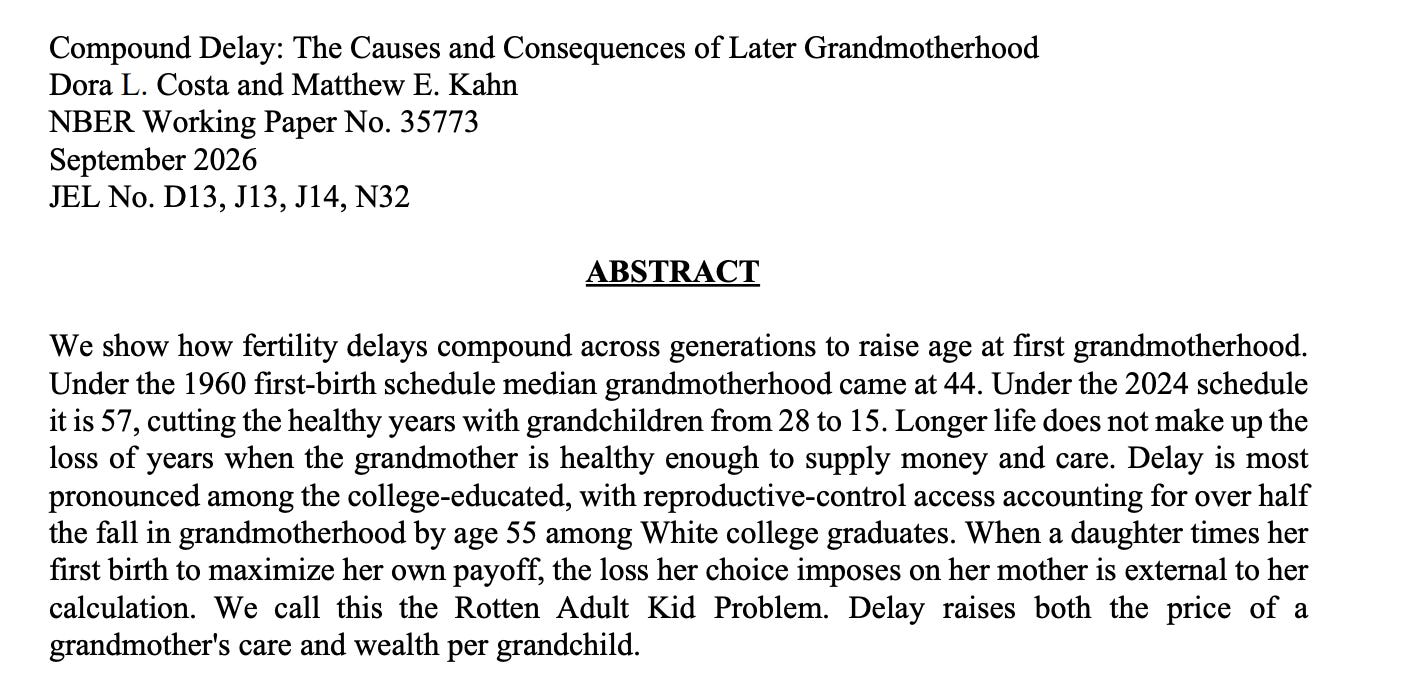
I balked at the language like “maximize her own payoff” to refer to a woman trying to time her pregnancies, the decision to say “the loss her choice imposes on her mother” and their rather proud decision to call it “the Rotten Adult Kid Problem” — a reference to economist Gary Becker’s “Rotten Kid Problem” which he coined in 1974 to describe how if a caring parent shares the family’s resources, then even a selfish child has a reason to avoid choices that leave the family worse off. My friend and I both thought this was gratuitous — and quite unfortunately so, since we both agreed the larger question of how declining birth rates/ delayed birth rates affects grandparents or would-be grandparents is an interesting and valuable one to talk about, as explored in this 2024 NYT piece.
Anyway, I tweeted twice about this.
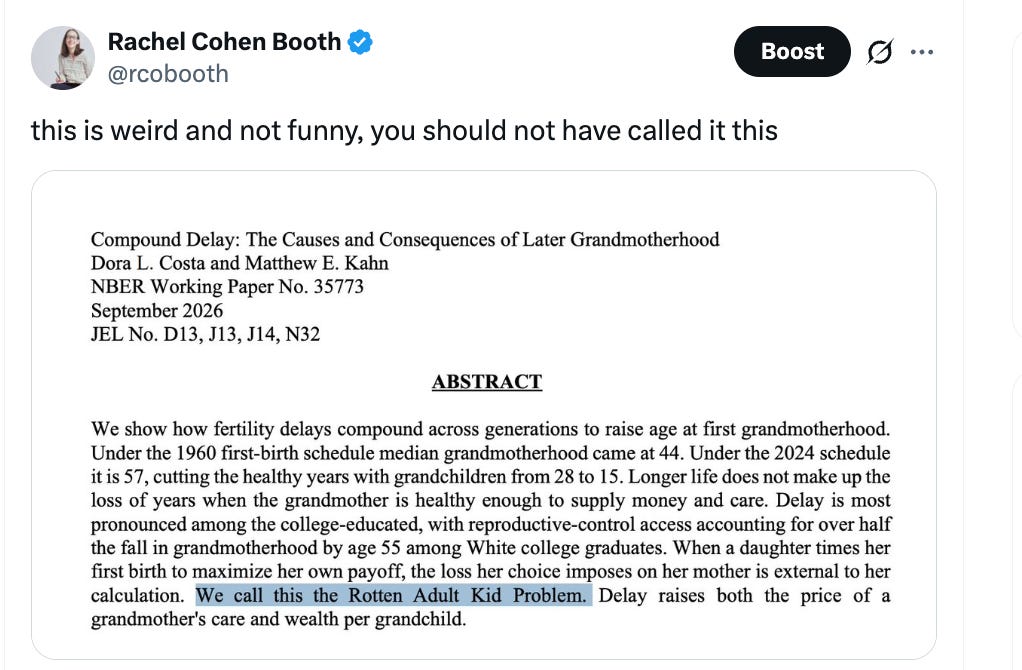
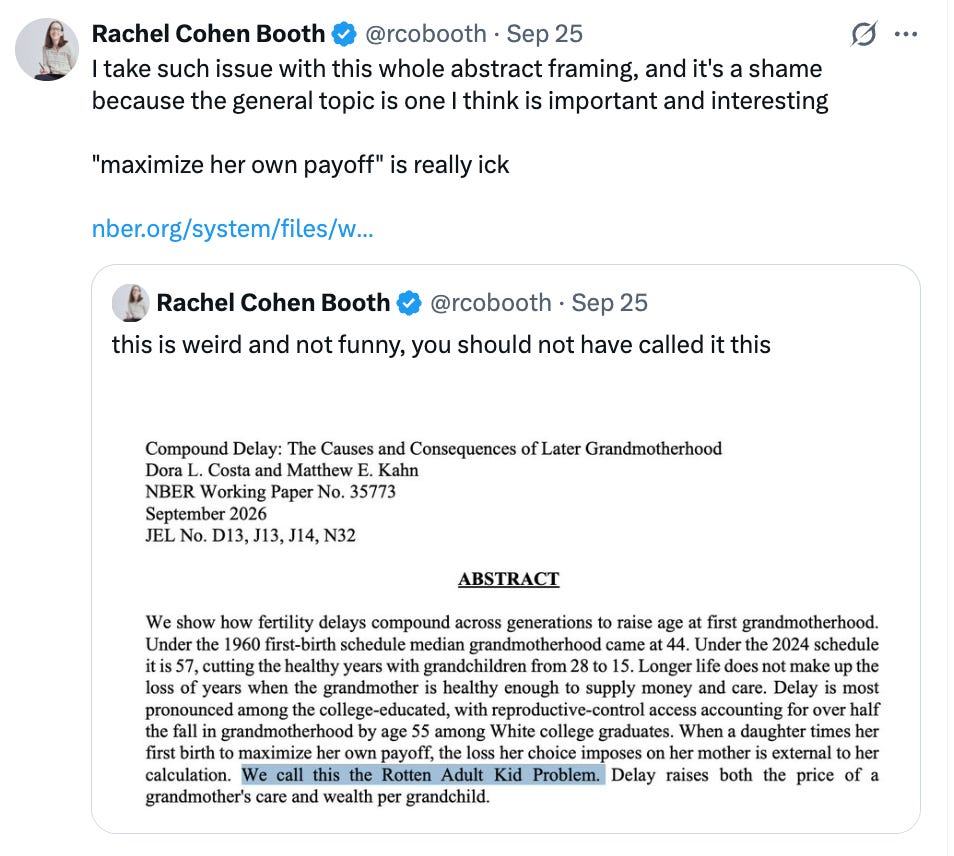
I immediately heard from dozens of people who had the same reaction. A few individuals (all men, for what it’s worth) said I’m effectively a humorless scold, others said oh no it’s a great analogy if you understand the academic literature. Sorry I do not think it’s constructive or appropriate to liken a woman’s decision to have children to being like a selfish child.
The day ended, I logged offline, had a nice evening with my son and husband and I went to bed.
Then I woke up on Saturday, checked my phone (I know, I know) and saw one of the co-authors of the study, (based in California) had quote-tweeted me and done a thread on Twitter at midnight ET.
It was, in my opinion, a confused, patronizing, and contradictory mess but I’ll paste it in full here.
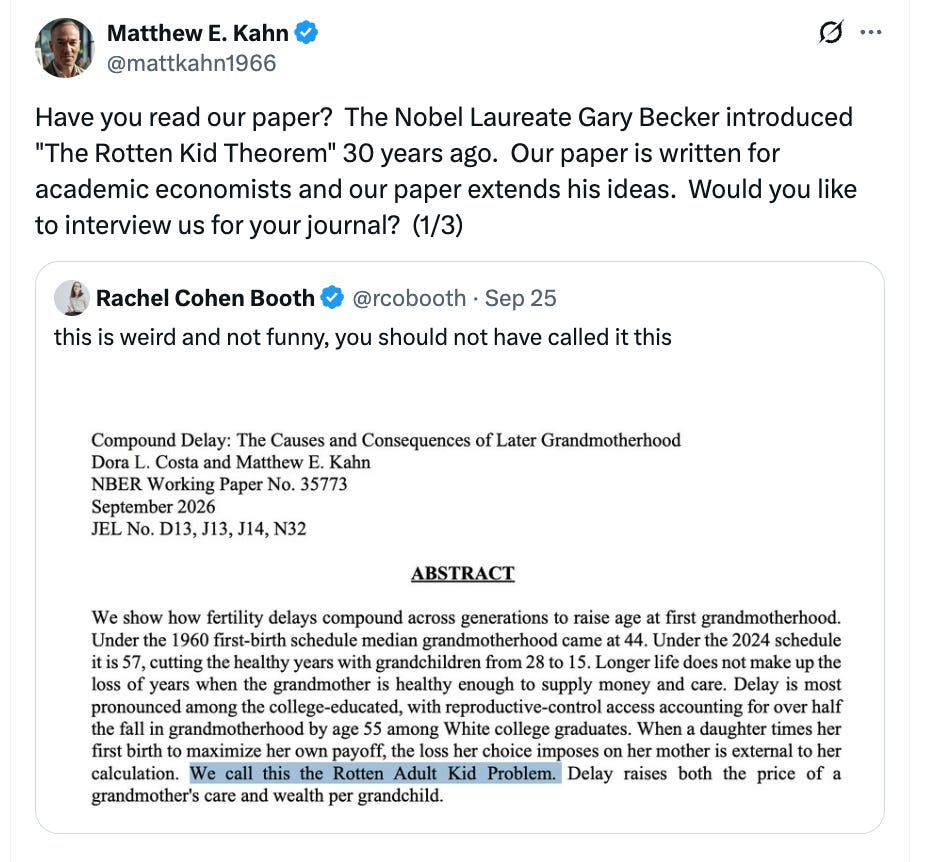
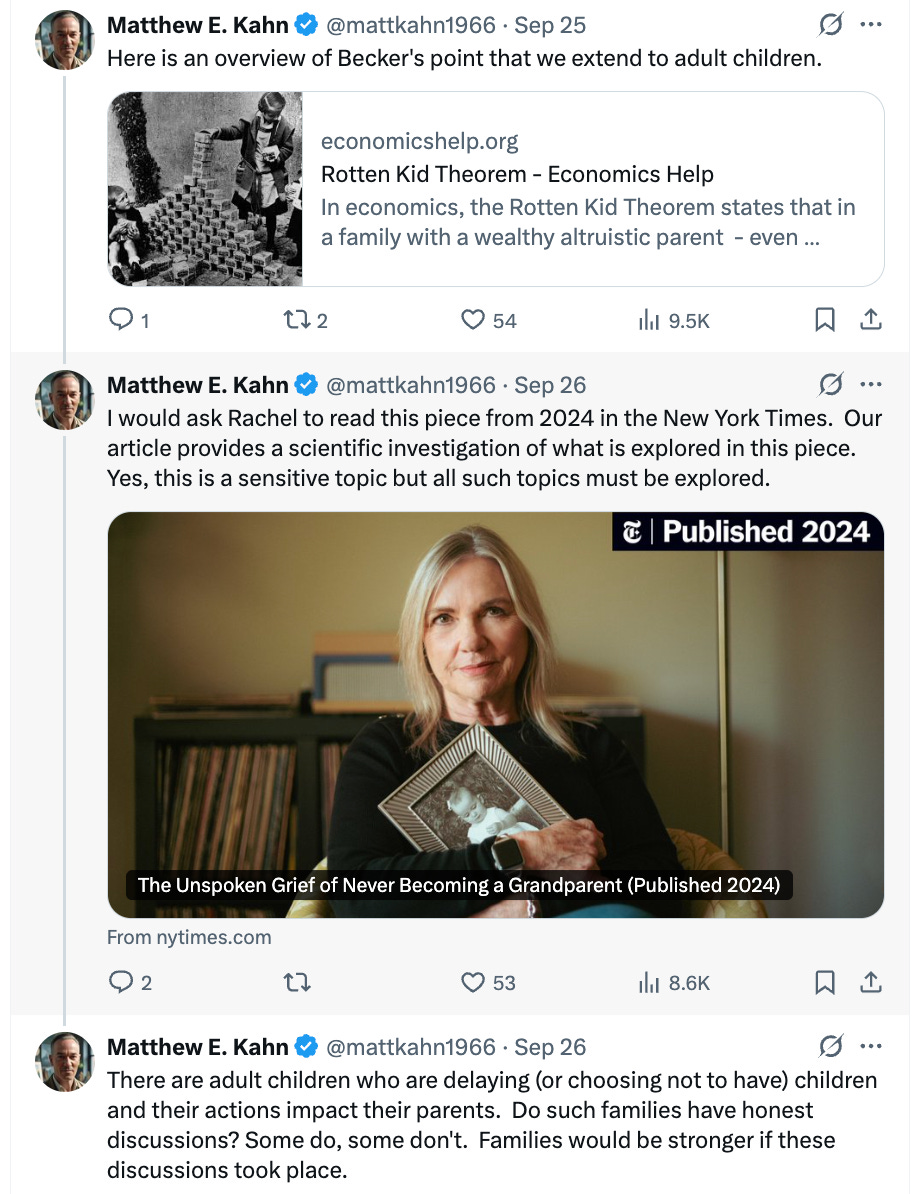
I am training for a 10K at the end of October, I decided alright I’ll bite and so I fired off a response before I went out for my run. (Though I feel like I shouldn’t have to say this, I’ll add that many academic economists were also put off!)
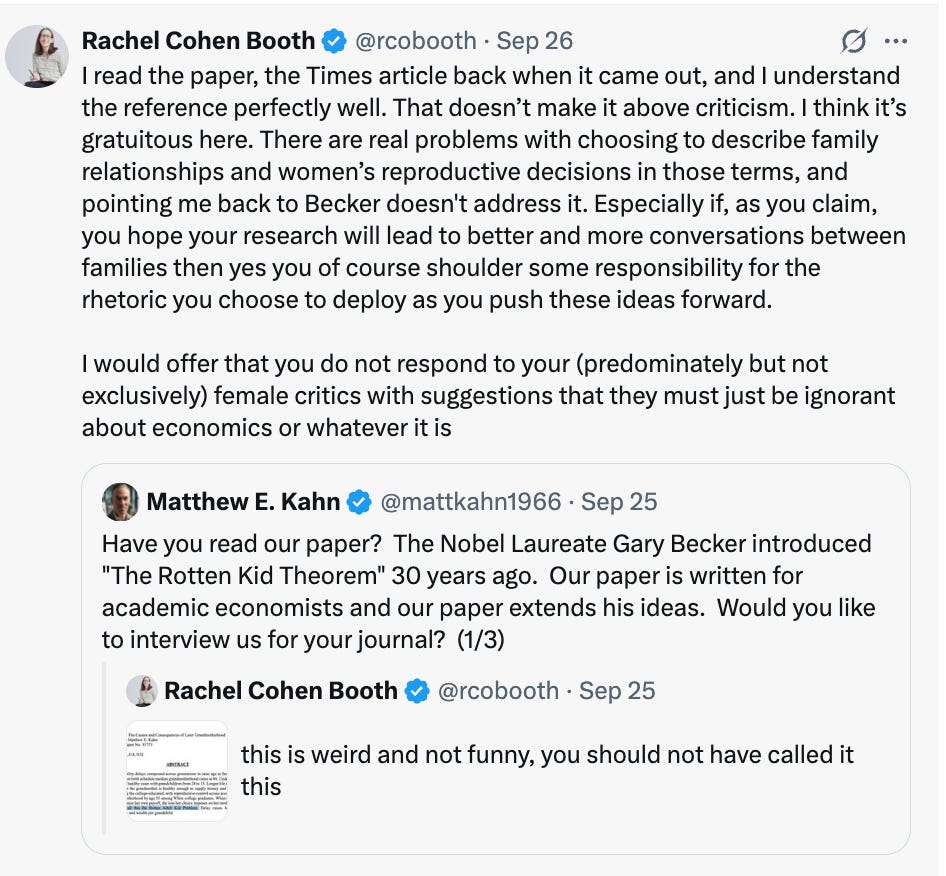
By the time I came back, he had actually published his own Substack post on this whole thing, and tweeted it at me. He and his wife, the study co-author, are not grandparents and wanted to explore those feelings and that phenomenon. I don’t begrudge that, though he then screenshots my tweets and writes, “Non-economists are reading our abstract and the word “rotten” is making them go a pinch nutty.”
Here’s some other…notable… parts from his post. (Bolded my own.)
For a 70 year old woman today who is not a grandmother and who has two adult children, has she had an honest discussion with her “kids” about her needs? What are her rights? If the family has had this discussion, then nobody is “rotten”. If the family hasn’t had these discussions because they are so awkward, then the Coase Theorem arises. While it is “tacky”, why didn’t the aging woman make an offer of $ or childcare to the adult kids to encourage them to have a child? Becker’s Rotten Kid Theorem focuses on this point about the gains to trade within a family.
…
Our choices have consequences for our family dynasties and for society . We need more people on this planet.
When an only child chooses not to have children, this person chooses to make that family extinct. Our paper explores the causes and the consequences of this within family externality. “Heavy is the head that wears the crown!” Adult children are no longer children and their choices have consequences.
In a world where people are having fewer children, these children decide the fate of the dynasty.
Anyway he (Matthew E. Kahn) tweeted at me a few times about this and I decided I’d do one more response, and then turn to my Saturday.
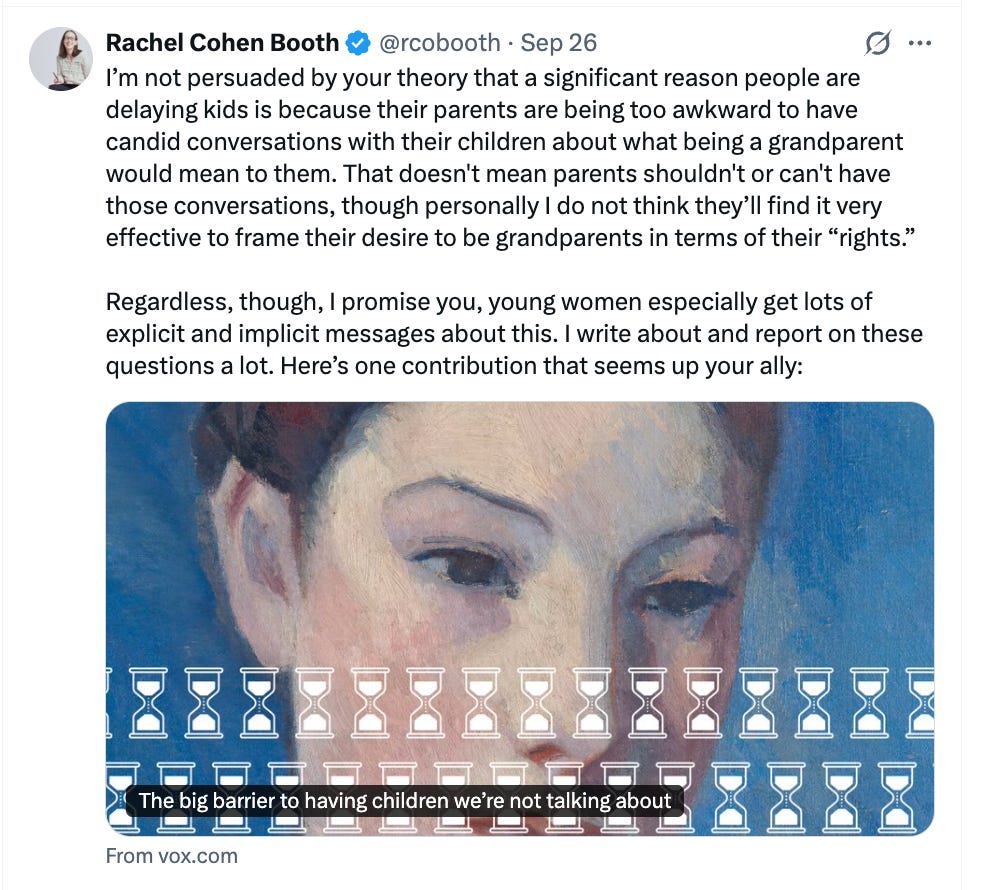
Here’s a gift link to that story, which I published last year about all the ways we make it difficult for people who want to have kids at earlier ages do so in today’s society. There are real policy and cultural changes we could make, and that I think that we should do them.
I appreciated his then respectful response to me (shown below). Though I realized today I want to say one other thing on this subject, and figure it was better to do it in non-tweet-form. (I still have people in my mentions tweeting at me that I should go learn some economics.)
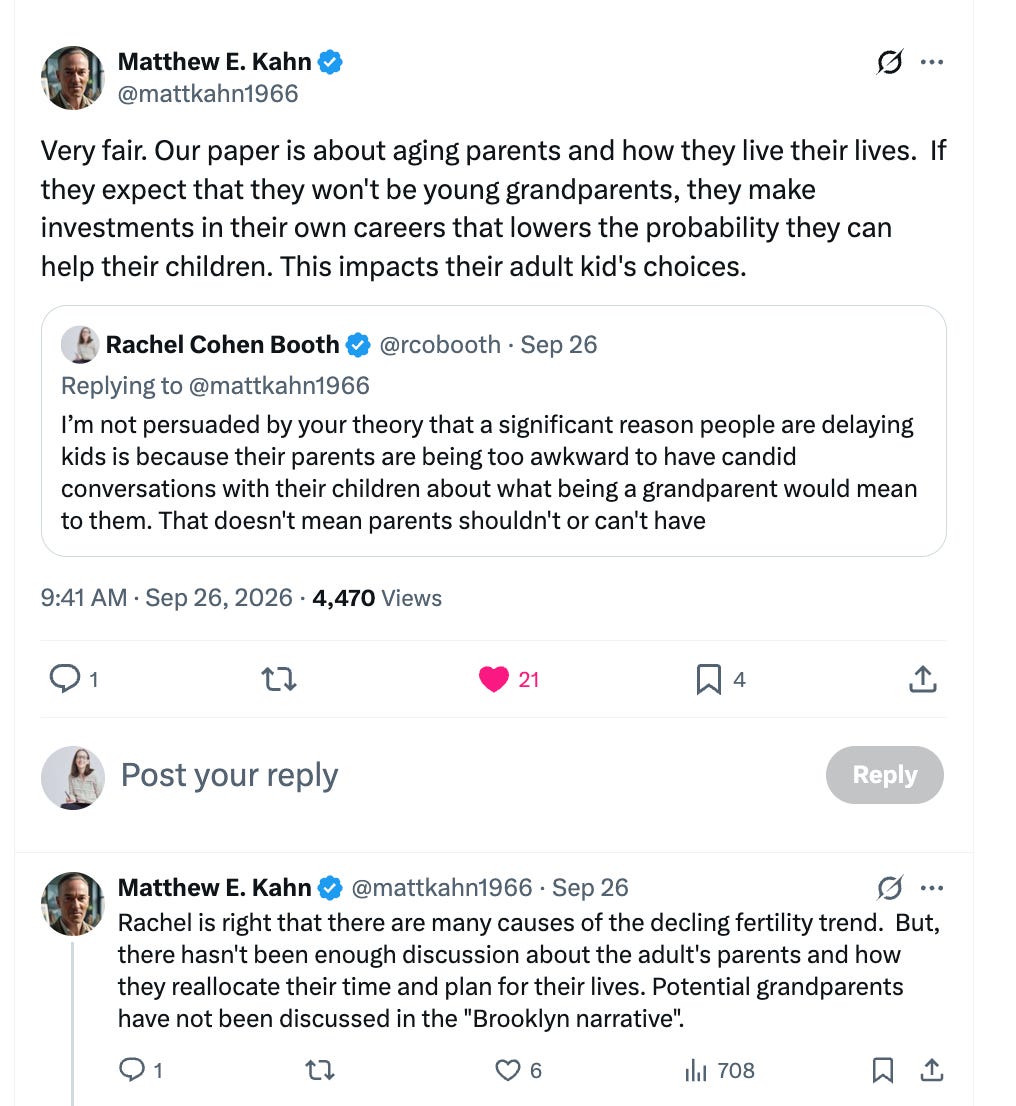
Anyway so Lyman Stone, which, for those of who don’t know, is a conservative demographer who is the director of the Pronatalism Institute at the Institute for Family Studies, started going on a tear at me yesterday about this. I’ve quoted Lyman’s work in the past and I’ve interviewed him directly for a few stories, but online he often treads into being-an-aggressive-jerk category, something he seems to relish and take pride in.
Yesterday he decided that despite me saying explicitly that I think exploring these intergenerational questions is interesting and important, I actually believe the opposite.
At this point I don’t expect Lyman to engage in this in good faith but I don’t like words being put into mouth, especially by someone who seems so sure he knows what I think despite what I say. It’s exhausting.
So for what it’s worth, I want to reiterate, I think exploring these questions is very much worth doing. And in fact aligns with questions I’ve thought about about in my work in the past and in my forthcoming book on individual agency and social change.
No I don’t think parents are entitled to grandchildren, but I think it’s totally reasonable and natural for parents to want them. And to feel disappointed if they don’t have them. Or to feel disappointed if they have them but they aren’t at an age where they can enjoy them like they’d like. Or to feel worried about what this might mean for their future care. I know many people my age are also experiencing the feeling of having kids, and wanting more help from their parents in caring for their kids than they’re receiving. Not because the grandparents are not physically able to care, but because the grandparents are living full, active lives and don’t want to babysit that much or be committed/locked into it. A lot of parents I know are grappling with feelings of disappointment, but also recognition that they’re not entitled to their parents’ grandparent caregiving.
Here are some other questions that I think might be interesting to explore in this vein, either academically or journalistically or through fiction:
From the grandparent or prospective grandparent side:
When a generation grows up assuming grandchildren will come, what happens to their sense of selves if that never arrives? How do you grieve or process something like that?
A lot of older people quietly assumed their kids, and eventually grandkids, would be there for connection and help as they aged. If that’s no longer looking likely, who steps in, and do the older parents feel they’re even allowed to ask? What space is there for those conversations?
A lot of meaning can be wrapped up in the idea that the family goes on after you. Without grandchildren, is there another way to feel that continuity?
When parents are still hoping and waiting as they get older, how is that drawn-out uncertainty different from hearing a clear no from their kids?
Are there parents who quietly don’t want to be grandparents, or feel relief when it doesn’t happen? Do they share that with anyone?
Do they think their own choices and regrets, and/or how they talked about parenthood, shaped their kids’ hesitation? Do they feel guilty or responsible?
From the adult child’s side:
When your parents want grandchildren and you’re not sure you do, how do you carry their longing without letting it make the decision for you?
Do you feel you owe your parents grandchildren? Do you think your parents think so?
Does watching your parents age without the grandchildren they hoped for stir guilt, or resentment? Do you feel any grief on their behalf?
Did you expect your parents to be more involved than they are now that you’re a parent? How does that make you feel?
Anyway I’d love to hear from all about any of this, or if there any other questions you’re thinking about in this vein.
Also wanted to share some of my recent reporting:
I looked at how abortion rights, and specifically her vote for Brett Kavanaugh in 2018 and the subsequent overturn of Roe v. Wade is playing out in the Maine Senate race between Troy Jackson and Susan Collins. And what a Collins win or loss would mean for 2028. You can read that here.
I wrote about the AI-in-schools backlash roiling around in the GOP, and why so many Republican parents and red states are pushing back on the White House’s vision. You can read that here.
I had a Q&A with Anna Louie Sussman about her new book Inconceivable, which unpacks why so many families struggle to build the families they want. You can read that here.
Thanks as always for reading,
Rachel


If I was Kahn's child, I am not sure how I would feel about him starting a Substack post that he is a father and not a grandfather. (I agree it is an interesting paper; also that information is not contained in the paper and I would feel weird about it being disclosed to the internet if I was his child.)
On a personal note: I am a childfree only child. My father has (a very serious) cancer, so we have been having a lot of "what regrets do you have" conversations. I asked if he felt like I made his life worse by choosing not to have children. His response was "it would have been nice, people say grandchildren are really special, but you shouldn't have children on my account". I think this is probably the view held by the majority of parents who will not be grandparents.
A major point that's frustrating me in this discourse (and perhaps it even is touched upon in the original paper) is that many millennials, the generation primarily targeted by this argument as the "Rotten Adult Kids," were themselves the children of parents who were already in their 30s when they were born, given the increase of women in the 1970s and '80s delaying motherhood because they now had more options and opportunities to do so. It seems disingenuous to solely blame today's 30- and 40somethings for compounding the grandchild-grandparent age gap.