

Here are the most interesting things I read, listened to, and watched in October. First, some announcements:
1. The ‘Films and cultural activities’ section of this post is paywalled. Upgrade to a paid subscription to read my reviews of: the new 5+ hour biopic about Charles de Gaulle, Possible Love, A Moon for the Misbegotten, Heat, Andrej Karpathy’s series of AI tutorials, the evolution of British supermarket aesthetics, and William F. Buckley’s response to the Northern Irish Troubles.
2. I just came runner-up in a competition for Irish economists to Ronan Lyons. I can only conclude that the election was rigged.
3. Apply to the Wolfram Winter School, which begins January 4th. I can never quite tell which side of the crank/genius line Stephen Wolfram is on a given issue, but this seems like a great way to find out.
Table of contents
Blogs and short links
Please read my review of the Daylight Computer. Since it came out, I have learned that the same company has now expanded its business into manufacturing lightbulbs, which, uhm, does not contradict my arguments about its leadership.1 There is also this prediction market indicating that there is a 63% chance that there will be a second generation of the Daylight Computer before 2028, which is honestly higher than I would have expected.
To paraphrase Sam Altman: AI will most likely lead to the end of the world, but in the meantime, there will be 200 additional jobs created in the Dublin Bay South constituency.
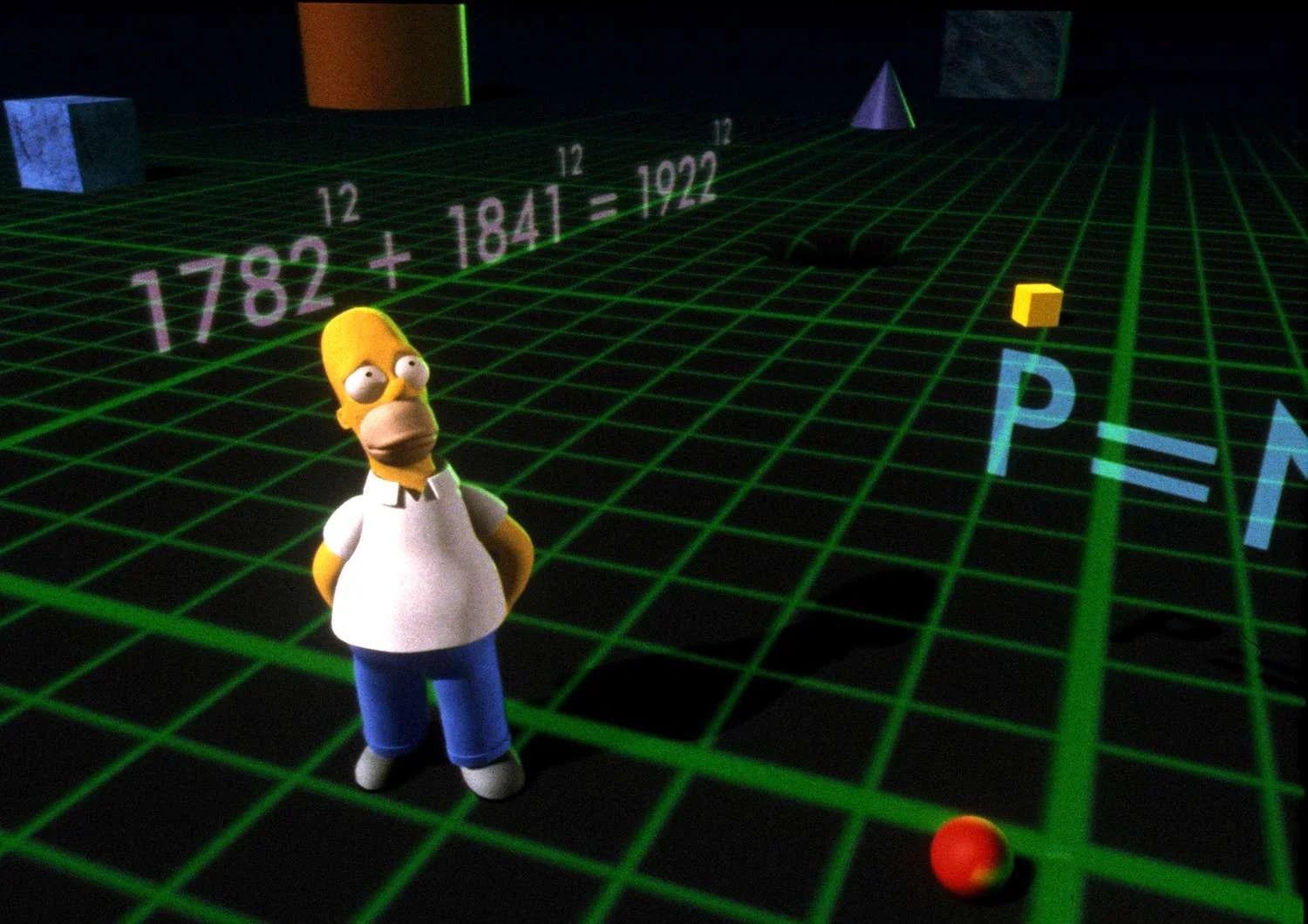
What you should know about the Lean theorem prover. Once you have understood this, you can move on to reading about Anthropic’s Lean formalisation of Fermat’s last theorem, a major achievement. As a child, I never really read books; the first non-children’s book I can recall finishing, which turned me on to regular reading at age 13, was Simon Singh’s history of Fermat’s last theorem. I still remember it fondly.
One of the greatest living jazz pianists is Brad Mehldau. He has now started a Substack. Here he is excoriating a New York Times critic for omitting Billy Joel from his list of greatest songwriters of all time:
[T]his is par for the course in the New York Times. Jon Caramanica is the latest iteration of a perennial figure: the Know-Nothing Pop Critic who thinks he knows something. He personifies the problem that has always existed in criticism of pop music – and historically, jazz as well. . . Namely: Jon Caramanica doesn’t know anything about the nuts and bolts of music. He is taken in with pop music as a cultural phenomenon, and not as a musical phenomenon.
This may also be a good time to revisit Henry Oliver on the philistine supremacy’s claim that Taylor Swift is just as good as Mary Shelley.
My housemate works in B2B SaaS,2 but we sometimes talk about how he was born to lead a pan-African logistics company. A new initiative, Exporters Without Borders, identifies promising export-oriented business ideas in developing countries and recruits founders to start them. Yes, yes, I know all about MITI and the Japanese Miracle and ITRI in Taiwan, but just as often, governments sink billions into misguided “national champions”, when it takes multinational entrepreneurs to actually create quality employment:
While the Indonesian government sank ~$2 billion into a failed national aircraft manufacturer, entrepreneurs grew a plywood industry from nothing to over $2 billion a year in exports. Bangladesh’s garment industry, likewise, came out of a single 1979 partnership between Korea’s Daewoo and Desh Garments, which sent 130 Bangladeshi workers to Korea to learn to make shirts. Upon returning home, many of them spun off competing firms, leading to an industry that now employs millions. In many cases [...] one or a few “anchor firms” showed the path to success and kickstarted a whole industry.
Jason Hausenloy bemoaning how intellectual discourse is boring these days because everybody works for an AI company.
From Adam Mastroianni’s Experimental History: The scientific misconduct of Francesca Gino and Dan Ariely, how AI surpassed human experts at conducting peer review, why tigers are orange, the influences on Oliver Sacks, how cosmic radiation looks to astronauts, and other links.
From the Pursuit of Liberalism, Henry Oliver on how difficult it’s become for Brits to credibly make fun of Americans:
[I]n many ways, England has been left behind. When you leave London and the South East, you quickly find a standard of living that is low by international standards. A recent poll of three thousand people found that more than half of Brits thought the UK would rank as the seventh-richest state if it joined the USA. In reality, we would rank fifty-first, with a lower GDP per capita than any of the fifty states.
And:
US gas prices might be over $4 a gallon at the national average this spring thanks to the war in Iran, but that is still half of what petrol costs in England thanks to high taxes. The British government is going to ban traditional dryers, which people hardly use because British electricity prices are among the highest in Europe, while Americans have relatively low-cost energy and run their dryers all the time. In London, it is normal to live with wet laundry in the house. The British who are sceptical of America like to ask, why do I need a bigger fridge? without having lived with the joy of a fridge that can actually hold enough food for a hungry family. . . . The standard of living in Britain has hardly improved since the financial crisis.
He just keeps going:
In response to the news that in some London boroughs two fifths of housing is socially rented—and of those people, nearly half are economically inactive—many British elites have denied any problem with this use of the capital’s housing stock . . . We think we are a free country, but there are thousands of recorded speech offences in the UK which would be unconstitutional in the USA.
Jordan Carr on the state of inference for robotics.3 Here is one dense but important passage, on the hardware bets that various companies are making about the compute needs for operating robots:
NVIDIA is the incumbent, betting on CUDA4 and software lock, Qualcomm is betting on unique plumbing and AMD is betting on FPGA.5 CUDA has proven valuable, to say the least, in the LLM market.
The key thing to bear in mind, though, is that CUDA is only a moat so long as model development is still the priority. Admittedly, this [no longer being the case] seems a long way off, but if we ever get to a point where robotics policies land on a standard VLA6 or WAM,7 then the switching costs [between chips will] become a one-time thing rather than a perpetual burden.
The end of these posts also has a cool feature where you can see how the author’s fake (?) money investments in the sector are performing.
I can never keep up with all the new things Gavin Leech is doing. He has launched a new research organisation called Paradigm 3; here is what they would like to fund.
The DeepMind Institute on cheaters and whistleblowers in the agent swarm. Has anybody clarified why the same people working out of the same building as DeepMind proper now count as an “institute”? Is this just pure mimesis of Anthropic?
The new cohort of Emergent Ventures India winners. I look forward to meeting the “backend engineer and eighth-generation Zoroastrian priest”.8
Currently, I reckon some of the most valuable economic data in the world is held by Stripe, since businesses using it generate the equivalent of 1.6% of global GDP,9 disproportionately concentrated in startups and AI companies. Here are interesting research questions they plan to look into with it.10
This list deepens my confusion about why it hasn’t been more common to bundle a software business with a hedge fund that trades on the information they receive from customers’ use of the product. Presumably Google could make a killing by using search trends or reading everybody’s emails to figure out mispriced assets. I guess the answer is just that “this is illegal”, but even after having spent a reasonable amount of time looking into securities law for exactly this sort of thing, I still feel like I don’t really understand why there aren’t more examples of people trying this in at least one jurisdiction.11
Ernie Tedeschi on Robert Hall and Michael Woodford’s Nobel Prize in Economics. This is an especially good read if you’ve heard about Bob Lucas and the “rational expectations” framework in macro, and wanted to know about how this ended up being actually useful.
As per usual, a thoughtful and moving life update from Witold Więcek. Did you know that, in Star Wars Episode VI, the Ewoks are speaking sped-up Tibetan? You may also have seen that Witold’s partner-in-crime Michael Kremer is now chief economist of the World Bank – very good news indeed!
Patrick Collison on The Brothers Karamazov.
Rebecca Lowe recommends twenty introductory classical music pieces.12 Here is also Rebecca’s appearance on the Year of Bach podcast. The host sometimes leaves comments on my blog posts; I hope one day my Bach knowledge will be sufficient to be invited on.
Tom McCarthy on the art of writing cold emails.13
I don’t want to adjudicate the “is AI a bubble?” debate, but this often turns into a sub-debate about whether the revenues of the labs will grow quickly enough to justify their astonishing valuations. Jamie Cassidy argues that this is completely the wrong metric; even if AI were a bubble, this is not where it would show up. And here is a follow-up now that Anthropic’s revenue growth has indeed slowed considerably. Jamie is putting real money behind his speculations, so we shall see if he is right.
In attempting to recall whether I’ve ever blogged before about Daron Acemoglu,14 I learned that I am one of the assigned authors on the University of Colorado’s Economic History of the United States class (for a blog post that no longer exists). An honour!
Luke Muehlhauser’s media diet. I will second his recommendation of John McLaughlin and Shakti.
A new tranche of Scott Sumner film reviews. You can compare his take on The Odyssey with mine.
Ben Yeoh claims:
My sense is that theatre and performance, in particular London theatre and performance, is full of energy at the moment. Arguably one of the strongest seasons in culture coming up in London. And, from what I can tell, echoed in New York.
I am glad that our friend group continues to spread joy:
Based on Fuchsia [Dunlop]’s new book, Neil Shevlin cooked us a banquet for a dinner party (being human!). I won this banquet in a ‘favour auction’ hosted by Sam Enright. I also made some new friends. I think favour auctions and dinner parties are big wins for friend-making!
I think I am attempting a recursive blog link series with Sam and his amazing esoteric links . . . He also links to me linking to him linking to me linking to him.
We are really putting the “self-improvement” in “recursive self-improvement”.
The rise of the Bayesian bookshop.
Nan Ransohoff on the third wave of American philanthropy.15 Nan is also leading the Intercept Fund, a $500 million initiative to end respiratory infections. Sadly, the funding for broad-spectrum preventatives for respiratory infections largely dried up after we found such effective but strain-specific COVID vaccines. This is an exciting initiative; there is no deep reason why humans should get colds.16
An interactive graph of the structure of the United States government.
After years of bookmarking things into oblivion, I finally learned where saved tweets go. As such, we have a longer “Best of Twitter” section this time around.
We begin with Michael Nielsen’s meta-thread of the greatest Twitter threads.
Here is also a beautiful one-life proof that there are infinitely many primes.
A narrative violation: on average, rents have been falling in the United States for the last four years and are in line with their long-run trend.17

Andy Matuschak on his magical printer machine.
Here is Claude’s reconstruction of the history of economic thought of how prices are determined. Not many people know that the smear “dismal science” was coined by Thomas Carlyle in a bizarre essay excoriating economics for failing to support his pro-slavery views.
Jesús Fernández-Villaverde’s list of economics papers a 21-year-old should read. A good list.
More claims about German notaries:
In Germany the notary gets 1% of the house sale price simply for reading out the contract. This fee is fixed by law.
Claims about Fidel Castro.
Nicholas Decker on price variations in ancient Babylon.
A remarkably coherent explainer of a number of GPU performance optimisation methods.
A thread of bands performing their now-incredibly-famous songs before they were known at all. (Or, is the market for music efficient?)
Patrick Collison on important historical novels and on the Silicon Valley canon.
What were the ten-year-old Terence Tao and Paul Erdős actually discussing in that famous photograph?
The current state of polygenic embryo screening.
PSA: Everyone constantly misuses the economic term “equilibrium”, whose meaning is actually highly unintuitive.
Podcasts
The Rest is History on the Suez Crisis, parts one and two. I didn’t know that Benjamin Disraeli’s government’s purchase of the Egyptian stake in the Suez Canal was financed by the Rothschild family.
I was recently invited to visit the Rothschild family archives in London (there is a lengthy screening process while they try to figure out if you’re an antisemitic conspiracy theorist). But I would feel like a chump visiting until I at least get through the Ferguson biographies.
Melvyn Bragg and guests on the Battle of Clontarf. I had no idea that Brian Boru was so important in the Icelandic sagas.
Ajeya Cotra breaking down the Hugging Face incident. This actually seems to be worse than most of the popular summaries?
Will O’Brien on John Collison’s Cheeky Pint podcast. I was pleased the show notes linked to Will’s Fitzwilliam post, No Great Stagnation in Guinness. The wall of the Cheeky Pint pub has a Tipperary North (TN) registration plate, which means that it came from before the 2014 merger that created Tipperary County Council.18 That’s a deep cut.
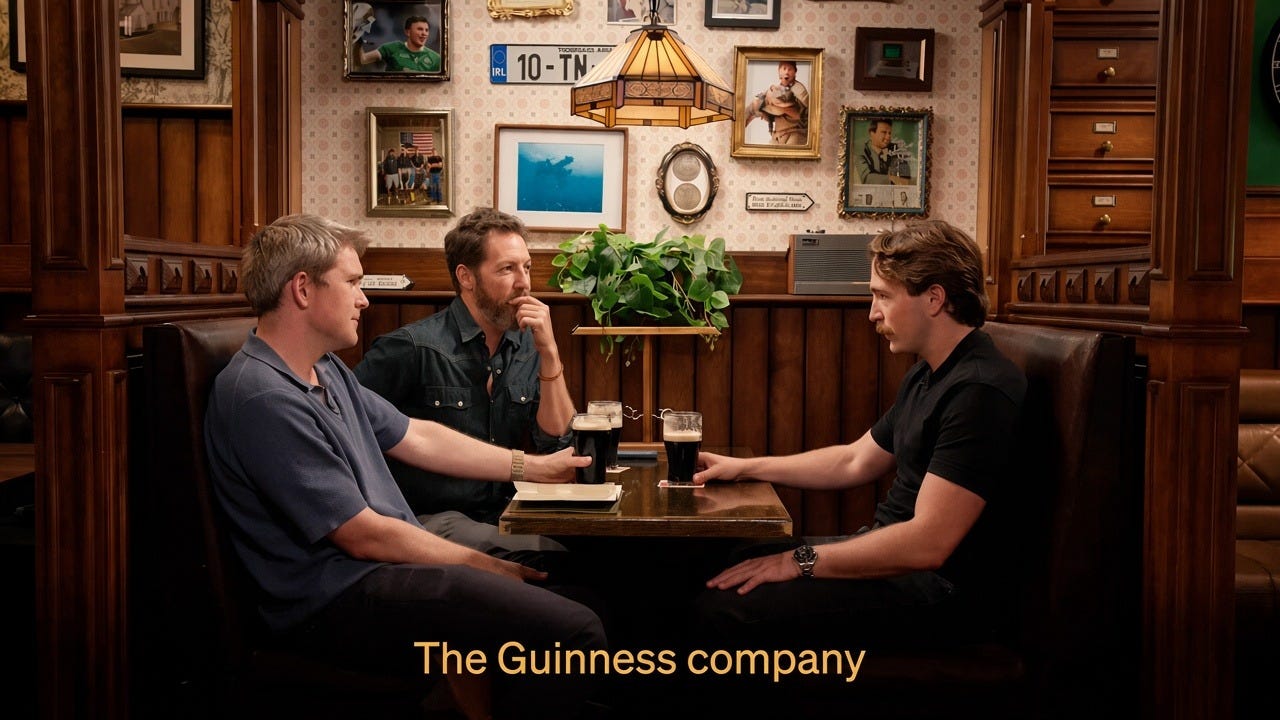
What has followed Will’s appearance has been a leaderboard of how many pints of Guinness each guest has drunk while on the podcast. Mark Zuckerberg had a remarkably poor performance, despite being a pillar of the Waterford GAA community (we live in such a weird timeline).
Luis Garicano on Spain and AI. The first time I met Luis, he greeted me with perhaps my favourite opening line: “Sam, I have heard such wonderful things about you, you can only disappoint me.” He has since given me a new European reform effort to feel depressed about, namely, the attempt to deepen European capital markets:
[W]hen [Europe] do[es] efforts, instead of “we put this new law and eliminate the previous ones”, the way it often happens in the European Parliament, European Commission, European Council, the European institutions, is we add this new law which is “harmonized”, but leave all the lower-layer laws there.
For example, we are giving right now in the new capital markets package more power to the European Securities Markets Authority, the ESMA, the SEC at the European level, without removing any power from the SEC at the national level, which means you’re not harmonizing anything. You’re just having more hurdles for people to raise money.
Ruby Wang on the evolution of Chinese healthcare, from the barefoot doctors on.
Music
Some new albums discovered, or listened to properly, this month:
Pyotr Ilyich Tchaikovsky, Symphony No. 6 (1893). And associated Sticky Notes, parts one and two. Putting aside the “Big Three” composers, this must surely be one of the greatest symphonies of all time? You almost certainly recognise the second theme of the first movement.19 I have been listening on repeat to the Berlin Philharmonic recording. While conventional movements for symphonies are (something like) allegro/andante/scherzo/allegro, this one is adagio/allegro/allegro/adagio.20
One of the things that intimidates people when they first start going to classical music concerts is that you’re not supposed to clap between the movements. If you do so, you are likely to be shushed and be highly embarrassed. That also means that sometimes an intense crescendo, as with the end of the third (allegro) movement here, is followed by a few seconds of eerie silence, before the music starts again more softly. It sounds weird live. Interestingly, this wasn’t the convention until well into the 20th century, and Tchaikovsky would have expected applause between the movements.
Sergei Rachmaninoff,21 Symphony No. 3 (1936). I listened to this performed live by the National Symphony Orchestra of Ireland last month, which was my second time hearing it in concert.22 This is probably my favourite Rachmaninoff. This piece premiered 20 years after he left during the Revolution, never to return. I guess I hear it as being distant and nostalgic for the Russia that could have been. This symphony also experiments with the conventional symphony format, only having three movements.
Hans Otte, Das Buch der Klänge (1982). I listened to this performed live last month by Xenia Pestova Bennett. This piece (whose name means “The Book of Sounds”) is a cycle of 12 parts by Hans Otte. It was composed between 1979 and 1982 and is considered one of the landmarks of European minimalism. Alas, it is too minimalist for me. I’m not sure that sitting down and listening the whole way through is the right way to consume this; if you try to do so, I anticipate you will be bored out of your mind. I think of it as almost like a more complex version of Brian Eno’s ambient music.
Otte was an interesting character: he introduced German audiences to then-obscure experimental composers like John Cage on Radio Bremen. Just one of many amazing cultural contributions of Bundesrepublik Deutschland.
Billy Joel, The Stranger (1977). A re-listen inspired by Mehldau’s rant. The title track is great, although I like Movin’ Out the most.
Papers
Alexander Bastounis et al., Navier-Stokes lost in translation: Why Lean verification of AI autoformalisation does not guarantee correct natural language proofs. You probably have heard about the ‘formal verification’ methods currently being used to algorithmically verify the correctness of purported mathematics proofs. Many details about these methods are commonly misunderstood. We just ran a session about this for the Fitzwilliam AI Circle; you can read the discussion prompts here.
Billy Snikkers et al., Formalizing Hironaka’s Resolution of Singularities. See the prompts.
Saint Patrick, Confessio. I was astonished to learn earlier this year that we have surviving writings from Saint Patrick himself.23 This is a short essay he wrote about his life and faith, written when he was a bishop, and directed at other members of the clergy.
Patrick seems to be under scrutiny from the church and feels the need to write something to clear his name. A “confession” at the time was more of a declaration of faith than actually confessing to anything bad you did.24 Patrick says that he did something sinful which lasted one hour when he was 15, but won’t tell us what it is.
Obviously, I can think of at least one sinful thing that teenage boys sometimes do, but it’s sort of unclear that the pre-Aquinas Christianity was sufficiently anti-masturbation that this would have become a Britain-wide scandal.
This is one of the most interesting historical manuscripts I’ve read in a long time. I even posted it into my Irish family’s WhatsApp group, although (perhaps unsurprisingly) nobody replied.
Saint Patrick, Letter to the Soldiers of Coroticus. Coroticus was a British warlord in the 5th century whose soldiers raided the east coast of Ireland and killed a group of Patrick’s converts. In response, Patrick wrote this letter, publicly denouncing and excommunicating Coroticus’s men, and telling other Christians not to associate with them. This is shorter than the Confessio, and follows from an even shorter letter in which Patrick asked for the captives back (which was met with mockery).
If you’re interested in early Christian arguments against slavery, this is an especially good read.
Like all but one of the patron saints of the British Isles, Patrick was not born in the country he represents, having been brought to Ireland as a slave aged 16.25 Perhaps not unrelatedly, his affection for the Irish is far from evident:
I declare that I, Patrick, – an unlearned sinner indeed – have been established a bishop in Ireland. I hold quite certainly that what I am, I have accepted from God. I live as an alien among non-Roman peoples, an exile on account of the love of God – he is my witness that this is so. It is not that I would choose to let anything so blunt and harsh come from my mouth, but I am driven by the zeal for God. And the truth of Christ stimulates me, for love of neighbours and children: for these, I have given up my homeland and my parents, and my very life to death, if I am worthy of that. I live for my God, to teach these peoples, even if I am despised by some.
It was surprising to me the extent to which Patrick thought of himself first and foremost as a Roman citizen. You really get the sense that the barbarians are at the gates, and the empire is only a few decades away from collapsing. He denounces Coroticus’s men for being “allies of… Scots and Picts” (the horror!).26 When I was reading, I couldn’t stop thinking about the Asterix comics.
Shannon Kim et al., Stereoselectivity of Aminoacyl-RNA Loop-Closing Ligation. I have made many previous attempts to read and understand this paper – not because I am in any position to write about it, but because my girlfriend is the lead author.27 Everybody expresses their love in different ways; I did it by grinding dozens of spaced repetition flashcards and familiarising myself with the relevant literature.
You probably know that the big important molecules in life mostly have the property of “handedness” (chirality). The two mirror-image forms of a molecule are called enantiomers. If an environment only has one type of chirality, then it is homochiral (or ‘enantiopure’). If it is a 50/50 mix between enantiomers, it is called ‘racemic’. Confusingly, left-handedness is indicated with an L while right-handedness is indicated by a D (from Latin ‘dexter’).
Life is made up of only one handedness, and nobody really knows why. Specifically, life is made up of D-nucleotides and L-amino acids. 28
To refresh your memory from secondary school biology: a nucleotide is made up of a sugar, a phosphate group, and a base (one of A, C, G, or T, with uracil (U) replacing thymine (T) in the case of RNA). An “oligonucleotide” is just a fancy name for a short chain of nucleotides. In papers like this, you’ll see this intimidating apostrophe-based notation, where 3’ just refers to the third carbon atom of the sugar.
Last month, the Nobel Prize in Chemistry was given to Kensō Soai29 for his work on “asymmetric autocatalysis”. In 1995, he demonstrated a reaction that amplified small deviations from racemic balance, in which the product of the reaction would catalyse its own formation. So a sample that begins with only a slight deviation from a 50/50 balance of enantiomers can end up as very lopsidedly one-handed.30
Ribonucleic acid (RNA) is made up of a chain of nucleotides, and Shannon takes it for granted that homochiral RNA came relatively early in the Earth’s history. Some of the arguments for why this is reasonable to assume come from the RNA world line of thinking dating back to Francis Crick and Leslie Orgel in the 1960s.31 This paper is primarily about, given homochiral RNA, how that homochirality gets passed on to amino acids.32
Amino acids are the building blocks of protein, and thus, the paper addresses a pretty important intermediate link to understand the origins of life. The origins of homochirality is among the biggest open problems of the field.
The RNA world hypothesis sounds surprising if you remember the central dogma, which posits a unidirectional flow of information whereby DNA makes RNA and RNA makes protein.33 Given this, it’s perhaps surprising that RNA most likely existed before DNA did.
In order to understand the actual experiment, I worked through the title one word at a time:
Stereoselectivity means that a chemical reaction produces one stereoisomer more than others. A ‘stereoisomer’ is an isomer for which the chemical formula and connectivity are the same, but the spatial arrangement of the atoms is different.34
Aminoacyl-RNA is RNA with an amino acid chemically attached to it.
Loop-closing describes how the reaction changes the shape of the RNA: it turns two strands into one continuous strand folded back on itself. The standard term for the product is a “hairpin”, because (if you squint) that’s sort of what the product looks like.
Ligation means that the joining together is done with a covalent bond.
This stereoselective aminoacyl-RNA loop-closing ligation reaction (whew!) occurs much faster for L-amino acids than for D-amino acids. You can also show that L-RNA symmetrically shows the opposite preference, in which D-amino acids are favoured. The basic mechanism is fairly straightforward, but the experimental setup to show this is extremely finicky.
Previous papers about related reactions found stereoselectivity of at most an order of magnitude between L-amino acids and D-amino acids, but Shannon observed up to 200-fold stereoselectivity. She also observed much weaker levels of stereoselectivity in other reactions, but there was stereoselectivity consistently in the predicted direction even when the RNA structure and the amino acids were varied.35
The paper rules out various alternative explanations for why L and D molecules could end up producing different amounts of the product. The “obvious” (not to me!) way would be hydrolysis, or the breaking of chemical bonds with water.
Finally, as with our previous discussion about how to read neuroscience papers, chemistry is unreasonably intimidating until you take time to learn the naming conventions. The product of the reaction in this paper is called ‘phosphoramidate’. When it’s observed that the two ends of the “hairpin” have joined through ligation, the existence of the phosphoramidate is inferred as the chemical bridge connecting one end of the RNA to the other. The name phosphoramidate looks scary, but you need to break it down:
The central atom is phosphorus.
-amid- means that a nitrogen-containing group has taken the place of a hydroxyl (–OH) group.
-ate means that the molecule is the fully oxidised form of an oxygen-containing acid (”oxyacid”), or a salt or ester of one.
The phosphoramidate is a ‘functional group’ rather than a specific molecule: a recipe, like hydroxyl, for how certain atoms are connected. Think of it this way: the amino acid (from the ‘aminoacyl’ in the title) is like a bridge. The phosphoramidate is like the cement connecting that bridge to the other end of the RNA. The amino acid was already connected to one of the ends of the RNA using an ester bond.
After I wrote the above, I asked the author to grade my response, and she said:
I give you an 8/10 for close reading of the paper and 7/10 for comprehension of the surrounding field for a 7.5 overall.
I’ll take it! To my reading, Shannon’s paper has made the RNA-to-amino-acid chirality transfer story about the origins of life more plausible. Although, as academics always like to say to secure more grant money, “more research is needed”.
Books
Jeffrey Gantz (translator), Early Irish Myths and Sagas. Every Irish child grows up hearing stories about Fionn mac Cumhaill, the Salmon of Knowledge, and the many modern retellings of the Irish myths. But I had never before actually read any original Celtic mythology, so I decided to finally do so with my buddies for the Halloween special of the Fitzwilliam Reading Group. You can read the discussion prompts here. I brought a hurley and was kitted out in my Cork 2026 gear for the occasion.36
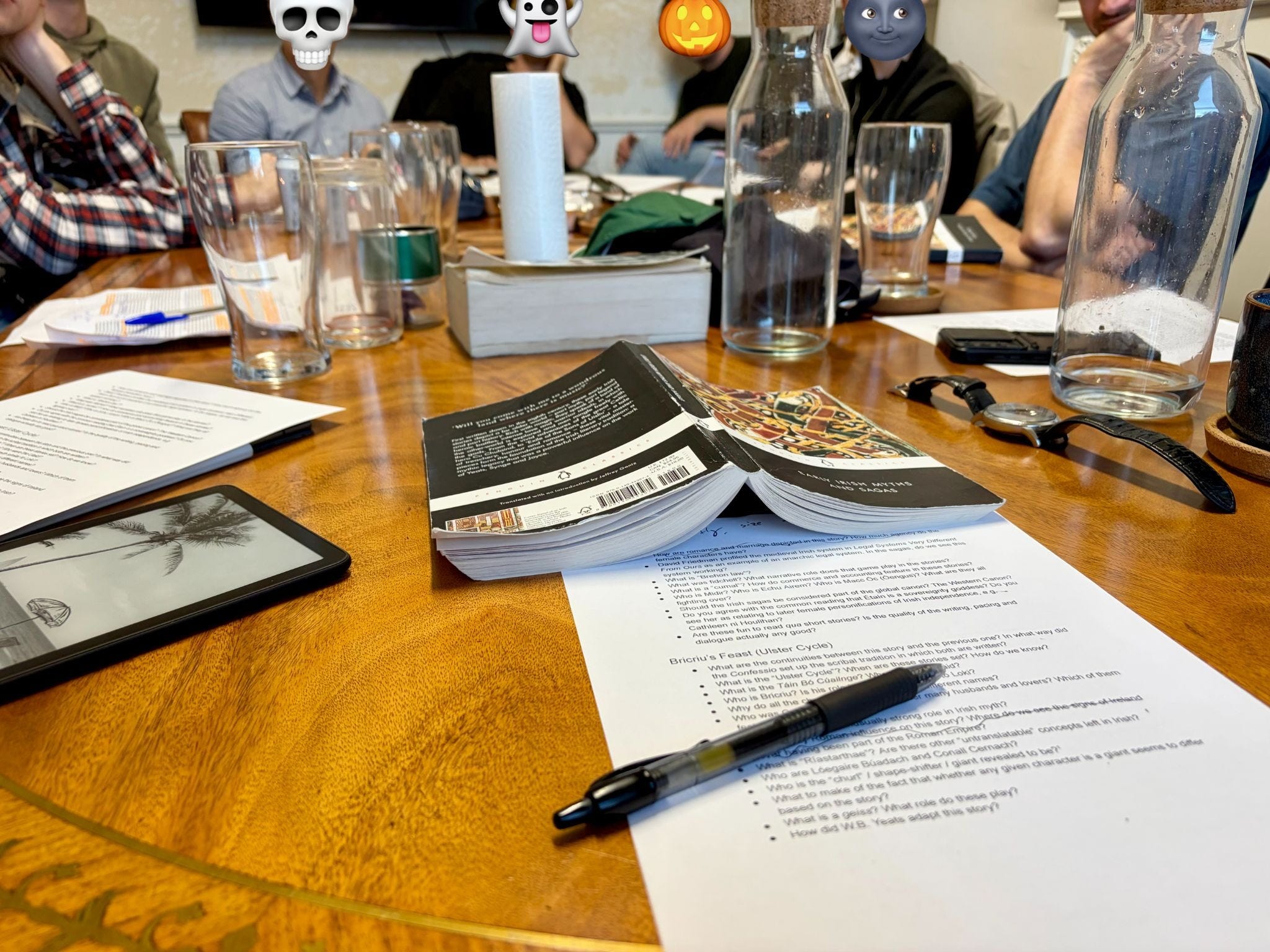
I found this to be incredibly fun. But the translation we chose was an odd one. I say this with utmost respect, given that he received a PhD in Celtic languages from Harvard and is a world-renowned expert in the field, but Jeffrey Gantz is a weeb for Ireland.37 I have a hard time evaluating the literary merits of these stories, given that the only reason anybody would possibly learn the obscure language needed to understand them is that they already love Irish mythology.
In this book, the proper nouns and some phrases were left untranslated in Old Irish. In the introduction, Gantz says that Old Irish pronunciation is easy to pick up and more intuitive than modern Irish. Maybe for him! A significant fraction of our group is fluent in Irish, and we still found it baffling. I find something distasteful about not translating a phrase the way it has already become universally known in English (e.g. he writes ‘Cú Chulaind’). I remember one time I read a translation of the Discourse on Method by Descartes which used a tortured literal translation from the French to avoid saying “I think, therefore I am”. Mate!
The names are tricky. One of the most famous and well-regarded stories is The Wooing of Étaín, which most Celticists think would have been pronounced ‘AY-dine’.38
Irish mythology is divided into four main cycles. This collection only contained stories from the Ulster Cycle (which is primarily about the gigachad Cú Chulainn) and the Mythological Cycle (about the race of gods the Tuatha Dé Danann). There is nothing about events that may have actually happened (the Cycles of the Kings) or about Fionn mac Cumhaill and the Fianna (the Fenian Cycle).
Unsurprisingly, a big question that hangs over the written versions of these myths is how much of it is a post-hoc reconstruction by churchmen to make a pagan belief system compatible with Christianity. There are a lot of points at which it feels like mystical beliefs are being gestured at, but having their specific content cut out in a way that creates a non sequitur, as in The Cattle Raid of Fróech (page 125):
Findabair sent her maid to look for the ring, and she said to Ailill ‘I swear by the god my people swear by. . . .’
(And which god would that be, Findabair?)
The units that numbers are given in are weird. All units of large numbers of people are given in units of fifty. Many other things are given in units of three or nine. The question of what base numeral system Celtic languages use is surprisingly complicated: the myths are mostly in base 10, but vigesimal (base 20) counting became common later. You may have seen those videos about farmers from Northern England counting in base 20, which is part of the same lineage.
Like Odysseus, Cú Chulainn is clearly a psychopath. In The Boyhood Deeds of Cú Chulainn, he is in his “ríastarthae”, a mysterious untranslatable super saiyan mode of Irish mythology which Thomas Kinsella famously translated as “warp-spasm”. The only way the villagers in the capital of the Ulaid can think of to calm him down in such a way that they don’t all get massacred is to put naked women in the front of the village. He is then dunked into a vat of cold water when he hides his face to save his modesty from bare-breasted ladies. Classic.
I was surprised that The Wasting Sickness of Cú Chulainn and The Only Jealousy of Emer39 were the only times in the collection that poetry plays a large part.
I was also reminded of the oddly specific mytho-religious tradition of things lasting forty days and nights (page 218):
Cú Chulaind entertained the Ulaid for forty nights with one feast; after that, they departed and left their blessing with him.
If nothing else, the Irish myths continue to be a fruitful source of baby-naming inspiration. It’s important to me that my hypothetical future children have artificial difficulty injected into their lives by having difficult-to-pronounce Irish names. Names like Deirdre, Oisín, Gráinne, Niamh, Emer, Aoife, and Naoise, which everybody knows today, were very obscure until the Gaelic Revival in the 19th century. Having previously been very similar, Irish and English names increasingly diverged in the 20th century.
This pattern was surprisingly reminiscent of what happened to African American naming conventions during and after the Civil Rights movement. White and Black Americans had similar naming conventions until the 1960s, and then, within a few years, they diverged rapidly, with a long tail of distinctive names like ‘Jamal’, ‘Lakisha’, and ‘DeShawn’ entering prominence. Contra the bizarre and racist cynicism about this, it is perfectly good and proper that culture is a procession of one made-up thing after another.
I also since came across this person talking about their experience regularly programming using the Daylight.
(Derogatory.)
I found this to be a challenging read, given that I know so little about robots. Note: I tidied up the grammar in this excerpt, since the paragraph was already so complicated.
CUDA is the software environment that NVIDIA uses to get calculations to run on its GPUs. Common deep learning frameworks like PyTorch and TensorFlow are built atop CUDA, which is one of the reasons why NVIDIA is so dominant and indeed why Jensen Huang is one of the most powerful men in the world.
A field-programmable gate array (FPGA) is a chip whose internal circuitry can be rewired. I understand it to be a large grid of basic logic blocks with programmable connections between them. This is in contrast to CPUs and GPUs, which have fixed circuits that run software instructions one after another. You can think of the FPGA being a way of computing “in space” rather than “in time”.
A vision-language-action model (VLA) is the dominant way of getting general-purpose robots to work right now. It’s basically a multimodal language model – which previous papers I’ve written about can help you understand – that outputs instructions for what actions the robot should take. Until fairly recently, the VLA outputted tokens, the same as a language model. Partly due to the influence of π0, a model released by Physical Intelligence, the VLAs have moved toward outputting a matrix of real numbers, which means that the robots can receive fully continuous instructions, and they no longer have to deal with the well-known quirks of the tokenisation procedure.
A world action model (WAM) is a different architecture that learns to predict how the world will change at the same time as it’s deciding what to do. This term mostly comes from NVIDIA. VLAs are mostly pretrained on static images and text, while WAMs are mostly pretrained on video. Famously, there is a zillion hours of video of people doing all sorts of random stuff on the internet, but you get very little useful information per token by training on it. As such, the VLA versus WAM debates hinge upon (a) whether there will be algorithmic breakthroughs allowing for more efficient pretraining on video, and also (b) whether there will be sufficient supply of new video data useful for robots’ understanding of physics and fine motor control. If (b) ends up being the binding constraint, then it would be a good time to own a proprietary source of video taken from eye level of physical objects being manipulated – like, hypothetically, from AI sunglasses.
This reminded me of Scott Alexander’s comment: “At this point I would be more impressed to meet a Buddhist meditation teacher who wasn’t a neuroscience PhD.”
This number is highly misleading, in that revenue-generation for a business captures trade of intermediate goods, while GDP measures final goods. The total volume of transactions is many multiples of GDP. If you and I take a $1 loaf of bread and buy and sell it back to each other two trillion times, then our business is the “equivalent of” 1.6% of global GDP.
Ordinarily, I would get annoyed about this kind of marketing, but the business has a good sense of humour about it, as with Patrick Collison joking (?) with Dwarkesh Patel that there is no reason why Stripe shouldn’t be more than 100% of global GDP.
There is also Stripe’s data on European stagnation. The most interesting one of these to me is restructuring costs per employee.
As always, speculation on the blog is not advice!
Here is the Apple Music playlist and my attempted reconstruction on Spotify.
A reminder: my email is sam@thefitzwilliam.com.
Answer: no.
Nan previously featured on the blog as the creator of the directory of syllabi.
Intercept is the spiritual successor to Frontier, a $1.8 billion advance market commitment from Stripe and others to accelerate carbon removal.
Going to college also continues to become more affordable.
You can see people grumbling about this on the subreddit for Tipperary (I did not know this was a thing).
The movement is in sonata form, which often means there are two themes.
It’s worth learning if you’re not familiar with Italian tempo notation.
You may have also seen this written as ‘Rachmaninov’. The transliteration of his name is a complete mess.
The other time was by the Royal Scottish National Orchestra, conducted by Patrick Hahn.
This first appeared in the Book of Armagh. It is highly debatable how close this is to what Patrick originally wrote.
This reminded me a bit of the evolution of the term “apology”. Socrates in Plato’s Apology is emphatically not apologising.
Whether Patrick was born in Wales, as I learned in school, is highly debatable. In general, very little is known about his life. If this surprises you, you should update your beliefs about the epistemic status of 5th-century saints.
Confusingly, “Scots” (Scotti) used to refer to Gaelic-speaking Irish people.
I am so proud of her!
You may also have heard of this because of worries about mirror life: there doesn’t seem to be any biological reason why life could not have instead been made out of L-nucleotides and D-amino acids. A mirror life infection could live off ordinary non-chiral nutrients inside your body, and your immune system’s responses would be completely ineffective because they are based on recognising molecular shape. Obviously, this is incredibly speculative, but there are some people who believe that this is one of the primary threat vectors whereby a misaligned superintelligence could lead to the extinction of the human race.
Jointly with Henri Kagan. This was quite unexpected: the winning candidates were not even listed in the Nobel Prize prediction market.
An analogous process for the chirality of crystals is called Viedma ripening.
Never forget Orgel’s second law: evolution is cleverer than you are.
Strictly speaking, I think it’s more about homochiral RNA giving rise to a homochiral reaction mechanism. The mix of amino acids themselves could theoretically be a racemic mixture if there is a selective mechanism whereby left-handed molecules are the ones chosen to do certain biological functions.
What Francis Crick actually meant by “the central dogma” is widely misunderstood. Crick just said that once information is passed into a protein, it can’t pass out again. The one-way flow-chart is a later, stronger, claim, which is more of a rough heuristic. You’ll often hear people say that the existence of reverse transcriptase violates (Crick’s sense of) the central dogma, which is wrong. Ozturk, Sasselov, and Sutherland have an interesting paper on what they call “the central dogma of biological homochirality”, in which they propose that handedness spreads from an RNA precursor to RNA to proteins to all other biological chiral molecules.
They thus have the same molecular graph.
There were three RNA architectures tried for each of four amino acids. Recall that there are about 20 types of amino acid total.
I was unable to procure a Celtic druid costume in time. Here are some real-life druids visiting the Hill of Tara.
He also translated the Mabinogion, the best-known body of Welsh literature (Welsh and Irish literature have some of the same characters). I’m told that his Irish translations are a lot more intuitive once you’ve understood his approach to translating Welsh.
Here is Lee Mack on Irish names.
This is the inspiration behind one of Yeats’s plays.


