
Note: I occasionally do posts that are not based on rock-solid evidence but instead are my speculation and vibing on a topic. This is one such. If you respond angry that I didn’t fully prove the thesis, you got got.
Man is born free, yet everywhere is in chains. So quoth Rousseau. He was correct in a certain sense: small-scale societies and hunter-gatherers do enjoy a high degree of certain types of freedom. Lacking states, and with “exit” always an option to go start your own micro-society, without borders, with the means of subsistence basically always at hand, hunter-gatherers do enjoy a high degree of a certain kind of freedom.
On the other hand, modernity does offer many chains. Fences and walls abound; you cannot simply set off across country so easily. Subsistence requires cooperation of many millions of people. You must drive in a certain lane. There are rules about what you wear. A key difference between small-scale hunter-gatherer societies and societies from agriculture to the present is that these larger-scale societies depend upon orderliness and this dependence motivates strict norm-enforcement.
This is not the speculative part of the post. I am informing you of facts. A recent large study, for example, found that agricultural societies make far more use of corporal punishment than hunter-gatherers. This is part of a broader trend: societies where subsistence allows more accumulation and requires participation by more people tend to emphasize obedience more. At the extreme, places with more historic rice cultivation (which requires a lot of cooperation) really do have more obedience, conformity, and collectivism-emphases in their culture, this relationship is probably causal, and it probably extends to parenting behaviors. It just is the case that agricultural societies have different parenting norms.
And this brings us to the speculative questions: first, a question which is largely addressed in scholarly literature, “Why?” do settled societies parent the way they do and, second, a question where I’m going to embark on wildly provocative parenting claims, “What does this tell us about how we should raise our own kids?”
In this post, based on only the barest shreds of evidence and obviously unreasonable readings of that evidence, I will:
1. Lay out a theory of what parenting is actually doing at a social level
2. Explain how that theory fits well with the existing evidence on heritability of traits
3. Explain why the heritability literature explains why you should focus on selecting your child’s cultural peers instead of making child-specific investments, and instead of selecting simply socioeconomic peers
4. Unite the theory of parenting and order with that emphasis on cultural peers to explain why parents should worry less about their children’s emotions and more on habitual disciplined behavior
5. Say outrageously insulting things about gentle parenting
To start with, let me describe my thesis in another way. Here is an incomplete but I think broadly representative list of things I think parents might “target” with parenting:
Promoting child health especially through healthy eating habits (targeting “health”)
Disciplining child habits whether negatively through punishment to disincentivize bad habits or rewards to incentivize good habits (targeting “discipline” or “habits”)
Investment in child skills and aptitudes through training, tutoring, lessons, and other skills-development activities (targeting “achievement”)
Investment in academics, learning, and scholastic ability (targeting “education”)
Having fun with their kids doing things child and/or parent enjoy (targeting “fun”)
Fostering their child’s emotional wellbeing (targeting “emotions”)
Integrating their child into their cultural group or cultural values, often through group-based activities or rituals (targeting “culture”)
Managing their child’s peer and social groups to give them friends the parent approves of (targeting “peers”)
Encouraging their child to excel in athletic and competitive activities (targeting “sports”)
Here’s my vibe on how parenting current looks today, vs. what I’m arguing it should be:
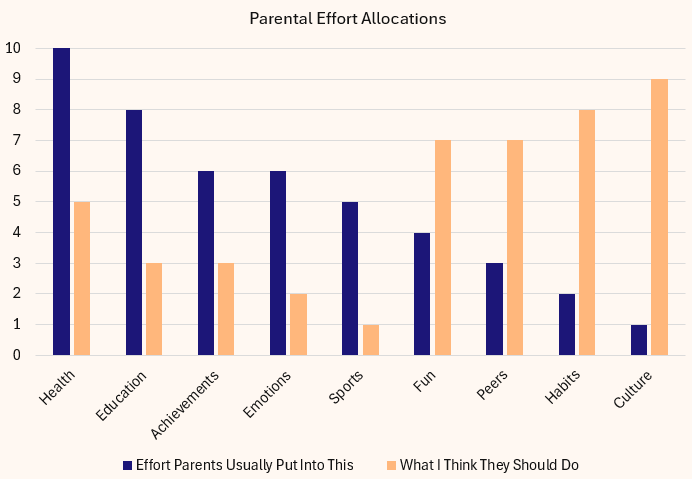
This post will be an elaboration on why I think the allocations I suggest make the most sense.
Human Nature Is Rebellious
Humans are not, in fact, political animals. For many many thousands of years or hundreds of thousands of years we were cognitively capable of creating sophisticated societies with exchange and specialization and hierarchies of authority— but we mostly didn’t. We didn’t do this not because there was no advantage to doing so (probably there was! evidence of group-based warfare among human ancestors is endemic, which suggests that humans absolutely did realize the advantages of that kind of highly specialized cooperation), but presumably because there were countervailing factors. One such factor is probably that maintaining an orderly society is psychologically taxing. Man evolved to wander the wide savannah in pursuit of game, to meander through the forest with an eye for edible berries and tubers, to sit around the fire and tell stories. We did not evolve to take orders.
James Scott in his book Against the Grain makes many arguments I think are goofy, but he is correct in that book (and in basically his whole written corpus— Weapons of the Weak and The Art of Not Being Governed give the same vibe, and all derive from his original perspective in The Moral Economy of the Peasant) that the peasant class is basically constantly scheming to escape the bondage of agricultural subsistence, that order is maintained only at great effort by elites, and that when nomadism, pastoralism, foraging, or hunter-gatherer lifestyles are a viable alternative to sedentary agriculture, the formation of states is nearly impossible (indeed, even stable formation of cities or settled agglomerations becomes almost impossible). Dawn of Everything and many other books have all adequately summarized how Europeans encountering native peoples often were quite fond of the freewheeling native lifestyle, at least as long as open frontiers could still be found.
Put bluntly, it is not in our nature to be willing and useful participants in orderly societies, that is, societies where people act according to fairly general rules of behavior in a way that dramatically reduces the frictions and transaction costs for large-scale cooperation. It is in our nature to defect from such societies and prioritize our own liberty.
Consider warfare. In hunter-gatherer societies, warfare is overwhelmingly about ambush, deception, raids, hit-and-run… hunter-gatherers very rarely fight pitched battles. Every encounter between settled and hunter-gatherer peoples is rife with complaints about the cowardice and dishonor of hunterer gatherers. They don’t follow the rules. They kill the women and children but run from the men. They use disguises. They hide among civilians. Heck, they don’t even recognize the role specialization of “civilian” or “combatant.” This is often described by settled peoples as savagery— but in practice what it is is just that one side lives under an elaborate set of rules which constrain their free action, while the other side does have rules, but they are radically different kinds of rules, and they are not rules which create generalized conditions of order. “Boys must hold a hot coal for 30 seconds to become men” may be a binding rule, but it does not in any meaningful sense reduce frictions for social cooperation in the way that, “When two societies fight, they should not kill random civilians” does. Many scholars argue that “moralizing high gods” were invented essentially in order to create superstitious reinforcement for generalized moral rules as part of the transition out of hunter-gatherer living. I’m skeptical of that particular chain of reasoning, but the fact that the argument exists and has some support should make you think I’m operating here on fairly well-trodden ground.
The rules of settled societies are rules which make large-scale, complex, specialized settled life workable. These rules are not part of our evolved environment. They are not part of our nature. They are invented elements which developed through cultural evolution, not biological evolution, and as a result may conflict with many of our biological impulses.
Rules are nurture. Introduce foragers to alcohol and watch how the lack of strong social rules about alcohol plays out. They didn’t have access to alcohol so never developed the cultural technology to regulate it. In fact, without broader cultural technologies for rule imposition, even developing a norm is very hard!
None of this, I should note, is about a difference in nature or genes between settled and forager peoples. My view is this is purely about culture. There’s no intrinsic inferiority involved; just different rules, and indeed, different cultural conceptions of what it even means to have rules.
If I am correct, and here I think it would still be hard to seriously rebut me and claim that there is not a major difference in social rules with the advent of agriculture, then two obvious propositions emerge:
Social rules are probably constitutive of life in a settled society. If we see all settled societies have a lot of rules, we should think that abandoning rules may have some chance of the loss of settled societies.
We should recognize that between us and the forager there is a great cultural divide: our children have to master a technology which is not in their nature to master. They must be rule-followers, or else they cannot operate in settled society. This is unnatural to the human frame, but it is the reality.
These propositions then suggest that if parents are left to sort of stumble around and just figure out what their job is, across a few generations, they will usually coalesce on basically “My job is to impose an orderly set of habits on my kid and to create good peer environments around them.”
But nowadays a lot of parents do not see their job this way. Instead they see their job as a lot of other things: saving for college! creating enriching extracurriculars! preparing for a specific career! engineering a specific kind of emotional life! making their child sincerely love Jesus!
This post will be an extended, meandering digression on why I think these kinds of goals for kids are mistakes, and instead our goals should mostly just be about passing on knowledge of and experience working with social rules and, more broadly, passing on our valued cultural norms.
Order Is Imposed
Consider, if you will, the case of handedness:
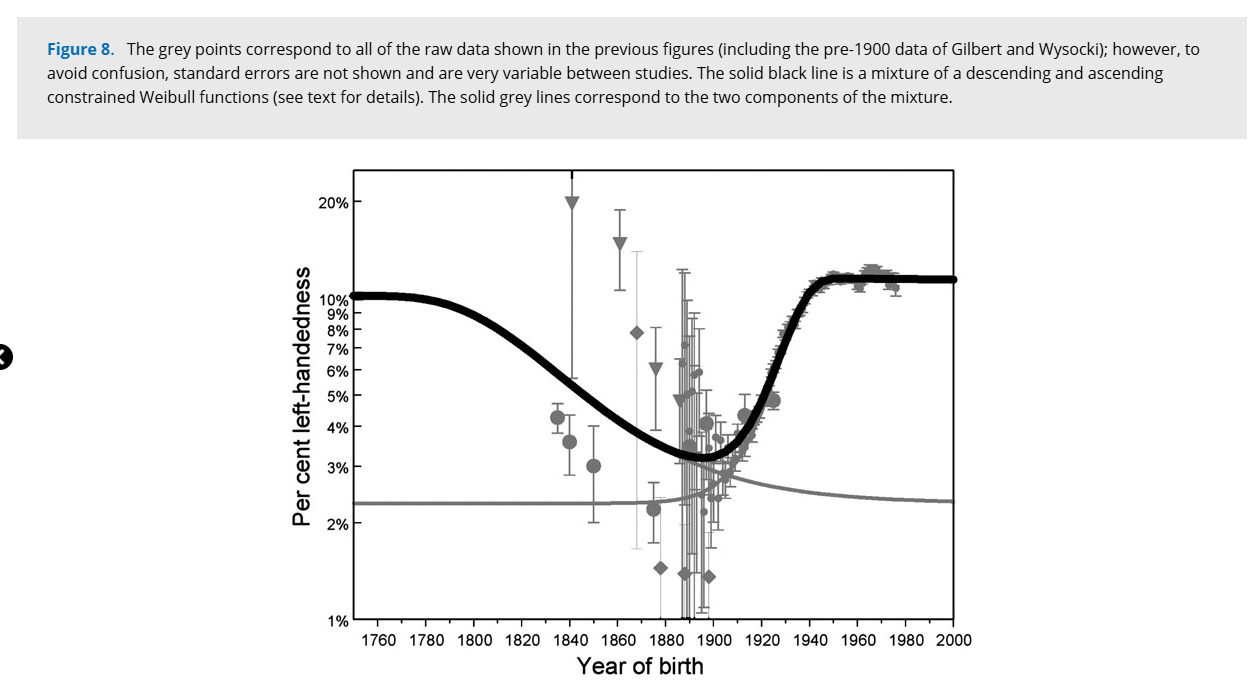
You can see that left-handedness probably had approximately its modern prevalence in the 1700s. There was not a deep-seated superstition against left-handed people sufficiently strong to actually pressure people to learn to be right-handed. Whatever anti-left-handedness norms might have existed before the latter-18th-century, they clearly just were not strong enough to have actually changed what hand people used to do things. It’s not until the 19th century that we observe what seems to be a decline in left-handedness. Just for reference, here’s handedness estimates from archaeological data going back to before the last ice age:
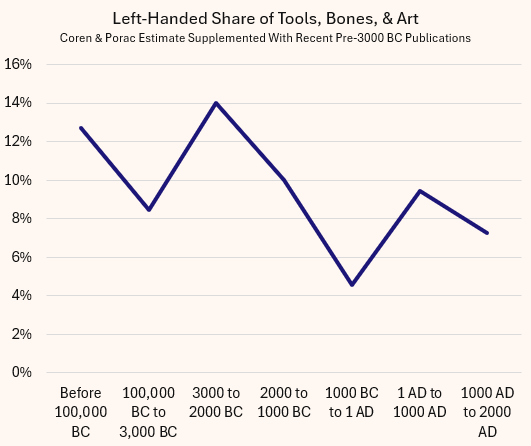
You can see that handedness probably declined around 4-6,000 years ago to its pre-modern level before declining again more recently.
Why did left-handedness decline? Again, it wasn’t about superstition! It was about rules! We don’t need to speculate because we know children were forced to write right-handedly as part of the rise of literacy:
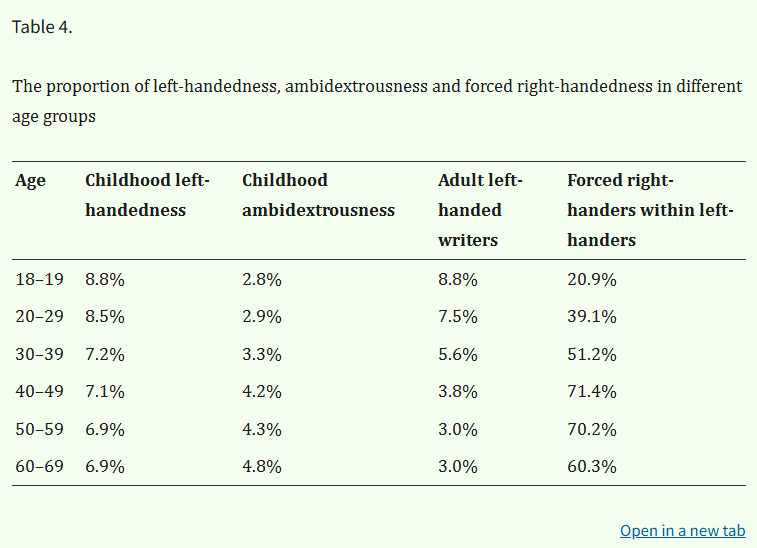
Society reached new levels of complexity and intermediation: literacy and factory work. Both of these had implications for handedness. Literacy instruction was quite formal and so children could be made to use their right hand as part of a belief this was necessary to develop a standardized and legible writing-hand, and of course factories arranged tasks in ways that biased towards certain degrees of handedness. But literacy was probably the main factor— notice left-handedness starts to explode for the cohorts born in the 1920s, that is to say, the generation of children raised by parents whose working careers were contemporaneous with the invention of the typewriter. The invention of the typewriter and its popularization in the early 20th century arguably vitiated the need for children to develop a uniform writing style and form: formal documents could be easily typed without needing a printing press.
When the exigency favoring standardized writing-hands faded, so did the rule. The decline in left-handedness 4-,6000 years ago is a bit more mysterious… but that’s when we start finding lots of bronze tools consistent with intensified agriculture. Maybe semi-standardized tool use did it? That period also saw a spike in warfare; maybe lefties were somehow at a disadvantage? Who knows!
You might consider homosexuality in a similar light. Most historic societies may have allowed homosexual behavior to various degrees, but obligate homosexuality has faced various degrees of stigmatization in the vast majority of settled societies; that is, whatever people did privately, adults in almost all settled society have been expected to engage in sexual reproduction or else to be set apart for reasons of religious taboo or sex work (sometimes the same thing). Why is this? The obvious reason is that in societies with high mortality it’s important to have lots of babies. As mortality fell, reproduction became less urgent, and nonreproductive sex generally has become more popularized. This process pretty obviously began almost as soon as mortality began declining, a process so widely observed this dynamic lies at the heart of the entire “demographic transition theory.” You’d think, though, that contraception would lead to a huge rise in the kinds of sex which can be procreative— but sexual frequency probably didn’t actually rise that much in the 1960s, and in fact the long decline of mortality and emergent norms around nonreproductive sex meant that despite penis-vagina sex being “lower cost” than ever before, it probably also makes up a smaller share of the orgasms of the world than ever before. Though the emergence of very low fertility nowadays could cause these norms to shift again.
The key point is, when the exigency favoring reproduction-maxing faded, so did the rules around sex.
Societies have rules created by imposition. Social order is “emergent” in the sense that it often involves many diffuse actors feeling their way through the dark towards a solution, but that emergence is responding to imposed shocks to society: subsistence, climate, technology, religious movements, wars, politics, whatever.
The crazy thing is a lot of people act like the decline in left-handedness was some kind of evil discrimination. But it wasn’t! Every society that goes through adoption of standardized tools and expanding literacy faces handedness shocks! Because optimal handedness under industrialization and hand-writing is less variably distributed than under other conditions. Acting like handedness was a dynamic of discrimination is absurd: it was socially optimal to pressure kids to be right-handed! A similar argument can be made on sexuality: why didn’t ancient societies ever develop long-term stable social norms endorsing obligate homosexuality? The most likely answer is just that under prevailing social conditions for human history that social form was not adaptive. Societies drifting that direction did not succeed in perpetuating those values. Our current circumstances may be different! Acting like historic societies were just imposing these norms for the fun of it makes no sense.
(Of course sick societies with norms that settle in suboptimal equilibria are also very common— many societies could be happier and more prosperous if they collectively adopted a modestly different norm which they really could adopt; I’m not arguing every society is always in an optimal normative space. Rather my mental model is that societies are almost never at their optimal normative space, it’s a zone of constant conflict and re-evaluation, but one which has a tendency to drift towards the shifting target of optimality)
A key vehicle through which settled societies have imposed the norms they thought were valuable and important is, of course, parents. In many societies very literally: parents controlled social resources, controlled marital choices, etc. For much of human history, society was to a great degree a consortium of parental (and especially paternal) authority.
Parenting, then, at a macro view, just is the process of civilizing hunter-gatherer children into agriculturalists. That’s it. That’s the job. Your children were born to wander in the woods scavenging for berries. Doing so is a lot of fun. Kids love the woods. However, they no longer live in a hunter-gatherer society. As such, your job is… not to reify the child’s inner forager. Your job is to provide the cultural evolution software booted onto the biological evolution hardware: to train your hunter-gatherer child to be a settled-society adult. Learning the rules, learning to self-manage, learning to comply, to cooperate, to coordinate, just is what parenting is. Everything else is a distraction.
This doesn’t mean you have to endorse every rule. Maybe you don’t want your kid to comply with some rules. But they should know the rules they’re breaking and know how to handle the consequences. Passing on The Rules is what parenting is really about.
Most Parenting Is Wasted Effort
You will not have much effect on your child’s IQ. It is largely genetic alongside some very broad social-environmental factors like avoiding serious head trauma, and a mixture of other environmental effects we just don’t understand very well yet. You won’t have a ton of influence on your child’s educational attainment either, provided you live in a society with free public education: the truth is that’s highly genetic too. Enrolling them in youth sports won’t make them nearly as athletic as choosing a slightly more athletic spouse. Their personality? That’s largely genetic too— you just aren’t going to shape it very much, again, barring really extreme edge cases. “Your parents, they fuck you up” — Larkin was full of shit, you were born that way. It’s only your parents’ fault in the sense that they chose to let their genes recombine.
But before you go all “Oh no, Lyman, the hereditarians got to you??? Blink twice if you need rescuing!” realize the above statement is perfectly compatible with environmental influences shaping everything that actually matters in life. Personality isn’t very important in life, and we know this because personality traits are highly varied within human populations and people in the normal ranges of all personality types live perfectly fine lives. IQ and educational attainment aren’t that important aside from at the extremes: super-geniuses yield massive social benefits and the bottom 5% create considerable social costs, but at the end of the day the distribution of adult self-reported happiness, adult income, and life expectancy for a 100 and a 110 IQ person are like 90%+ overlapping.
Seriously, using the NLSY 1997 data which has early-life scores on IQ-correlated tests and a good measure of mental health in the longitudinal respondents’ 30s and early 40s, here’s how many standard deviations difference in adult mental health is predicted by standard deviations difference in test scores:
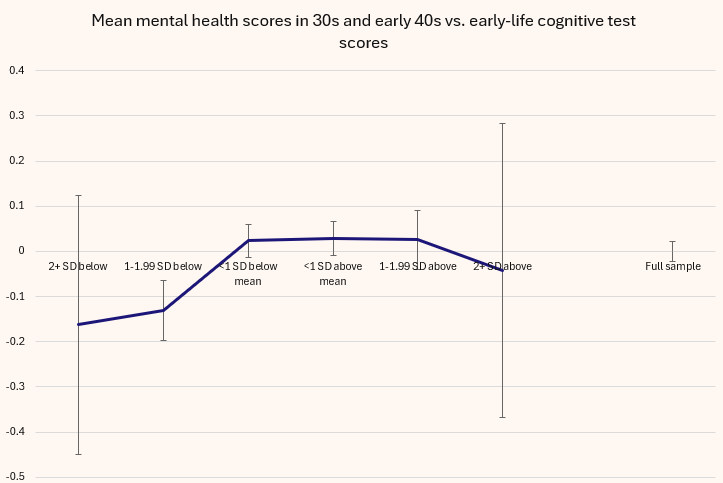
You can see the mean estimates are all very small, and at the extremes the standard errors are comically huge. It does look like being >1 SD below-average on cognitive scores in high school may be associated with perhaps… 0.05-0.25 standard deviations lower mental health? But 1) the effect is all on the low end, notice there are no gains throughout the center of the distribution and maybe losses at the high end though that’s super noisy and unreliable.
Here’s the actual distributions:
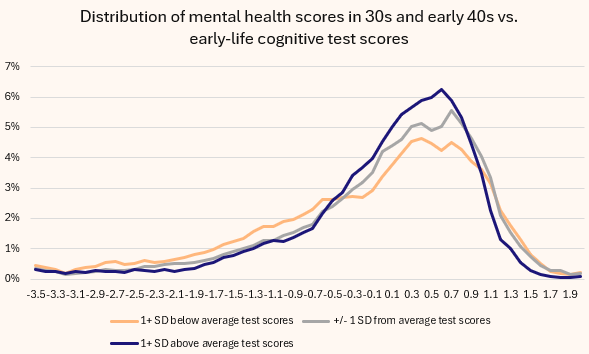
You can see that, yes, respondents with 1+ SD below-average test scores do have elevated risks of very adverse mental health in adulthood (the left part of the graph)… but also have higher risks of very positive mental health in adulthood!
The main effect is actually that smart people have less variance in mental health!
But even so, fully 72% of the total mass of the entire distribution is under all three curves, that is to say, mostly they have the same experiences. Mean differences are small, distributions overwhelmingly overlap— even if you could boost your kid’s IQ, it wouldn’t actually change many the big things in their life like “Do they say they’re constantly anxious on a survey?” and “Do they often contemplate committing suicide?” and “Are they happy?”
This is because happiness and suicide are also in the category of rather genetically influenced things. Non-genetic stuff may have big short-term effects on happiness, but long-run subjective wellbeing indicators (i.e. “steady state” subjective wellbeing) has a big genetic component.
You can’t make your kid a superstar athlete. You can’t make your kid a genius. You honestly might not even be able to make your kid happy.
School, sports, happy vibes— that’s like 85% of what modern parents focus on. And it’s mostly a wash. When parents say “I just want my kid to be healthy, go to college, get a good job, and be happy” they are literally listing four categories over which they honestly have some of the least influence.
Some Parenting Is Very Useful
And yet, parenting is hugely influential.
Consider language. When a child under age 3 from Ethiopia or Korea or Russia is adopted in America, what are they odds they speak English as an adult? Virtually 100%! What are the odds they speak Amharic, Korean, or Russian? Well, unless the adoptive parent specifically chooses to support instruction, the odds are basically 0%. Basically 0% of Americans just pick up Russian in their daily life. I know some Ethiopian, Korean, and Russian adoptees; none of the ones I’m close with speak Ethiopian, Korean, or Russian.
Language is a classic example of a social rule. You can’t just make any random babbling sounds and expect to be understood. You have to make sounds that other people understand as referring to something. In other words, you have to engage in a coordination-game governed by rules. All human societies have languages, so virtually all kids pick up languages.
But it would be wrong to act like this is just from kids picking it up. The odds that a child in America speaks Korean are literally dozens or hundreds of times higher if they have a Korean parent. And indeed, even in monoglot households, parents put a lot of effort into language. We talk to our kids with babbling noises, an activity which we know evolutionarily is part of how kids acquire sounds. When they ask what a word means (547 times a day), we tell them. Every family has words a child mispronounced in a beloved way which are now “family words.” Language instruction is actually a massive case of parental investment which does work. If a parent wants to pass on a language to a child, investing efforts to do so increases the probability the child as an adult has the targeted trait by an enormous amount. Hebrew School works. Here’s Hebrew fluency by denomination among US born Jews; this is obviously about Orthodox parents putting their kids in yeshivah:
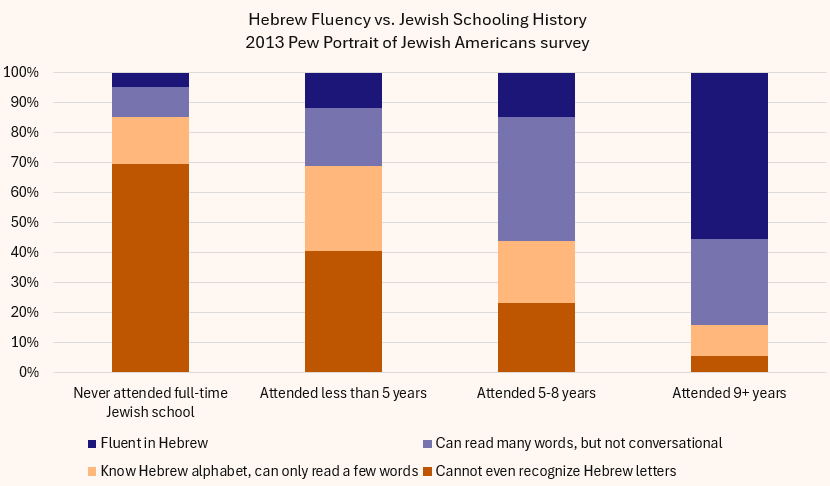
That graph is not subtle! If there’s a gene for knowing Hebrew, you’d imagine pretty much all Jews to carry it. And yet, it turns out basically only the ones in full-time Jewish school learn Hebrew. The ones who learn it without full-time school likely learned it in part-time schools of various kinds.
As with language, so with specific religious beliefs. Religiosity has some genetic components, but they’re smallish, as shown in a recent meta-analysis of twin studies:
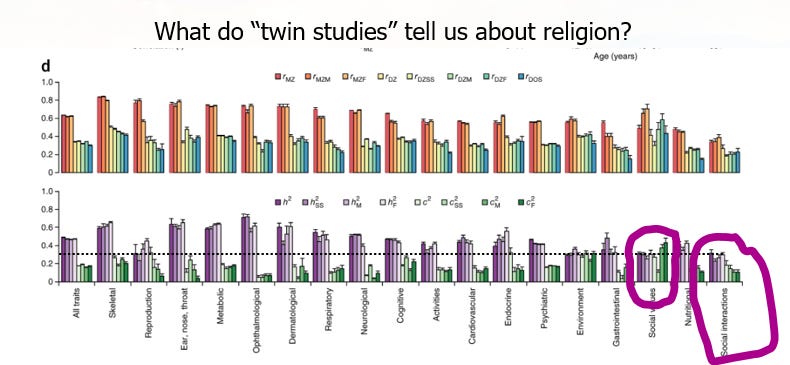
The circled groups are the categories including religious belief (social values) and religious behavior (social interactions). You can see that those categories have the lowest estimates of heritability (purple bars) of any trait categories. They also have some of the higher estimates of shared environment effects (green bars). Social values actually has the highest shared environment effect, except for “reproduction,” i.e. fertility.
Here’s detailed results from a big Danish twin study:
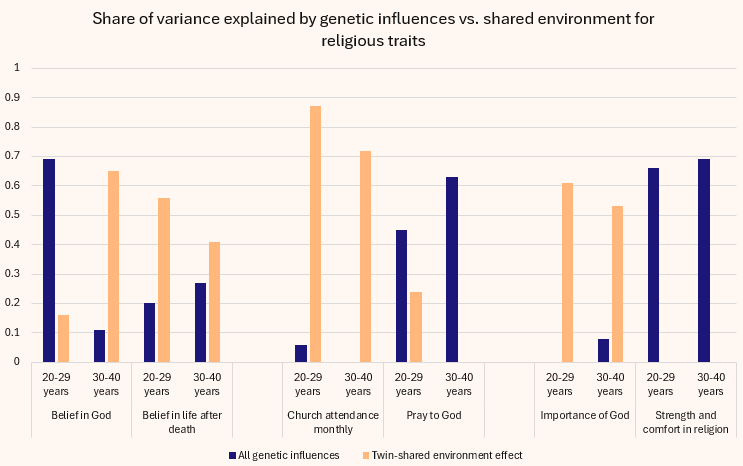
You can see that in this study the direct genetic effect on measures of religion is highly variable, but twin-shared environments are often actually a bigger effect, which is super rare in twin studies! For frequency of church attendance, importance of God, and belief in God in the 30s, genes hardly seem to matter at all. Genes do predominate apparently for prayer behaviors, odds of finding “strength and comfort in religion,” and belief in God in the 20s. But whereas most twin studies tend to show shared environment effects <20% of variance, for religion we routinely find these huge effects.
The classic citation for an Australian study shows that genes have virtually no influence on specific religious denomination, and shared environments and parental traits have huge effects.
So if you want your kid to have specific religious beliefs, or, by extension, specific political, social, and ideological beliefs, or practices associated with the above, parenting matters.
Do you see why that might be so?
100,000 years ago, being smart and healthy and happy was super useful, just like it is today. Humanity was selected for these traits to some extent; we don’t “need” parents to teach them to us. Reproduction is an exception case because reproduction is fitness and so reproduction hits a Fisher-type constraint on selection. But these other things are modestly related to fitness at various levels.
100,000 years ago, learning complex systems of ideology, social rules, social order, etc was not a super useful skill and most such systems didn’t exist. Humanity basically isn’t as extensively hardwired to just figure them out. We need cultural evolution to give us a hand up, and that “hand” comes in the form of parenting.
If you want your kid to play euchre, teach them. They won’t learn it otherwise. If you want your kid to be a chess master, genes matter, but obviously so does environment. Smart kids will be smart no matter what, but they may use their smarts on complicated mapgames, or on chess, or on cooking slightly better meth.
One recent study showed, for example, that tattoo behavior has very little genetic influence, and lots of shared environment: if your sibling is tattooed, you’re more likely to be too!
Tattooing is such a useful thing to study because the prevalence of tattooing has changed massively over time:
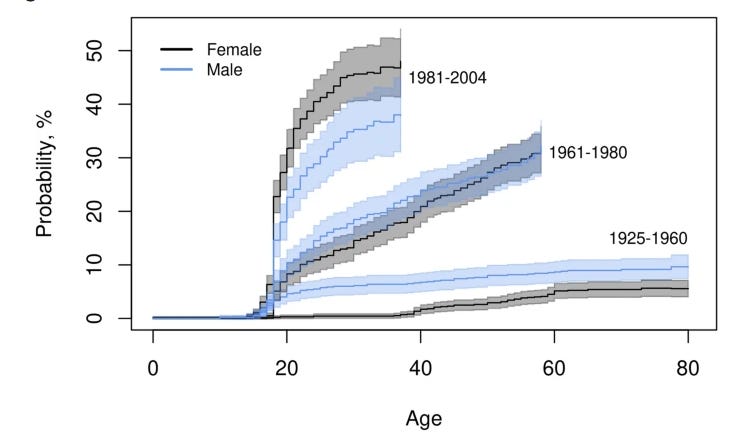
For Danes born 1925-1960, tattooing was rare and a disproportionately male activity (or women over 40, for some reason?). Then it rose sharply for those born 1961-1980, and then those born 1981-2004 even more, especially for females. For the youngest cohorts, tattooing has a pretty strong female bias.
This is a phenomenal case where the prevalence changed sharply over time. I’m super annoyed the authors only estimated heritability for the whole pooled sample instead of for each of the three cohort groups separately. But the key point is that we have a case here of a trait that has undergone massive recent cultural change and as a result it has virtually no genetic heritability! It’s just culture!
Parents do not have the ability to alter the deep substrate of the child in a positive way (they can, of course, shatter the child’s psyche with abuse and trauma, or break their body with poisons and violence), but they do have an ability to alter the particular social and cultural values the child adopts, the specific cultural and social behaviors they enact, in a word, the rules of society.
If you want your parenting to be informed by the evidence on heredity, you should focus your direct parental investments into your kids on culture. Investing in your kid’s academic skills and athletic skills is probably low-return. Investing in their religious formation, their hobbies and habits, their ideas about “how clean is clean enough” for the house, their views of what is beautiful, this is the stuff you can actually perhaps modulate. Introduce your kid to all the stuff you enjoy, love, value, and skip the boring stuff! Okay don’t literally skip it, we’re stipulating a basically normal educational trajectory here, but don’t make costly investments beyond the norm in it, except insofar as doing so furthers overtly cultural projects you want to advance.
As a parent, you can’t dramatically alter your child’s hardware. But you can dramatically alter their cultural software. And as it turns out, you may want your kid to absorb a certain kind of culture. Your enjoyment of your life will be impacted heavily by if your child grows up to share things you treasure vs. if they don’t. In fact that’s hugely important. A kid who grows up to be at 10 percentiles lower income than you vs. 10 percentiles high won’t change your life all that much! That kind of range is unlikely to radically alter your experience of life!
But a kid who still values celebrating holidays together, who can talk to you in the nursing home about the games you watch, who brings grandkids around to sing songs you know with you— these are priceless. A rich child who raises their own children in a way which is anathema to you is a blight on your experience of life: and this isn’t me giving my Hot Take! Go talk to people about their grandkids and their kids! As long as their kid isn’t a total economic failure or a mega-uber-success, most parents of grown kids don’t derive much joy from the midrange variation in their kid’s outcome! But they derive massive amounts of anxiety and worry or joy and pride from their children’s cultural projects! Now, to some families, economic projects and cultural projects run together: you can think of immigrant families demanding their kids be a doctor or a lawyer kind of in this vein, but I’ll say I know a lot of grandparents who pushed their American-born kids to be doctors and lawyers who now simmer in constant anger that their kid isn’t Christian anymore or isn’t Hindu or isn’t Muslim, and they’re bewildered about what went wrong. What went wrong is simple: you spent all your parental influence capital on your kid’s career and not enough on their culture.
But Culture Matters For Non-Cultural Reasons
Alcohol consumption has an appreciable shared environmental component, but also a large genetic component. However, that genetic component is grossly misleading. You may have heard that alcohol abuse is 50% genetic, maybe even more for severe cases, but these studies have a huge problem. Consider a recent meta-analysis. Fully half of the sampled twins in studies of alcoholism were from Nordic countries (pooling across studies), and most of the remainder were US whites, and several of those studies are heavily sampled in the US midwest and Minnesota. Why does this matter?
Lutheranism! When it comes to alcoholism, Lutheranism is a degenerate and wrecked culture. I can say this because I am a diehard Lutheran, I ride for the Great Lutheran Khanate, I love my faith, but seriously these people have a drinking problem.
We know alcoholism is highly heritable within families and that much of this is perhaps genetic. We also have GWAS studies identifying some relevant behavioral genes, so it’s plausible.
We also know alcoholism rates have huge variance around the world and that variance is massively predicted by religion (especially Islam, Hinduism, and Mormonism), and that the effect of religion persists across genes: Asian Muslims, African Muslims, Turkic Muslims, and Arab Muslims all drink way less than their non-Muslim co-ethnics. My family members in teetotaling denominations drink way less than my family members in other denominations even though we’re all genetically extremely similar.
When fully 50% of the total sample in the meta-analysis is from one notoriously hard-drinking sect (Lutheranism) and the other 50% is from societies with basically no major taboos on alcohol consumption, are we actually learning anything about heritability?
Consider a fake model. In this model we have 5,00 Lutheran twins and 5,000 Mormon twins. Mormons, of course, are one of the best cultures in America. You can trust I’m not biased on this because my theological beliefs extremely at odds with the LDS; I’m not out here ride-or-die for Joseph Smith.
So imagine 25% of the Lutheran twins are alcoholics vs. 10% of the Mormon twins. This is very much higher than the real prevalences in both cases but it reduces the model size Claude had to estimate which reduces the tokens I had to burn to use higher rates instead of low prevalence rates.
Despite huge prevalence differences, the within-group heritabilities can be whatever I want them to be. I simply told Claude the a2, c2, and e2 parameters to target. In a big enough sample size you can get any combination of heritabilities paired with any prevalence.
Here’s how it shakes out:
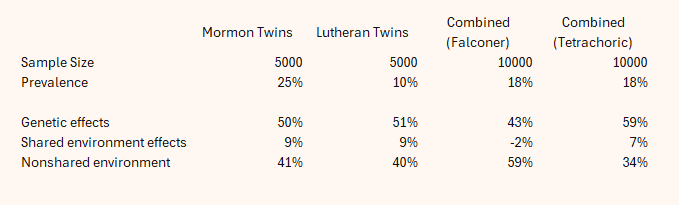
The first two columns are effects within the two groups. Those heritabilities are nearly identical and they match published studies.
But as you can see, when we pool Lutheranism and Mormonism together, even though we have prespecified that Mormonism massively reduces alcoholism in our fake model, we actually find, in both model approaches Claude tried, a reduction in the role of shared environment! In one we see more genetic effects, and in one more nonshared environmental effects, but in either case, we see that when groups of twins have group-level traits that dramatically influence prevalence, shared environmental effects are incorrectly estimated as being too low. The shared environment effect could also be estimated too high sometimes; the key point is that it is not correctly estimated.
The key intuition here is simple: where cultural values for a group of parents radically shift the social prevalence of a behavior, you can actually escape the problem of heritability. Quantitatively speaking, the point is that shared environment estimates are only valid where models are stratified across the actual categories shaping major group-level differences in outcomes.
This is not the usual practice of heritability studies but that is because most twin studies are bollocks, I mean it. Twin studies often test for “threshold differences” across one or two variables they may have data for (sex, age, race), but they almost never even have data on cultural background, and if they have it, don’t bother using it. If you have any reason to believe there could be large group-level prevalence differences which might be altering prevalence of a trait without disturbing its heritability within group, then your ACE model must stratify by that trait or it will incorrectly estimate every part of the ACE model. In general, my view is twin studies should always stratify by things like “marital status of parents” and “religion of parents” and “race,” but this is not the standard view.
In terms of what this means for parents, it means you can just alter the prevalence level of your social circle. Even in the data we do have, it turns out that alcohol abuse has quite high shared environment effects at the younger ages where alcoholism is most crime-correlated: for teenagers, their peers matter a lot. If you are thinking, “My uncle was a raging alcoholic, and then he did 10 years for killing someone with a DUI, so I may carry alcoholism-risk genes, and I see the causal chain from imprisonment to collapse of my uncle’s family. How can I mitigate that risk?” the solution of “Join an anti-alcohol sect” is actually quite plausible. When it comes to the adolescence effects: your genes may guarantee your kid becomes an alcoholic, but alcoholism at 20 leads to reckless criminality, while alcoholism at 55 tends to lead to falling asleep at 8 PM. If you can give your kids more years without alcoholism, you should do it, so environments matter! Yes, within that religious sect your kids will still have a higher risk than their peers without alcoholic relatives because genes are still genes, but the base rate of the risk really can be suppressed! Probably. Maybe. It’s a decent bet.
In general, I would say it still seems likely you can’t radically alter your kid’s athleticism or IQ or happiness… but actually if you as a parent create a social world around a kid where all their friends do competitive sports, then yeah I bet your kid’s odds of playing at least D3 ball go way, way up! Notably, one study found that there is a huge shared-environment effect on sports participation in childhood (i.e. some families choose to be “sports families”), but this evaporates in adulthood. Another study found basically no shared environment effect across a multi-country diverse twin dataset. Also it’s worth noting in that study that country-level sports prevalence did not predict country-level heritability.
But look, I’d be shocked if parents couldn’t influence their kids’ athleticism at all! Whether it makes sense to center a kid’s childhood on an activity they can’t carry with them into retirement is another question (spoiler: that’s a really bad plan actually), but in principle I’d wager parents can have some effect. And for a child with a given athleticism, I bet parents can have a huge effect on which kind of athletic activity kids do. It seems super plausible a parent could influence if a kid is a runner, a swimber, a climber, or plays basketball, or baseball, or rugby, or crickett, or horse-jumping, or Mongolian wrestling, or whatever. It’s not a mystery that some countries have “sporting cultures” around specific sports, and it’s obviously related to cultural background. It’s not biology that makes America underperform at soccer!
Anyways, I gave the example of alcoholism because nobody with a brain denies that religion shapes alcohol use. But I could point you elsewhere. A recent study of genetic risks from suicide claims the shared environment component is ~zero. But you can see the stratification problem right in the initial tables: the study treats half-siblings as a single kinship group with twins (i.e. in one model) even though half-siblings in the data already had double or more the prevalence of suicide, because there are already genetic and nongenetic risk factors for suicide associated with being or having half-siblings! The same genes and nongenetic traits that shape the odds of unmarried parentage or divorce may influence (indeed, almost certainly do influence) suicide risks! The authors use half-siblings to get more statistical power, but at the expense of creating a prevalence problem which obviously biases the results.
Is it possible to alter your kid’s suicide risk? Yes, it is! Suicide behavior is contagious! I’m not joking, it really is! There’s debate about exactly how this works, and research remains to be done, but it really is the case that social and media exposure to suicide shapes suicidality. When kids at school are exposed to more suicide among families-of-friends, they commit suicide more.
But who commits suicide? We don’t know for sure, but probability kids you’d predict from family heredity! This is how to mesh together “suicide has no shared environment component” with “social exposure to suicide has a huge effect”: social environment may set the base rate of suicide, the threshold effect for suicide, but hereditary factors are still going to predict which kids actually do it.
Here’s how I imagine suicide looking in a theoretical model:

Suicide rates are way higher in the high-prevalence environment, but the relative suicide rate of high-hereditable-risk kids is identical across environments.
If this is what suicide risk looks like, then you as a parent can probably shape your kid’s suicide odds by discriminating against families with suicide in their family history. This is a very unkind thing to do to a kid whose family member recently committed suicide, so to be clear I’m not advising a shunning strategy. But I am saying that how schools and media and other public-discourse shapers present suicide matters. Coming over the intercom system to remind students that supper services are available to counsel them about so-and-so’s recent suicide may not be an optimal public health intervention. More broadly, while specific discrimination is extremely ethically shady, when considering a school for your kid, you could ask, “How many students have committed suicide in the last 10 years?” and exclude the schools with the highest numbers. Because although your children’s suicide risks are highly correlated with each other due to heredity, their overall prevalence of suicide among your children will likely be shaped by the prevalence of their environment!
How about violent crime? Can you influence the odds your kid becomes a violent criminal? The best recent study I know of suggests that genes could explain at least 40% and perhaps up to 60% of criminality, while shared environment is probably 10-25% for boys and 0-15% for girls: that doesn’t leave a lot of room for parenting, though it’s encouraging that there’s some effect. But notice the effect is bigger for boys! Is anything else different about boys? Yes, duh: in this sample 5.2% of boys had violent convictions vs. 0.7% of girls! Classic threshold difference! So for the higher-crime group, shared environments mattered more!
Could it be possible part of what’s going on here is that there’s some other kind of stratification of violent criminality at work, especially among boys? Yes! When students are reassigned to higher-crime schools their own odds of doing crimes goes up. When juveniles are locked up in facilities with more fellow inmates who have committed specific kinds of crimes, their own odds of doing those specific crimes go up! It turns out that while it’s definitely the case that some people are more predisposed to criminal activity for a variety of background reasons, it is also the case that their environmental context can set different thresholds for their background risk being activated. Your kid may just intrinsically have 3x the background risk of going to jail because your spouse went to jail— but 3x the risk in a school where 1% of kids go to jail is a lot lower than 3x the risk in a school where 15% of kids go to jail!
Now, I’m being unreasonably “clean” here, assuming that all cases are like my toy model where stratifying identities set pure causal prevalences and heritable traits only regulate threshold liability: that’s not realistic. In reality if you get a group of people with background risk for suicide in a room together, the prevalence of suicide will rise. Vicious cycles are almost certainly real. The kids who most need to be in low-prevalence-of-bad-shit-environments are those with the most genetic risk for bad shit, but their presence may cause the environmental quality to shift. Likewise, the kids who most need to be in high-prevalence-of-very-good-shit-environments are those with the most genetic risk for very good shit, because they’re the ones most likely to get huge upside benefits. That is to say, genius kids should be allowed to dramatically accelerate through school, and kids with behavioral problems need highly managed environments with lots of good influences. Squaring those two dictates is sometimes hard for society. Society and parents have to make their own choices about how to balance these realities.
I could go on, but the point here is that, as a parent, just like your central job is cultural rules because that’s what humans are not well-evolved for, it turns out your central job is putting your kid in social environments with low prevalence of bad shit of kinds they have high risk for because base rates matter for interpreting hereditability.
But that second part… is just more rules! In some high schools, doing minor crimes is highly normal and the social barrier to criminality is quite low. In other high schools, the social barrier to criminality is higher; it’s harder to find a (literal) partner in crime. The difference is formal and informal social rules and norms. Thus, our job as parents is to focus our direct investment in our kids on passing on cultural norms and rules, rather than attainment-maxxing; and our job as parents is to focus our environmental structuring for our kids on…. cultural norms and rules! You don’t want your kid in a school with high grades— you want your kid in a school where kids do the homework. You don’t want your kid in a school where the other kids’ families earn high incomes— you want your kid in a school where the children push each other to be ambitious. Or whatever— the point is the norms among the students not the traits of the parents.
In practice parental traits and student norms are sometimes very correlated— but not always! Imperfect correlations exist! There are arbitrage opportunities!
Now look, this idea that prevalences interact with heritabilities to shape traits isn’t uniformly true. If your kid has bad eyesight, giving him peers with good eyesight won’t help. We are necessarily talking here about traits that meet the following conditions:
Have substantial variance across humans
Have large prevalence/level differences across socially or culturally defined groups of humans
Clearly involve a behavioral and attitudinal component (i.e. are definitely not >90% just biology)
And the traits a parent can probably most influence are also going to be:
Traits where not all parents agree on which trait value is optimal
Traits where selecting against the trait would be socially awkward
Traits where adults already self-select into social groups around that trait
In other words, even if culture-maxxing doesn’t alter the hereditability of traits you may care about like “going to prison” or “doing drugs,” it can probably alter the prevalence of those traits in your child’s social circles, and altering the prevalence of dispreferred traits in your child’s peer group may be as good as altering heritability for some traits. If your kid is max-risk genetically, they may still end up above the risk threshold for the bad outcome, but maybe not.
A Unified Theory of Parenting
Evolutionarily speaking, modern parenting very obviously differs from prehistoric parenting by virtue of the role parents play in fostering social complexity. Because humans evolved for small-scale societies where formal rules were not always as necessary and cooperation could be managed on a Dunbar-number-type-scale, children are very poorly suited to modern society. Parents have to teach them to be beings who can operate in formalized, rules-based societies, where rules exist for socially important reasons. This is literally why parenting is what it is. If you’re not doing that, you’re implicitly arguing that we’re in a new dispensation where formal and informal rules in a largely impersonal complex society are no longer important. That seems insane to me. The prevalence of “cancellation” to me says we are absolutely not exiting the era of an extremely rules-circumscribed-existence. The forager world isn’t coming back. Digital panopticons are the future, so our children must learn scrupulous self-management and discipline, because somebody is always watching, and humans love nothing so much as to punish villains. Children who do not learn the self-discipline the digital panopticon of their future requires will face a range of difficulties.
Empirically speaking, it just is the case that parents are often targeting outcomes they cannot easily alter very well (health, smarts, sports, income), while underinvesting in outcomes they can almost certainly alter (peer groups, cultural norms, religious beliefs— social rules). This is particularly bad since cultural groups may set the base prevalences for the risks parents are trying to manage through costly interventions: bad diets, suicide, drug and alcohol abuse, criminality, doing your homework, parents may not be able to alter where their kid falls in the distribution of their peers, i.e. they can’t make their kid top of the class, but they actually sometimes can shift the mean of the distribution, and for some traits at least some of the time, shifting the mean of the distribution drags your kid’s place with it. Parents choosing schools for the peers are being rational. Empirical evidence supports this claim: in a large school choice case, many schools did indeed impact test scores, but other schools impacted other life outcomes, and parents often preferred the schools that reduced criminality or teen pregnancy by more than those that boosted test scores!
The theory I’m articulating is one many parents vaguely intuit, but are told is crazy and wrong by pseudo-empiricists. Matching your kid on “good vibes about the friend group” or “we all go to the same church” is very rational if your goal is “no crimes” and “no drugs” and “married before kids” and “share a faith.” If you as a parent are targeting, “My child grows up to be an adult who shares things I value and love and passes those things on to their kid,” a lot of stuff is worth doing that may not be worth doing if you are targeting income or education. Choosing your kids’ friends or school based on test scores turns out not to be always a great strategy.
Thus, the unified theory of parenting is this:
Figure out which kinds of self-management and habitual rule-compliance are important for your child to have the life outcomes you value for them. As much as possible try to ensure those outcomes are things you may actually have a decent chance of being able to modify. A good way to check this is to ask yourself, “If my parents had this goal, could they have done anything to actually help me attain it?”
Focus your parenting on teaching habitual behaviors that reinforce those kinds of self-management, and on cultivating a community which has similar outcomes and habits. Community cultivation is probably especially important and may need to be ruthless. Cutting people out of your kid’s life because they are a threat to the values you are passing on may be empirically justifiable. Being a squeaky wheel about school policies, volunteering to help at Sunday school— managing the environment around your kid is a lot more important than yet another extracurricular activity or tutor.
Avoid focusing on traits that are zero-sum competitive across kids, that are targeted explicitly by all or nearly all parents, that you can’t enlist other parents in supporting, that you can’t support and demonstrate yourself, or that are highly biologically mediated. Instead, focus on overtly cultural traits that are intrinsically important to you.
To the extent you target things I’ve said you shouldn’t target, try doing so through cross-correlation with cultural traits you can manage: for academic achievement, devout Presbyterianism is probably the power move, or, if it’s an option for you, Judaism. Worried about alcoholism in your family? Your local Free Methodist Church serves grape juice for communion; the Mormons will happily send someone to talk to you about their church. Worried about anxiety and depression? Find communities with really good mental health of children; ask the school guidance counselor to estimate prevalence; ask about recent suicides in the school. Worried they won’t share your political values? Bring your kids along to protests. Want them to share your faith? Lead family prayer time every morning— and bully the other families at church into doing so as well!
The idea here is just:
Your happiness as a parent depends on cultural projects succeeding
Cultural traits are the traits you can most credibly affect for your kids anyways
You do this mostly by propagating rules-based habits and disciplines, or,
By structuring peer environments
Contra Gentle Parenting
In 1 Samuel God chooses David to be king, rejecting phenotypically optimal specimens for kingship in favor of a candidate whose heart is in the right place. It yields the famous verse, “But the Lord said to Samuel, “Do not look at his appearance or at the height of his stature, because I have rejected him; for God does not see as man sees, since man looks at the outward appearance, but the Lord looks at the heart.”
So went awry many millions of parents, thinking they could look at the heart.
God has given special prophetic revelation to Samuel about David’s heart. You don’t have that revelation about your kids. Their inner lives are almost completely uninspectable. You delude yourself in thinking your mind-reading accuracy rate is high. It’s not zero, but it’s not high. You cannot know your kid’s heart. Trying to do so is delusional. I see so many parents whose “target” for parenting is a metric they can never observe and about which their child has an incentive to be deceptive. Human ability to fake emotion is a primordial evolved trait that even nonhuman creatures have. It’s truly insane to use this as the yardstick for your parenting. Your child’s expressions about their feelings are deeply moving and affecting to a parent, I love hearing when my kid is happy, and hate hearing when they’re sad, and for that very reason their statements on these matters can never be trusted as outcomes of parenting. My kids routinely lie about what makes them happy or sad to manipulate me, because faking is low-cost and they know how much I care about their emotions!
For this very reason, while I believe parents absolutely should care about their children’s feelings (and indeed you really can’t help but care about them), their feelings can never be the target of parenting. You cannot have your child’s happiness as a parenting target. Nor, it should be said, the sincerity of their religious faith. Your parenting target can’t be something you can’t actually discern!
Parenting must target behaviors. I know this is unpopular these days, but “Good parents pass on good habits, positive behaviors, and activities that are useful for life, and they do so pass it on via demonstration, instruction, and practice” is just obviously true, especially when you think about what parenting-as-such evolved to do: help hunter-gatherer minds cope with regimented agricultural societies.
We all know behaviors are the actual goal. If you meet an adult who feels sad but does good things you have met a good adult. If you meet an adult who feels happy but does bad things you have met a bad adult; actually an adult who feels happy about doing bad things is an extremely bad adult. This is one of the worst possible outcomes I imagine: I raise a child who is happy about being a terrible person.
All of us understand this in our day-to-day lives but when it comes to our kids suddenly we are all like “oh, but what if my child cries every day for three weeks while we work on this bad habit? doesn’t that mean i’m a bad parent?” No, it doesn’t say anything good or bad about your parenting. If you successfully ameliorate the bad habit you’re a good parent. If you don’t, you’re not, and you, and everybody around you, can externally observe the success or failure. The behavior is the entire measure. If your actions have led to your child developing behaviors which enable them to function better in society and which are consistent with your cultural projects, you’re a good parent.
Though, note I say ameliorate. If your kid has Maximum Energy and is thus kinda punchy-hitty-kicky at the park, and you manage to, through practice and management, reduce them to 25% less violence, that’s great parenting! Even if they’re still more violent than most other kids! I am not here arguing that every child has to be brought to the standard of the preternaturally docile child at the park; I am simply saying as parents we cannot be misled by peddlers of “the heart:” it is only, ever, and always behaviors which we can observe, behaviors which we can modify, and behaviors which, in the long run, shape our children’s development. Habits train the heart.
The reason this model is correct is because of what parenting actually is: you’re turning a forager who evolved for a lifestyle of very little structure into an agriculturalist who lives in a highly structured society. That’s a hard transition to make. If your child doesn’t make that transition, they will grow up as a forager in an agriculturalist society, and that’s a psychological disaster case. Your kid will feel constantly oppressed by rules for which they are psychologically unready. They will confront the formal complexity of basic tasks in a stratified and complex society and feel extremely psychologically taxed by them.
ahahahaha right so that’s just people nowadays. We’ve had multiple generations of exactly that dynamic: kids getting more and more anxious and depressed, “adulting” being hard, etc.
And in fact the data we have is consistent with this story. Young adults today are getting progressively more mentally unwell:


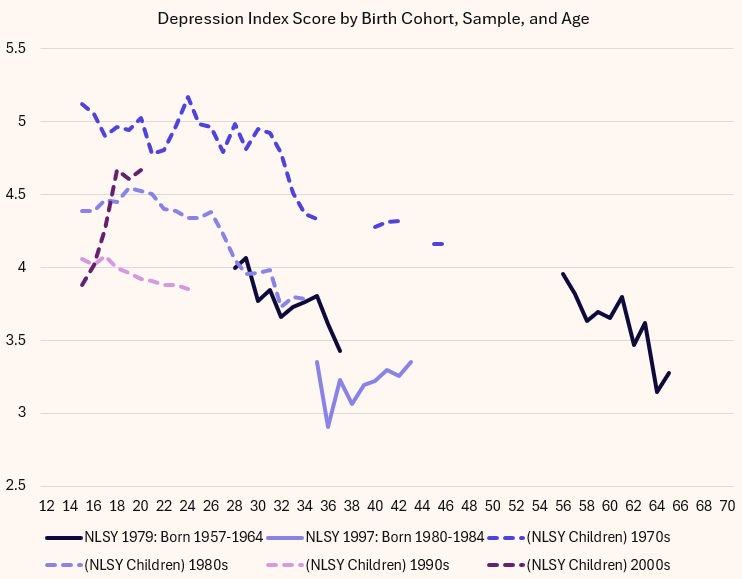
That’s of college students and the diminishing degree of positive selection for college students could be an issue here, I grant it. And I also grant that data on high schoolers from Monitoring the Future surveys don’t exactly replicate this trend (though there’s certainly been a worsening trend recently). I’m also aware the NLSY cohort data is only mildly supportive: in my own analysis CES-D scores controlled for age seem to get worse for birth cohorts between the 1950s and the 1970s, before getting better for birth cohorts through the 1990s, and now getting sharply worse again for cohorts in the 2000s. Here’s what that looks like (bit hard to interpret visually):
Another survey program, the Health and Retirement Survey, looks at old people. Here’s what it shows as the approximate cohort-specific effect on CES-D scores:
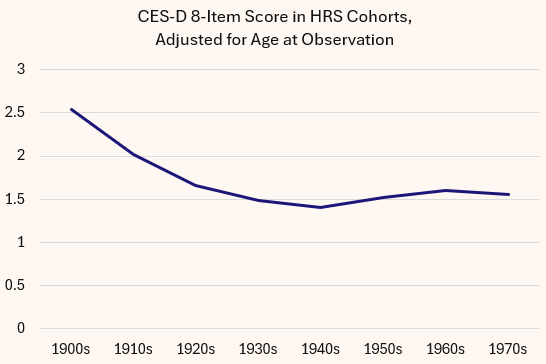
You can see that depression declined from the 1900s to the 1940s cohorts, then rose a bit in the 1940s and 1960s cohorts. Not a resounding confirmation of my thesis, but possibly supportive of the idea that more recent birth cohorts are having some problems.
But sentiment analysis of textual corpuses does match my timeline:
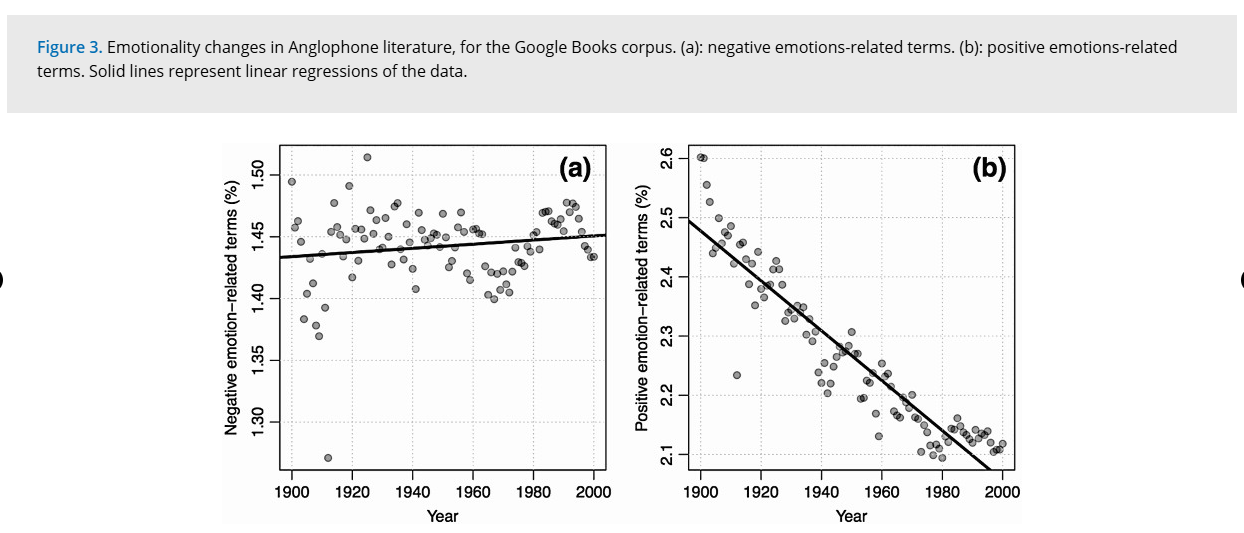
Anglophone fiction, a decent measure of the vibes, had less and less positive emotional language 1900-present, and more negative language. On the negative side you can see a more non-linear trend, rising negativity 1900-1920 perhaps, stable to 1960, falling negativity 1960-1970, then a big rise in negativity 1970-1990 or so, and a decline since; not sure what it would show since 2000.
So I think the thesis that mental health has gotten worse across latter 20th-century birth cohorts is not a slam dunk but is supported in at least some of the data.
My basic thesis here is that from approximately 10,000 BC until 1950, parents cared deeply for their children much as they do now (I reject the theory that parental affect and devotion to their children is historically recent— our visceral, emotional lives are primordial!), but that they enacted this care through imposing rules, order, and discipline on their children. I think since the 1950s, the extent to which parents centered their parenting on order and discipline has declined. I think part of this was a good correction: I won’t do a huge digression, but 1900-1940 did witness a kind of insane trend in parenting norms towards ludicrous amounts of emotional coldness towards children. But recent decades have seen a wild pivot the other way. I asked Claude to give me a list of parenting terms and parenting styles which were very similar in principle or approach to “gentle parenting.” Here are things Claude says are all similar concepts in the Google Ngram corpus:
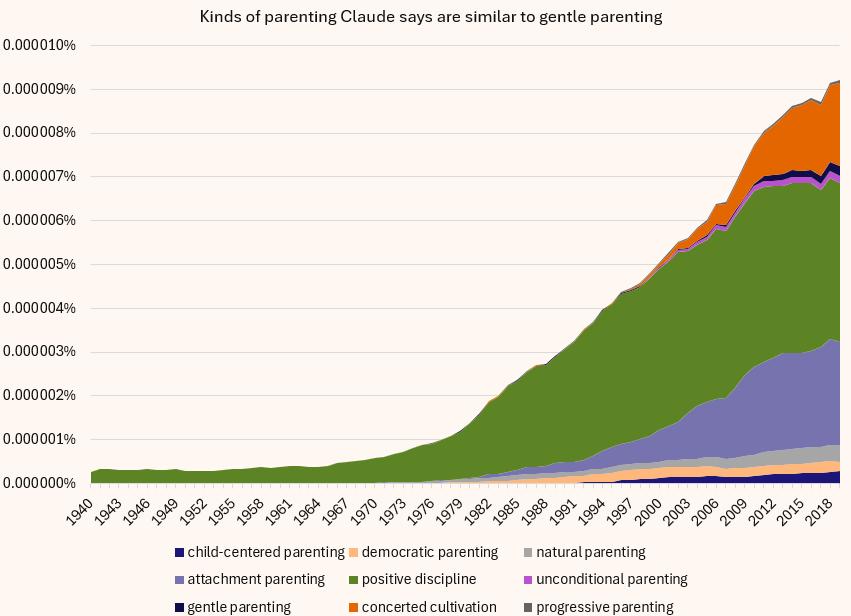
Just for reference, here’s just “parenting” vs. other terms people use:
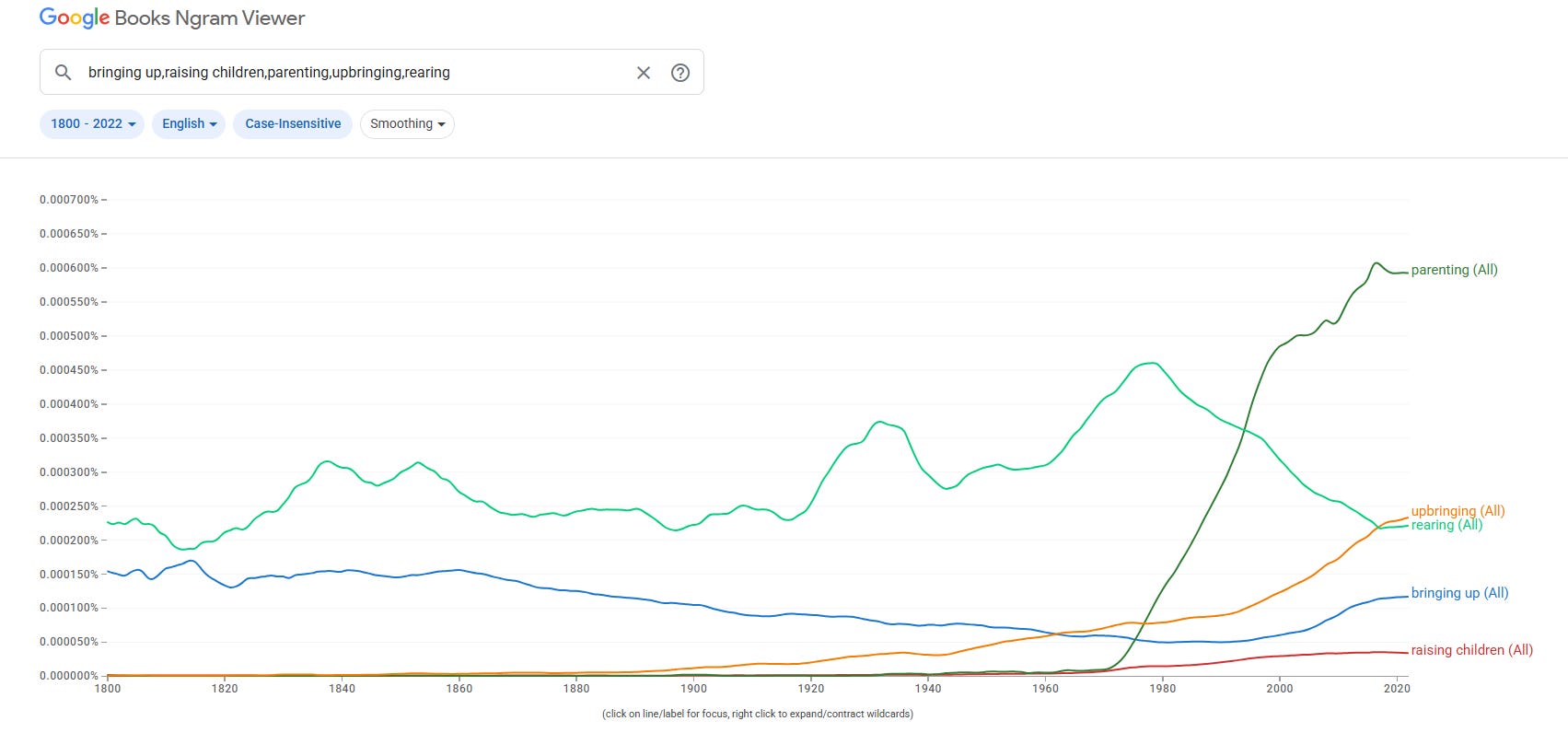
You can see that “parenting” as such is a pretty new linguistic invention. I would argue that parenting as a concept is the issue here. All the gentle-parenting varieties I showed above are just varieties of the fact that “parenting” as a notion, i.e. reflexively placing the parent at the center instead of older terms like “(child)rearing” and “raising children” and “bringing up children” and “(child) upbringing.” If you think of what these terms denote, you’ll notice what’s unique about parenting: it’s about the parent.
Weirdly enough, all these “child-centric” forms of raising kids actually center on parental behavior and child emotions. To a very great extent, modern parents are highly concerned with child emotional lives, and believe their own actions are key constitutive parts of those emotional lives. As such, modern parenting tends to take the form:
“So that the child may feel X, parents should do Y.”
Whereas I posit the probably older form of parenting was:
“Because the parent feels X towards their child, the parent should cause the child to do Y.”
Speculatively, I think we have shifted the burden of growing up off of kids. Parenting is supposed to do the work via the parent, and the parent is supposed to be a steward of feelings, not a trainer of behavior.
I think this is all terribly misbegotten. I think our job as parents is much easier than modern parenting suggests: we cannot by huge inputs make our kids superstars; our kids will mostly tend to be at the level of what our socioeconomic background, genes, and economic/political circumstances allow, with moderate variation. To the extent we can structure their core material outcomes in an important way, this mostly amounts to choosing cultural groups and cultural norms for our children which will propagate values to them which may help shave off some of their particular risks. The key factor in creating an effective cultural group is basically just “The parent becoming friends with other parents who share the same concern.” Literally all you have got to do to be a pretty successful parent is spend a lot of time hanging out with other parents who share your values, and then reifying those values in your solo time.
This is very easy, except for when it is impossible. What if other parents don’t share your values? What if your values are so idiosyncratic that you can’t find allies in parenting your kids? What if you don’t have a village?
I’d say you’re up a creek and you’re going to have to try harder to find that community, relocate, or find new values. The ultimate takeaway of this article is that parenting is going to be a collaborative task of culture-creation and norm-generation, not an individual process by which specific parents make specific investments in specific kids.


I came for data-driven parenting goals, I came away with absolution for that one time I essentially ended a friendship because of their extremely indulgent child’s-feelings-led parenting style. Thanks Lyman!
Sounds like you're saying "the ROI of skill-building is lower than the ROI of character/habit/moral/culture building." Our culture emphasizes too much skill-based striverism, and not enough character-based judgments. We need to bring back institutional frameworks that select for leaders with positive character traits, and put less emphasis on maximizing resumes. Effectively, this looks like institutions dominated at the top by a contest of virtue. The question then becomes, which virtues do we select for?
The loss of Mainline Christianity as a dominant morality created a "hyper-morality" -- that is, we are not less moral, but we are more morally *conflicted* than ever before. MAGA seems to value conspiracy-mindedness and anti-elitism as a virtue, while wokeness is centered on "harm avoidance." It's not that we are "amoral," but that we have too many competing moral systems. Basically, we need to narrow the field of virtue, define it rigorously, and start excluding people from leadership who display poor virtue.